The economy has a Strait of Hormuz deadline for Trump: Two weeks
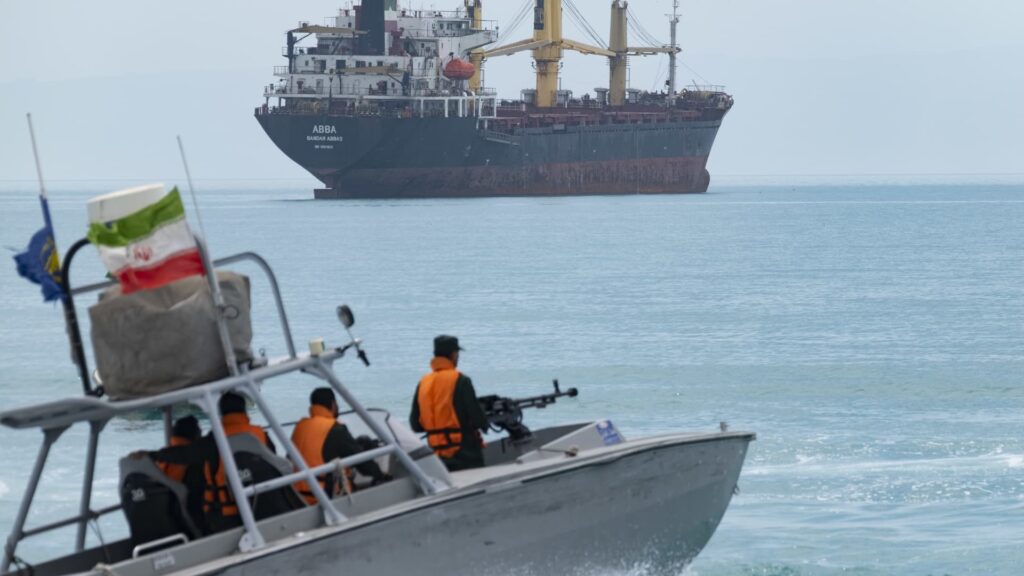
An Islamic Revolutionary Guard Corps (IRGC) speed boat sailing along the Persian Gulf near a cargo vessel.
Nurphoto | Nurphoto | Getty Images
With oil prices at levels not seen in years and global business supply chains across sectors of the economy shut down by the de facto closure of the Strait of Hormuz, faith in the C-suite that the worst isn’t yet to come is being tested. On Friday, United Airlines CEO Scott Kirby said he is planning for $175 oil, and for an oil price that remains above $100 through 2027. This forecast, he said, may not come to pass, but the airline CEO added that there is every reason to at least start planning for it as a potential reality.
Corporate executives have become accustomed in recent years to a world in which it is one new form of uncertainty after another. But the potential ramifications of the U.S.-Iran war, for which President Donald Trump has continued to offer uncertain timelines for ending, has the market and many inside the C-suite on edge. The Nasdaq entered a correction on Friday, a fourth consecutive negative week for the stock market, and it is not just risk-on assets but safe havens such as gold and bonds that are falling.
The administration and military are responding. By Thursday, the Chairman of the Joint Chiefs of Staff said the military was “hunting and killing” watercraft used by Iran to choke traffic in the strait. President Trump’s threats about the Strait of Hormuz have intensified, with Trump saying on Saturday that Iran had 48 hours to reopen the Strait or the U.S. would take out power plants in the country. Meanwhile, more allies of the U.S. have indicated a willingness to support efforts to secure safe passage for ships, though no specific plan has been implemented. Trump also said on Friday that the Strait of Hormuz “will have to be guarded and policed, as necessary, by other Nations who use it — The United States does not!”
For now, the C-suite has its own view of the matter: it’s roughly two weeks and counting for the Trump administration and any allies that join the effort to reopen the Strait of Hormuz, or corporate executives have to assume that the conflict will drag on until at least mid-year, with all of the negative consequences that come with that for the global economy. That was the conclusion on a call among members of the CNBC CFO Council earlier this week with energy and commodities market expert John Kilduff of Again Capital, who joined CFOs to share his view of the oil price outlook from inside the trader and investor community.
Among sectors, it is energy that can be said to be truly in the war, and an energy CFO on the Tuesday morning call — CFOs are granted anonymity on the call to speak freely about the discussions inside their firms — said their company is scenario planning for the future with three distinct potentials: a reopening of the Strait of Hormuz by the end of March, one that is closer to the middle of the year, or in the worst-case scenario, a closure that extends through the end of the year. But the energy CFO conceded that it is difficult at this point to have a good sense as to which scenario is more likely, and that leaves the executive team with no choice but to be “worried about what’s the worst thing that can happen here.”
Those concerns about the ticking clock were echoed by CFOs on the call from outside the energy sector. A tech sector CFO on the call said that not having to worry about the price of oil does not mean his company doesn’t worry about the indirect impact, and for a global business, that means pressure around the world, including the Middle East specifically, and booming economies like Saudi Arabia and Dubai and the rest of the UAE. Even though the tech sector CFO noted his business is enterprise-sales focused, “consumer demand ultimately impacts business demand, which would directly impact our business.”
“How long can this go on?” he asked.

Kilduff said the scenario planning inside the energy company boardroom matches what traders in the market are working with, too. “The [end of] March reopening that you talk about; that’s about two weeks from now; that’s what I’ve been talking about,” he told the energy CFO. “This is a huge window that we’re living in right now, partly because the military folks are now telling us they’re turning their attention to the Strait,” Kilduff said. “Where that goes, we don’t know, but certainly after April 1, if we’re looking at this as something that’s going to drag on into mid-year, that’s when you get the next phase of the repricing, in my opinion, where we get well above $100 for WTI, where we start to be concerned about shortages, particularly out in Asia,” he said.
Measures to shore up, conserve oil supply can’t do enough
Strategic petroleum reserve announcements from Japan to the U.S., and the ability of the U.S. to release over a million barrels a day — which just a few years ago may have been doubted — will help quell the supply fears that occurred as recently as in the aftermath of the Russian-Ukraine war. But Kilduff said “the numbers are just too big” for that solution to be effective for long. “This is a 10 to 12 million barrel per day deficit. … really just insurmountable. There’s no policy measure that can be taken. There’s no lever that can be pulled to offset this,” he said.
That is why he thinks the timeframe to be focused on is that post-April 1 date. “If there’s no resolution, if there’s no plan, if there’s no sort of even hopefulness that we can get the Strait reopened, with amassing troops or doing whatever the military has to do to do that,” that is when this becomes an energy crisis, Kilduff said. “By mid-year, you will see shortages in places like India, Japan, and South Korea. They will start to rein in industrial production. They’re going to have to conserve to keep the lights on, literally,” he said. If the military and government do not have good answers by April 1, “The crunch is coming.”
If there’s good news, Kilduff said, it’s that there is less reason to be worried about the U.S. right now.
While there is already scrambling in the diesel market, and diesel prices have reacted even more violently as compared to crude and even gasoline to the upside, the market is still relatively well supplied for the short-term. But by the end of the year, even in the U.S., “We’re going to have a major energy crisis on our hands. … I think the shortages would certainly have come to California by then,” Kilduff said.
To date, he noted, policy measures being talked about to keep the prices down at the pump, such as no-tax holidays, are in a sense almost perverse measures because they seek to support demand. “In a situation like this, we kind of want demand destruction to allow the price to stay stable, or maybe even go back down, because of how problematic this is for the consumer,” he said.

WTI crude oil futures pricing 2026.
Oil market responses can’t do enough either, he said, with the roughly 20 million barrels a day that would flow through the Strait of Hormuz on a normal basis impossible to redirect through infrastructure such as the Saudi East-West Pipeline. Even with up to 2 million barrels total daily, and 1 million to 1.5 million barrels a day able to get to ships through the pipeline, “none of these policy measures that we have been talking about really can address this situation,” Kilduff said.
In Kilduff’s view, there’s one reason WTI has had a ceiling around $100 and Brent crude has been “fairly well behaved” in the range of $105-$110 on the upside. “That’s because this situation could resolve itself fairly quickly. … we’re just waiting here on the precipice to see if we take another leg higher. Because if this goes on much more than two weeks or so, we’re going to reprice the barrels of oil here considerably higher,” he said.
Kilduff told CFOs there is some truth to the argument that higher oil prices don’t do as much damage to the U.S. economy as crude did back in the 1970s, because of our strong production position and because of how less energy-intensive the economy has become. The U.S. position is aided by the fact that most of the oil imported comes from Canada, and the U.S. now has the newly “rediscovered” resource from Venezuela, which in contrast to U.S. shale oil, is well-suited to the operations of Gulf Coast refiners. “These prices in the global market would be much, much higher if it wasn’t for the U.S. production position. There’s no two two ways about that,” Kilduff said.
There also remains plenty of floating storage, and other oil storage, in the world. In fact, when 2026 began there was an oil glut that had begun developing, which now is still being worked off, and that may sync up in a positive way with the military approach in terms of not prioritizing the strait first. But Kilduff added, “I also think this misses the boat on what the inflation pulse will be throughout the supply chain, and also what it does to consumer confidence.”
$100 WTI oil price ‘floor’ may soon be set
Even if the Strait of Hormuz situation is resolved, there is every expectation in the market that an enhanced risk premium is here to stay in oil prices as other Mideast nations have shut in production, facilities across the Mideast are damaged, and it will take some time to restore production to previous levels. That timeline gets extended the more damage that is done to oil and gas operations. An Iranian attack that took out 17% of Qatar’s liquefied natural gas export capacity could take three to five years to be fully repaired, QatarEnergy’s CEO told Reuters on Thursday.
If the U.S. or Israel hit more Iranian oil export facilities, “I would expect them, with whatever they have left, to asymmetrically go after oil production facilities in all the surrounding countries,” Kilduff said. “The UAE is sort of the closest and easiest to hit. So that’s why they’re doing that.”
“This was one of the unknowns. What would Iran do in response? Would they go after their neighbors? Would they be like what I call ‘the drowning man syndrome,’ where you go to save somebody and they take you down with them? It looks like that for the Iranians. They are looking, in fact, to take everyone down with them,” Kilduff said. “It’s clear that the Iranians are looking to spread the pain, and they’ve turned out to be fairly good at it,” he added. “If you were to hear about a successful Iranian attack on meaningful Saudi or Kuwait or Iraq infrastructure, then this price jumps up $20 a barrel in no time. It’s ‘buy now, ask questions later’ mode for traders in the market.”
Even if the situation deescalates, “It’s going to be a very careful, slow step process,” Kilduff said. “Coming back down to the $70s or $60s becomes a harder trip because of the fundamentals and what may still be a very enhanced risk environment,” he said.
But the next two weeks come first. “We’re on the precipice of $100 being the new floor here over the next week or two. If there’s not meaningful progress in terms of securing the Strait, the benefit of the doubt will go out of this market,” Kilduff said. “The loss of supply will start to grip, will start to bite,” he added.
With the recent focus on the strait from Trump and the military, “now the test will be for the market, do we get out of this within the next two weeks? We are holding our breath,” Kilduff said. “Pick your analogy, your metaphor. Are we like the people in one of those disaster movies, looking at that big wave coming at us as before it all ends badly?”