Stocks fall, S&P 500 and Nasdaq pull back from all-time highs: Live updates
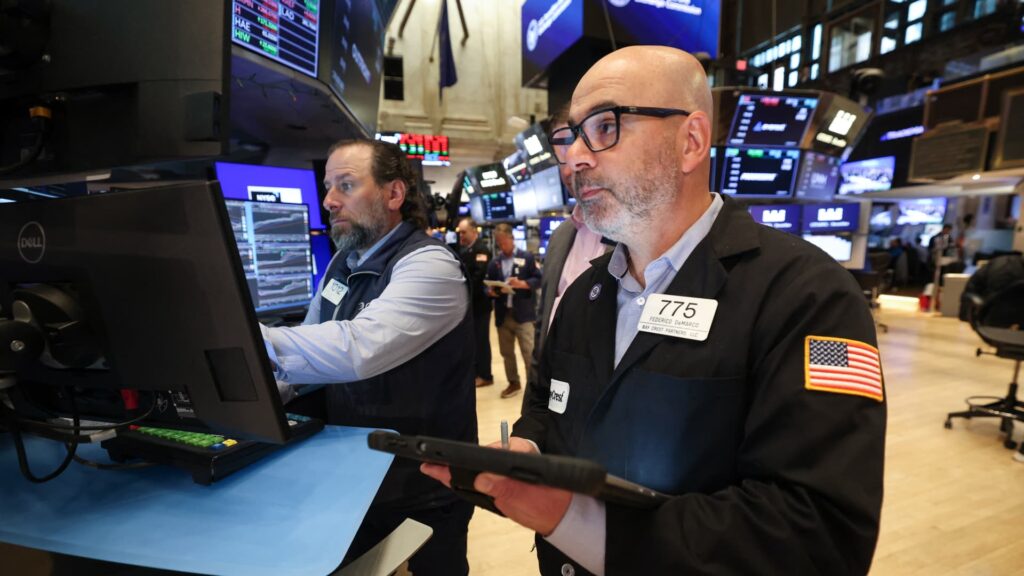
Stock market doing a ‘balancing act,’ says B. Riley’s Hogan
“It’s a balancing act right now,” said Art Hogan, chief market strategist at B. Riley Wealth. “For most of the earnings reporting season over the course of the last two weeks, there had been a shift in focus from the macro concerns about geopolitics to the micro reporting on a company by company basis, which was a positive.”
“But, there’s just so long that we can ignore some of the headlines coming out of the conflict,” Hogan said.
“The scary part about all of this is actually one well-placed social media post can shift that sentiment pretty quickly. So, you’re not seeing massive moves to the downside because people have a pretty strong muscle memory of what happens when this administration decides to use their preferred news dissemination vehicle to announce something that may well be market positive.”
— Sarah Min
PMI readings better than estimates for April
Business activity in the U.S. has been stronger than expected so far in April, according to separate S&P Global measures.
The firm’s manufacturing and services gauges both turned in upside surprises for the month: 54.0 against a 52.5 forecast in manufacturing, and 51.3 vs. a 51.0 estimate on the services side.
The manufacturing reading marked the best showing since May 2022 as production and new orders both hit multi-year highs. Still, expectations for the conditions ahead were muted.
“Companies’ expectations for output in the year ahead improved in April but remained historically low,” the report noted.
—Jeff Cox
Tech is the major driver of the rebound since the conflict, UBS says
Tech stocks is the primary driver of the rebound since the conflict, accounting for roughly 57% of the rally even though it represents just a 35% weight in the index, according to UBS.
This is mainly due to the fact that technology is relatively insulated from the oil shock compared to other sectors such as energy. It is also where earnings momentum has been concentrated since the start of the year, given that of the 4.2 percentage point increase in MSCI US earnings revisions, 78% is attributable to tech, the firm noted.
— Sarah Min
Stocks open lower Thursday
Stocks opened lower Thursday.
The Dow Jones Industrial Average fell 166 points, or 0.3%. S&P 500 slipped 0.2%, while the Nasdaq Composite dropped 0.5%.
— Sarah Min
Wall Street remains divided on IBM after its earnings report
Visitors crowd the IBM exhibition stand at the 2026 Hannover Messe industrial trade fair on April 20, 2026 in Hanover, Germany.
Sean Gallup | Getty Images
IBM fell more than 7.5% on Thursday after delivering its first quarter earnings report on Wednesday. Wall Street analysts are divided about what to make of the quarter.
Goldman Sachs and Bank of America both reiterated their buy ratings on the stock after the report, with the former cutting their price target to $335 from $365. Analysts at both banks said they were happy to see some of the company’s productivity initiatives offsetting cost headwinds from its acquisition of IT company Confluent in March.
“IBM’s ongoing operational efficiency actions are allowing the company to deliver ratable, predictable earnings growth while offsetting dilution from M&A – and we expect free cash flow to move higher over the course of the year,” wrote Goldman analyst James Schneider.
But Morgan Stanley and UBS — which have an equal-weight and a neutral rating on the stock, respectively — had a different take. UBS said the as-expected full-year guidance doesn’t quell long-term concerns about the risk to the company’s software business from AI.
“We believe there was investor expectation that we could see upward pressure on full year estimates that didn’t materialize this quarter,” wrote Morgan Stanley analyst Erik Woodring. “We don’t believe 1Q results do much to shift the narrative on IBM either way.”

IBM year-to-date chart.
ServiceNow lead software stocks to the downside
ServiceNow tumbled 13% in the premarket on Thursday, leading software stocks to the downside after its latest earnings results failed to instill confidence in a name that’s been embroiled in AI disruption fears.
The enterprise software provider posted first-quarter results on Wednesday that narrowly beat analysts’ expectations, with adjusted earnings of 97 cents per share on revenue of $3.77 billion. Analysts polled by LSEG anticipated earnings of 96 cents per share on revenue of $3.74 billion.
Even with the earnings reaction, however, the stock remains a buy on the Street, according to the CNBC’s analyst consensus tool. Thirty out of 49 analysts have given the stock a buy rating, while 14 have rated it a strong buy.
ServiceNow, 1-day
Several Wall Street firms maintained a buy rating on the stock following the results, saying ServiceNow will eventually benefit from AI, though they also acknowledged that more meaningful catalysts for the stock could come later in the year.
“Post a ~19% bounce in the Software sector over the past 12 days, the moving pieces to ServiceNow’s 1Q EPS likely pushes out the catalyst path for a durable Software rally to 2H,” read a Wednesday note from Goldman Sachs’ Gabriela Borges.
“We expect several of the themes of ServiceNow’s call to be recurring through the rest of earnings season, which will likely make it challenging for the group to collectively outperform,” Borges continued. “Our key takeaway is that it is still too early to see AI driven product cycles move the needle on large SaaS revenue bases, although early indications from many of our industry conversations are constructive for SaaS leaders like ServiceNow.”
— Sarah Min
Jobless claims rose more than forecast last week
Jobseekers speak with recruiters past event signage during the WorkSource North Seattle Career Fair in Seattle, Washington, US, on Tuesday, Feb. 10, 2026.
David Ryder | Bloomberg | Getty Images
Initial jobless claims were slightly higher than expected last week but still in keeping with a subdued level of layoffs.
First-time filings totaled a seasonally adjusted 214,000 for the week ending April 18, up 6,000 from the prior period and above the Dow Jones consensus estimate for 210,000, the Labor Department reported Thursday.
Continuing claims, which run a week behind, edged up to 1.82 million.
—Jeff Cox
American Airlines cuts 2026 earnings projections
American Airlines and American Eagle planes on the tarmac at LaGuardia Airport in New York City, U.S., Nov. 18, 2025.
Kylie Cooper | Reuters
American Airlines on Thursday cut its 2026 earnings forecast, becoming the latest airline to lower its outlook after a surge in fuel costs added billions to expenses this year. Here is what American reported in the first quarter compared with Wall Street estimates compiled by LSEG:
- Loss per share: 40 cents adjusted vs. a loss of 47 cents expected
- Revenue: $13.91 billion vs. $13.79 billion expected
American Airlines, 1-day
Shares gained nearly 2% in the premarket.
— Leslie Josephs, Sarah Min
Expect a choppy march higher, UBS says
Earnings season is alleviating fears of a weaker consumer due to the U.S.-Iran war and increasing investor interest in risk again, according to UBS. But there are some warning signs that traders should be cautious of signaling volatility ahead, even if not another move downward.
In a Thursday note, the bank said oil prices rise for a fourth day is a concern, as normal traffic flow through the Strait of Hormuz remains elusive despite the ceasefire in the Middle East. Brent Crude futures crossed $100 per barrel again on Wednesday.
“While we continue to expect stocks to end the year higher amid a still-supportive economic backdrop, ongoing risks to the growth outlook and concerns over AI investment and disruptions suggest that the path upward may remain bumpy,” wrote UBS chief investment officer for the Americas Ulrike Hoffmann-Burchardi.
As a hedge against volatility, Burchardi recommends investors stay or get diversified across sectors and geographies. She also advised traders have exposure to bonds, gold and other commodities.
— Davis Giangiulio & Michael Bloom
Stocks making the biggest moves premarket
Check out the companies making the biggest moves before the bell:
Netflix — The streaming giant gained more than 1% after a regulatory filing showed the company authorized an additional $25 billion share buyback.
Helix Energy Solutions — Shares of the offshore energy company rose more than 3% after Helix agreed to merge with privately held Hornbeck Offshore Services in an all-stock deal. The deal is expected to close in the second half of 2026. The newly formed entity will operate as Hornbeck Offshore Services and will trade under the ticker HOS.
Honeywell — The industrial giant shed 5.6% after it reported mixed first-quarter results and issued lackluster second-quarter guidance. In Q1, adjusted earnings of $2.45 per share beat an LSEG estimate of $2.32 per share, though revenue of $9.1 billion was below consensus. For Q2, the company sees EPS between $2.35 and $2.45, below a FactSet forecast of $2.56.
— Fred Imbert
European stocks slide as IEA chief warns of ‘biggest energy security threat in history’
The International Energy Agency’s Executive Director, Fatih Birol, photographed in Denmark on June 8, 2022.
Claus Fisker | AFP | Getty Images
European stocks were negative territory on Thursday, with oil prices ticking higher, as the head of the International Energy Agency warned that the world faces an unprecedented energy security threat.
The pan-European Stoxx 600 was about 0.4% lower in morning dealmaking, with most regional sectors and bourses trading in the red. Brent crude, the international oil benchmark, was up 2.2%, reaching $104.17 per barrel.
Speaking with CNBC’s Steve Sedgwick at this year’s CNBC CONVERGE LIVE in Singapore on Thursday, Fatih Birol, the head of the International Energy Agency (IEA), said the world faces the “biggest energy security threat in history.”
He also warned of “difficult days” ahead for Europe’s jet fuel supplies as a result of the Iran conflict.
Among individual stocks, L’Oreal soared 8.7% after the cosmetics giant notched its fastest quarterly growth in two years, while Nokia shares surged 8.2% after posting a quarterly profit beat.
L’Oreal.
Asia markets mostly end lower on fragile ceasefire optimism as U.S. reportedly intercepts Iranian oil tankers
Most Asian markets gave up early gains to end lower Thursday, following reports that the U.S. had intercepted at least three Iranian oil tankers in Asian waters, stoking concerns that the Middle East conflict could drag on.
Japan’s Nikkei 225 ended Thursday’s session 0.75% lower at 59,140.23, after briefly touching an all-time intraday high of 60,013.98 in early trade.
Japan’s manufacturing activity expanded at its fastest pace in four years in April, according to the S&P Global flash Purchasing Managers’ Index, as firms boosted output amid supply concerns linked to Middle East tensions.
South Korea’s Kospi reached an all-time intraday high of 6,538.72 in early trade and ended 0.90% higher at 6,475.81. The small-cap Kosdaq dropped 0.58% to 1,174.31. The country’s economy grew more than expected in the first three months of the year, recording the fastest growth since the third quarter of 2020.
Australia’s S&P/ASX 200 traded choppy, falling 0.57% to 8,793.40.
Mainland China’s CSI 300 index slipped 0.28% to 4,786.33, while Hong Kong’s Hang Seng index fell 0.92% as of its last hour of trade.
India’s Nifty 50 fell 0.67% as of 3:40 a.m. ET.
The West Texas Intermediate futures rose 1.33% to $94.20 per barrel as of 2:31 a.m. ET. Brent crude added 1.21% to $103.50 per barrel.
— Justina Lee
Japan and South Korea markets reach all-time high on Iran-U.S. extended ceasefire
Japan and South Korea stocks hit record highs Thursday, trailing overnight gains on Wall Street after President Donald Trump‘s extended a ceasefire with Iran, boosting investor sentiment alongside strong corporate earnings.
Japan’s Nikkei 225 briefly touched an all-time intraday high of 60,013.98, before slipping 0.31% on profit taking.
Japan’s manufacturing activity expanded at its fastest pace in four years in April, according to the S&P Global flash Purchasing Managers’ Index, as firms boosted output amid supply concerns linked to Middle East tensions.
Index heavyweight Softbank Group Corp gained over 6%. A Bloomberg report said the company is taking on more debt in its push for AI, seeking a $10 billion margin loan backed by its OpenAI holdings.
South Korea’s Kospi also reached an all-time intraday high of 6,538.72, advancing 1.58%. The small-cap Kosdaq was 0.58% higher. The country’s economy grew more than expected in the first three months of the year, recording the fastest growth since the third quarter of 2020.
The 1.7% growth in January to March from the previous quarter exceeded Reuters’ estimates of 1.0% and rebounded from the 0.2% contraction in the prior quarter.
Samsung Electronics shares hit a new intraday record of 227,000. Investors were also monitoring labor developments, as the company’s unions expected more than 30,000 workers to attend a rally in South Korea on Thursday, ahead of a planned strike next month.
Australia’s S&P/ASX 200 traded choppy, fallling 0.76%.
Mainland China’s CSI300 index rose 0.35%, while Hong Kong’s Hang Seng index fell 0.51% ahead of the release of the city’s March inflation data.
Oil prices rise, with West Texas Intermediate futures rose 0.49% to $93.42 per barrel as of 9:33 p.m. ET. Brent crude added 0.28% to $102.20 per barrel.
— Justina Lee
7 of the 11 GICS sectors rise on Wednesday
On Wednesday, seven of the 11 GICS sectors finished higher.
Gains were led by information technology stocks, which rose 2.31%. Communication services and energy stocks followed in performance, respectively adding 1.41% and 1.14%.
On the other hand, real estate stocks slipped 0.69% and were the day’s underperformers. The industrials, financials and utilities sectors followed, respectively slipping 0.20%, 0.17% and 0.16%.
— Lisa Kailai Han
Stocks making the biggest moves after hours: Tesla, IBM and more
Refreshed versions of the Tesla Model Y are shown parked next to a Tesla Cybertruck outside a Tesla store in San Diego, California, U.S. October 21, 2025.
Mike Blake | Reuters
These are the stocks moving the most in extended hours trading:
- Tesla — Shares initially popped 4% after the electric vehicle maker posted first-quarter adjusted earnings of 41 cents per share, beating the 37 cents analysts polled by LSEG had expected. However, shares were recently down about 1% in extended trading.
- International Business Machines — The technology giant slipped nearly 7% after IBM failed to raise its full-year guidance after posting an earnings beat.
- ServiceNow — The AI-powered software company reported first-quarter earnings and revenue that topped Wall Street expectations. However, shares tumbled more than 13% as subscription revenue disappointed investors.
Read the full list of stocks moving here.
— Lisa Kailai Han