MS Dhoni, Rohit Sharma, Rajat Patidar: The IPL's most unlikely trilogy
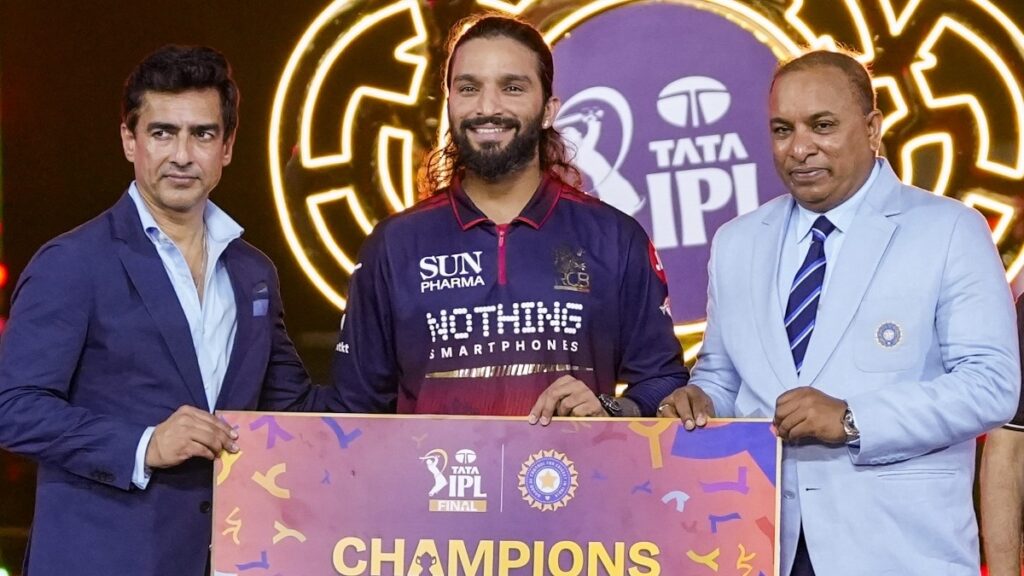
On a sweltering Saturday evening in Ahmedabad, Rajat Patidar walked into the press conference room with the slow, deliberate stride of a man looking for a quiet corner to have a cup of tea. Even by the hyper-managed standards of modern cricketing diplomacy, this did not feel like the eve of an IPL final. There was no theatrical tension. No calculated bravado. He calmly walked in, nodded a ‘thank you’ to the journalists who offered their early congratulations, and sat down to field questions.
The room had a particular thickness to it. That specific atmosphere of high occasion, broadcast cameras and shuffling chairs, journalists mentally drafting their lines. Outside the Narendra Modi Stadium, Ahmedabad was doing what Ahmedabad does on nights like this: loud, restless, convinced Sunday would be historic. Inside, Rajat Patidar sat in the centre of it and simply settled. He just sat there. Still. Present.
For the reporters in the room, it was an exercise in beautiful frustration. It is the job of sports journalists to mine headlines from a captain’s mouth on the threshold of history, but Rajat gives you nothing flashy. He speaks with an absolute, almost mathematical economy of language. It will never be one word extra; it will never be one word less.
IPL 2026 FINAL: HIGHLIGHTS | SCORECARD
Once the microphone was turned off, he didn’t linger. He quietly walked out to the nets, began training, hit a few balls with minimal fuss, spoke briefly to his coaches, and left.
Cut to Sunday night. The sky over Ahmedabad is thick with golden confetti, the stands are a roaring sea of red, and Royal Challengers Bengaluru have just defended their IPL crown. No captain in the history of the tournament had ever won the title in each of their first two editions as leader. By doing so, Patidar became only the third captain in history to retain the trophy.
The two men who preceded him inhabit the pantheon of Indian cricketing mythology. There is MS Dhoni, the serial winner, renowned for his chilling calmness and an astute, mystical tactical brain. On the other side sits Rohit Sharma, expressive, embracing numbers, backed by a formidable management machine, a relatable, street-smart people’s man loved by the masses. Both World Cup-winning captains. Both national icons.
Rajat Patidar has four caps for India.
And yet, here he is. The third man in the most unlikely trilogy Indian cricket has ever produced.
Is Rajat a mix of both? Or is he something entirely detached from the traditional archetype of the larger-than-life Indian captain?
When he returned to the press room on Sunday night, the historic gravity of the moment hadn’t altered his pulse. The only time he showed even a flicker of personal excitement was when he quietly slipped in a piece of personal trivia.
“It feels really good,” Patidar said, his voice entirely devoid of chest-thumping. “It is the best gift because it is my birthday today, so it can’t be a better gift.”
Then he slipped in a thought that may well shape the conversation around RCB next season.
“It feels good overall, but the way I am as an individual, I try to stay in the present. We will have to focus more on how we can do three in a row. Obviously, we won today, so we will celebrate today.”
To mention the possibility of a hat-trick of IPL titles so matter-of-factly is the quintessential Rajat Patidar experience.
When asked directly to define his method in a captaincy landscape dominated by expressive giants, his answer was characteristically stripped of romance:
“My way of captaincy is different. I don’t express much. I am not expressive, but at the same time I am aware of the game situation. Of course, you need backing. As I said, there was a lot of backing from the management and the players as well.”
THE QUIET MAN AT MID-OFF
To truly understand how this unexpressive leadership functions under pressure, you have to look away from the broadcast cameras and watch Rajat on the field.
During the final in Ahmedabad, youngster Rasikh Dar — twenty-two years old, the youngest member of the RCB pace attack — was marking his run-up, preparing to bowl a crucial over. Patidar was stationed at mid-off. He did not pace. He did not fidget. He stood there the way he sits in press conferences — still, watching, processing.
At the start of the over, he walked across to Rasikh. Not urgently. Not with the energy of a captain trying to impose himself on the moment. He asked the bowler one question: do you need a deep fine leg? Rasikh, apparently, said yes. Patidar turned, gestured to one of his fielders, began to move him towards the boundary.
Then he stopped.
Something had shifted in his reading — a recalibration, quiet and instantaneous. He changed his mind. He redirected the fielder to deep point instead. He told Rasikh. The over began.
The very next ball was sliced directly to deep point.
And that, in all likelihood, was the last thing Patidar said to Rasikh for the remainder of that over. No sermonising after every delivery. No tactical huddle mid-over. No theatrical arm around the shoulder for the cameras. He trusts his men. He trusts his bowlers. And that quiet clarity transfers itself onto the team without the need for noise.
“When we gave a chance to Rasikh Dar, he looked confident because he has been playing IPL for three to four years,” Patidar said after the final, heaping praise on the uncapped medium pacer who finished with 19 wickets, four more than Josh Hazlewood.
“He is very confident about his skills, about his slower ones, back-of-the-hand deliveries and especially yorkers. He spent a lot of time with Avishkar Salvi sir. He is very clear about his plans. I always tell my bowlers that if you have a plan, go and execute it. That’s it.”
And, that’s really it.
UNSOLD. UNWANTED. UNSTOPPABLE
It is crucial to understand where Rajat Patidar comes from, because the distance he has covered is staggering.
He is from Madhya Pradesh, a domestic cricketing territory historically not known for churning out the kind of glitzy, commercially bulletproof superstars produced by Mumbai, Karnataka, Chennai, or Delhi. His journey to this moment is the kind that gets made into films, and in this case, not without reason. He was picked up for his base price in 2021, given four games in the middle order, and released. At the 2022 mega auction, his name passed in silence — not a single bid. He went home to Indore, returned to division cricket, and fixed his wedding for May of that year, quietly certain he had to do more to resume his IPL story. For once, cricket could wait. There was a wedding to plan.
A twist in the story came. A replacement call came. He was not sure. But his close ones nudged him to take the opportunity. He postponed the wedding, packed his bags, and walked out in the 2022 Eliminator to score 112 not out off 54 balls against Lucknow Super Giants — the first uncapped player in IPL history to score a century in the playoffs. A Ranji Trophy followed that same year with Madhya Pradesh. Then a quiet, relentless accumulation of runs and trust over the seasons that followed.
The man who would one day stand alongside Dhoni and Rohit had, just weeks earlier, been planning his wedding because he assumed cricket was done with him.
WHAT RCB SAW IN HIM
He was already 31 years old when RCB handed him the captaincy. He didn’t inherit a blank slate; he inherited a kingdom defined by 17 years of existential pain. For 15 of those years, the franchise’s identity had been consumed entirely by the blazing sun of Virat Kohli’s presence. Two transitional years under Faf du Plessis followed, where RCB showed tantalising signs of getting there, but fell short.
The management had earmarked Patidar early. They asked him to lead Madhya Pradesh in the 2024-25 domestic season as a quiet dry run — he promptly took them to the final of the Syed Mushtaq Ali Trophy, scoring 428 runs in the process. RCB had seen enough.
The announcement came at the Unbox event in 2025. Kohli’s endorsement was characteristically generous.
“He is the guy who is going to lead us for a long time. He is an amazing player, we have all seen that. But he has a great head on his shoulders. He will do a great job. He has got everything that is required.”
Yet the weight of the shadow was immense. But RCB’s head coach Andy Flower had already seen something in Patidar that others hadn’t.
“The calm, simple demeanour that inherently lives within Rajat is going to serve him really well in the hurly-burly of that tournament,” Flower said before the start of last season.
And underneath that calm, Flower had detected something else entirely.
“He’s got a stubbornness and a strength and a steeliness about him. I’ve seen it myself when I’m trying to coach him in the nets and he won’t listen to me, but you see it in the way that he plays. You see the bravery with which he takes on the game.”
AB de Villiers, meanwhile, had offered a cautionary note. “Patidar’s biggest challenge will be insecurity. Having Virat around and constantly almost doubting yourself — ‘Am I doing the right thing? What would Virat do?’ Always stay true to who you are.”
It was good advice. The problem, from Patidar’s perspective, was that he had already been following it for years.
Quiet. But not soft. There is a difference, and it is everything.
POINT DULY MADE
That stubbornness is precisely what allowed Patidar to dismantle the analytical narratives built around his batting. For a long time, he had been pigeonholed as a specialised spin-basher — a batter who feasted on turning tracks but lacked the gears to take down high-quality pace. RCB Director of Cricket Mo Bobat chuckled at the memory, admitting cheerfully to his own role in fuelling Rajat’s internal fire.
“I remember at some point last season, I think I called him a ‘spin basher’ and I think he got quite annoyed with me because I was implying that it was only spin,” Bobat laughed. “So I think he’s probably trying to prove a point to me.”
The point was proven with devastating, clinical precision. In the IPL 2026 Qualifier 1 in Dharamsala, Patidar walked in to bat against Gujarat Titans with the innings in early difficulty. He did not try to bludgeon his way through the problem. He watched. He waited. He let himself in. And then he detonated — 93 not out off 33 balls, powering RCB to 254 for 5, the highest total in IPL playoff history.
“One of the things I think he’s done well this year is he’s picked his moments quite well,” Bobat explained after that knock. “He took his time to get in, we lost a couple of quick wickets. Rajat recognised those moments and understood that he needed to build a mini-partnership and then go through the gears again — that’s the thing that I’ve enjoyed seeing. Him reading situations and conditions and knowing when to go to his top gear and when to go down is a really, really impressive part of his development.”
By the end of IPL 2026, Patidar had 501 runs at a strike rate of 192. Point made, emphatically, without a single word.
THE ONLY ZONE
When you ask Rajat about how he remains unbothered by the external circus, his answers always return to a strict, almost monastic focus on the immediate present. On the eve of the final, the scribes tried to prod him into acknowledging his cinematic trajectory — the replacement player, the captain, the trophy, the cusp of history.
Patidar simply shut the comparison down.
“No, I’ve never thought about what another captain has done before, and whether I want to compete with someone or not. I’ve never thought about that. And as an individual, my journey is rollercoaster riding. I’ve never focused on that. Wherever I am, I focus on what I can do best.”
This refusal to look backward or project forward is his ultimate defensive shield. Even entering the 2026 season as defending champions, he refused to let the squad adopt the posture of a team protecting a crown.
“We are not here to defend anything with the mindset of defending champions. We have an opportunity to win one more title.”
The distinction matters enormously to him. Defending is reactive, winning is active. And it shaped the entire mood of the campaign.
That internal clarity is what he actively passes down to the anxious youngsters in the RCB dressing room. Having known the sting of uncertainty early in his own career, his counsel to them is built entirely around filtering out the noise.
“I always try to tell them that it’s important to be yourself and to back your strengths because I faced this situation when I was there in 2021. I was looking at the senior players. Of course, there was anxiety and nervousness. And I keep telling them the same thing — you don’t need to look at who is standing in front of you or who is there in your team. You are here because you deserve it. Focus on your strengths rather than focusing on what is not in your control.”
The advice he gives them is the advice he has lived by himself his entire career.
He learned it, in part, by watching. What he chose to absorb from Faf du Plessis was not a tactic or a formation but something far more intangible: body language. The confidence of his bearing. The way Faf refused to be swayed by the enormity of the moment, however large.
“When Faf du Plessis was the captain in IPL, how he presented himself, how confident his body language was — I learned a lot from him.”
It is a very Patidar kind of lesson. Not what to do. How to be.
When he was finally asked on Sunday night what he had learned as a captain and batter this season, the answer was vintage Patidar — methodical, honest, entirely without vanity.
“Before coming to the IPL, I spent a lot of time on myself. I did proper net sessions. I was the only one there and I needed some bowlers. After that, I communicated a lot with DK (DInesh Karthik) Bhai about how I could do more, some trigger movements, and technical changes. I got a lot of clarity in execution as a batsman. As a captain, I learned a lot. When Faf du Plessis was the captain in the IPL, how he presented himself, how confident his body language was — I learned a lot from him.”
Then came the question about his unexpressive nature, whether it ever made things difficult, given the scale of everything he had achieved in 24 months. His answer arrived softly, without drama, and landed like the whole piece came full circle.
“As I said, I don’t think too much about the past. I don’t go too far ahead either. I always like to remain in the present. Whatever best I can do, I will do. I will try to do it for the team. After that, whatever the result is, I don’t care. I know I have given 100%. That’s it for me. This thought process is helping me in my batting and also in my leadership role.”
Dhoni had his aura. Rohit had his masses. Patidar has only himself, and it turns out, that is the rarest thing of all.
And with that, no roar, no fist in the air, just a man from Indore on his birthday, he walked out of the Ahmedabad press room, a second IPL trophy his, the night still young.
You don’t need to scream to conquer the loudest tournament on earth. You just have to be entirely, stubbornly yourself.
IPL 2026 | IPL Schedule | IPL Points Table | IPL Player Stats | Purple Cap | Orange Cap | IPL Videos | Cricket News | Live Score
– Ends