SpaceX IPO live updates: Maye Musk arrives at Nasdaq, protesters set up in Times Square
Former Tesla board member says SpaceX needs to achieve 2 of its 3 moonshots to keep $2 trillion valuation
Elon Musk’s SpaceX will need to achieve at least two of its three “moonshots” to justify its huge valuation, a former Tesla board member told CNBC.
Venture capitalist and former Tesla board member Steve Westly told CNBC’s “Squawk Box Europe” that pricing SpaceX’s imminent IPO is going to be hard to predict, as its three core companies are “completely disparate.”
In addition to its space business, Musk’s company owns the Starlink satellite internet service, which accounts for the bulk of its revenue and is the only profitable unit. It also includes xAI, which Musk merged with SpaceX in February.
— Joseph Wilkins
Musk biographer says SpaceX debut is start of ‘whole new economy’

Famed journalist and Elon Musk biographer Walter Isaacson says SpaceX’s IPO will usher in a new wave of innovation for the space industry.
“It’s not just that you’re getting a new trillionaire, but you’re getting a whole new economy here, which is a space economy,” he told CNBC’s “Squawk Box” on Friday.
This new economy includes Starlink satellites, future data centers in outer space, and could also expand to mineral mining, Isaacson said.
—Samantha Subin
SpaceX ‘demonstrated things that no one else can do,’ David George says

Andressen Horowitz’s David George said SpaceX has “demonstrated things that no one else can do.”
“This is the best entrepreneur of our generation in Elon, and he’s going after two of the biggest markets of all time, and two of the most important markets in technology for our society — so space and AI,” George told CNBC.
“They can send a Starship, which is the size of a football field, effectively up to space, land it back on earth with the chopsticks − no one else is close to being able to do that.”
—CJ Haddad
The Nasdaq opening window is set for 9:50 a.m. ET

The Nasdaq opening window is set for 9:50 a.m. ET. That’s when indications for SpaceX’s opening price should start to appear.
—Ashley Capoot
SpaceX rivals OpenAI and Anthropic are also preparing to go public
Two of SpaceX’s major competitors in AI — OpenAI and Anthropic — are also gearing up for IPOs.
OpenAI, which is valued at $852 billion by private investors, confidentially filed its prospectus with the SEC on Monday. The company said it has not decided on timing, and that it’s weighing a “complicated set of tradeoffs.”
Anthropic announced it confidentially filed its prospectus with regulators earlier this month. The company said the IPO will “depend on market conditions and other factors.” Anthropic closed a funding round at a $965 billion valuation in May.
—Ashley Capoot
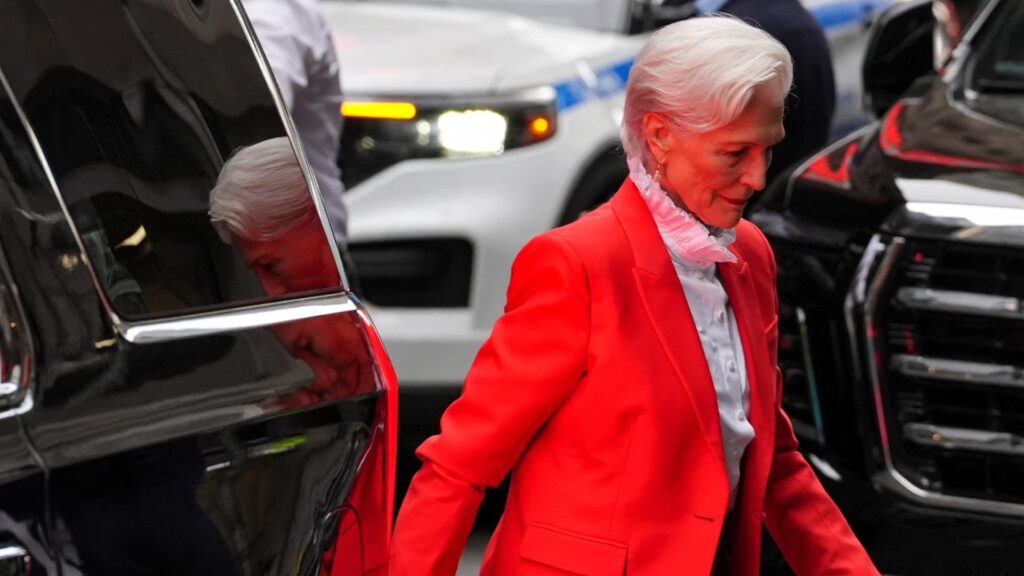
Elon Musk’s mother, Maye, arrives at the Nasdaq
Maye Musk arrives on the day of SpaceX’s initial public offering (IPO) at the Nasdaq MarketSite in New York City, U.S., June 12, 2026.
David Dee Delgado | Reuters
Maye Musk is the first family member pictured arriving at the Nasdaq for the debut of SpaceX.
The family has close ties to Elon’s companies, with his brother Kimbal on the Tesla board.
—Chris Eudaily
Space stocks jump with huge action in the options pits ahead of SpaceX IPO
Options volumes are booming in stocks with ties to SpaceX ahead of Friday’s historic debut.
Shares of EchoStar, which owns an estimated 3% of SpaceX stock, surged 11% Thursday and options volume was more than eleven times the 30-day average in ‘SATS’, according to data from Cboe’s LiveVol. AST Spacemobile jumped 12% Thursday alongside almost $140 million in options trading.
EchoStar shares were higher by another 5% in early trading Friday. AST SpaceMobile was also trading higher in the premarket.
Read more here.
—Oliver Renick, John Melloy
SpaceX ‘perps’ trading indicate an initial pop of about 30%
A general view of a SpaceX building ahead of the SpaceX initial public offering (IPO), in Starbase, Texas, U.S., June 11, 2026.
Gabriel V. Cardenas | Reuters
Crypto traders in SpaceX-linked perpetual futures continue to price in a strong public-market debut for Elon Musk’s space company.
The SPCX-USDC perpetual contract was trading around $176 on Hyperliquid on Friday, about 30% higher than the IPO price of $135 per share, though still down sharply from the peak levels exceeding $220 in May.
More than $233 million worth of the perp changed hands over the past 24 hours, while open interest climbed above $263 million, indicating sustained speculative demand.
The contracts, which do not expire and are primarily traded by leverage-seeking crypto investors, are one of the market’s most active proxies for pre-IPO sentiment toward SpaceX.
— Tanaya Macheel
Polymarket traders see SpaceX crossing $2 trillion market cap
Traders on prediction market platform Polymarket think that SpaceX will close above a $2 trillion market cap after its IPO on Friday.
They place 70% odds for the stock to do so on its debut on the public markets. They also think there are near 50-50 odds it will close above $2.2 trillion in market cap. And they think it’s extremely likely the stock will rise today, with an 84% chance it closes above a $1.8 trillion valuation.
SpaceX at its IPO is valued at around $1.77 trillion.
Five other U.S. companies have reached the $2 trillion market cap benchmark: Nvidia, Apple, Alphabet, Microsoft and Amazon.
—Davis Giangiulio
Protesters decry SpaceX AI safety record in Times Square
An inflatable likeness of SpaceX CEO Elon Musk stands in New York City as protest to Grok AI on June 11, 2026.
Ashley Capoot | CNBC
Protesters gathered in New York City’s Times Square one day ahead of SpaceX’s public debut, aiming to draw attention to Elon Musk’s track record where AI safety is concerned.
Musk’s Grok AI tools and social network X have come under fire for enabling users to easily create and distribute sexualized and violent images of real people, including children, based on their photos and without their consent.
Multiple international jurisdictions have launched formal investigations of xAI, now known as SpaceXAI, and the company was also sued over Grok in the U.S., including by the city of Baltimore, and by a group of women and girls who had been directly impacted.
In its IPO filings, SpaceX said it had “recorded an accrual of $530 million for litigation losses that are probable and reasonably estimable” resulting from these cases as of the end of 2025.
One group that described itself as a coalition of concerned citizens and industry and faith leaders, Safe AI Now, set up a 40-foot inflatable in Times Square depicting a pale, shirtless Musk with the words “SpaceX’s Grok Makes AI Child Porn” scrawled across his chest.
An inflatable likeness of SpaceX CEO Elon Musk stands in New York City as protest to Grok AI on June 11, 2026.
Ashley Capoot | CNBC
In an e-mailed statement to CNBC, the coalition said:
“The effigy of Musk bears a simple warning to investors: Musk built a dangerous and exploitative AI, covered up the damage, merged it with SpaceX, and is now selling the liability to the public at $135 a share.”
They added that “A company that enables child porn is inherently unstable and puts American investors and retirement funds at risk. SpaceX shareholders are on the hook for every Grok lawsuit, criminal investigation, and regulatory fine that is coming. All while Musk becomes a “paper trillionaire” and his investors pick up the tab.”
—Lora Kolodny
How retail investors are prepping for SpaceX IPO
Retail investors have dumped artificial intelligence plays ahead of SpaceX’s IPO, according to VandaTrack.
The market data provider said individual traders have pulled back on AI-related names such as Micron, Advanced Micro Devices and Marvell Technology. Vanda said small traders may be shoring up money to play SpaceX’s market debut, in addition to the expected IPOs of OpenAI and Anthropic in the future.
“We’re already seeing signs that retail investors are rotating out of recent AI [favorites] ahead of the IPO wave,” Vanda told clients in a note this week.
—Alex Harring
Elon Musk’s ownership stake
Tesla CEO Elon Musk walks to board Air Force One with U.S. President Donald Trump (not pictured) as they depart for Philadelphia, Pennsylvania, from Morristown Municipal Airport in Morristown, New Jersey, on March 22, 2025.
Nathan Howard | Reuters
After its market debut, CEO and founder Elon Musk will have voting control of 82.4% in SpaceX, according to the company’s IPO filings. He will need to hold onto all of his SpaceX shares for a year, however.
“We believe that Mr. Musk’s substantial ownership interest in us provides him with an economic incentive to assist us to be successful,” SpaceX said in the risk factors section of its prospectus.
After a 366-day lock-up period, “Mr. Musk will not be subject to any obligation to maintain his ownership interest in us and may elect at any time thereafter to sell all or a substantial portion of or otherwise reduce his ownership interest in us,” the filing said.
SpaceX is officially a “controlled company” with no independent board majority. About 911 million insider shares, or about twice the public float, will unlock two days after the company’s first planned earnings report.
—Lora Kolodny
SpaceX spends more than it makes, even with Starlink as its cash cow
According to IPO filings, the company has racked up a deficit of around $41.3 billion since it was founded in 2002.
It has already spent more than $15 billion to develop its massive, Starship rocket, which it intends to be fully re-usable in the future. Starship is also meant to bring NASA astronauts back to the surface of the moon, and eventually to Mars.
SpaceX said in its prospectus that its connectivity unit, primarily comprised of Starlink, generated $11.39 billion in 2025, accounting for 61% of total sales. In the first quarter of this year, it climbed to 69% of total sales.
The company cautioned investors in its prospectus about its history of net losses, and that it may not achieve profitability in the future. It lost $4.9 billion last year, and $4.28 billion in the first quarter of 2026, alone with both capital and operating expenses expected to increase as it spends heavily on Starship and AI initiatives.
—Lora Kolodny
SpaceX plans orbital data centers, skeptics highlight risks
On a livestream before the SpaceX IPO, Musk said he wanted to take the company public in part to raise money for the “massive capital endeavor” of building and running artificial intelligence data centers in space.
So-called orbital data centers “will be the primary means by which AI can be expanded,” Musk said. And putting data centers into orbit may help companies avoid the community backlash against data centers and the sometimes polluting power plants installed to run them on Earth.
“There are very few people who want a power plant in their backyard, so if we wanted to say double the electricity usage of the United States, which is on average about 500 gigawatts, we would have twice as many power plants,” he said.
In space, he mused, companies can “go far beyond the electricity generation of earth,” by running their equipment on solar power around the clock.
However, space-based data centers are unproven so far, and have a panoply of associated risks.
Electronics required for AI training and inference are heavy to lift, power-hungry, and require thermal regulation. Yet, cooling them can’t be done as easily in the vacuum of space.
Putting satellites packed with computing equipment in space could become less impractical with the adoption of chips that feature superconducting logic, rather than traditional semiconductors, said Peter Barrett, a general partner at venture firm Playground Global.
“Doing it the way they’re currently planning on doing it is madness, but it won’t be a problem, because it’s never going to happen,” he said.
SpaceX is not the only company working on orbital data centers, of course. Alphabet’s Project Suncatcher shares the same ambition. However, SpaceX’s timeline is aggressive.
The company aims to deploy its first satellites that can provide computing power for AI models as soon as 2028, according to its IPO prospectus.
—Jordan Novet and Lora Kolodny
Shotwell says we could see Starship in orbit by the end of the year

Shotwell said orbital flights for Starship “largely depends” on the Federal Aviation Administration, but the company should fly every month and we could see Starship in orbit by the end of this year.
“We have done an in-space Raptor lighting, so we feel pretty comfortable, but we want another suborbital shot on the next flight,” she said.
—Chris Eudaily
SpaceX IPO is Gwynne Shotwell’s ‘unveiling’
SpaceX President and COO Gwynne Shotwell sits down with CNBC’s Morgan Brennan to talk about the company’s IPO.
CNBC
Jennifer Nason, former global chair, investment banking at JP Morgan, told CNBC’s “Morning Call” that the SpaceX IPO is “a bit of an unveiling” for Gwynne Shotwell.
“Elon can take a lot of the oxygen out of the room, but she’s been there from the beginning,” Nason said.
—Chris Eudaily
COO Gwynne Shotwell had her doubts about an IPO

SpaceX President and COO Gwynne Shotwell told CNBC’s Morgan Brennan that she “wasn’t sure we would go public.”
“Today, across SpaceX’s various businesses, the building blocks of a publicly traded company are now in place,” she said in an exclusive interview.
Shotwell is the company’s top executive underneath Musk.
“I do not want to focus on quarterly earnings,” she told Brennan. “I’m not saying we’re not going to do right by our investors, but what folks who invest in SpaceX need to know is that what we’re doing is very futuristic.”
—Chris Eudaily
How many shares are being sold and what is the market cap
SpaceX is offering 555,555,555 shares of Class A common stock in the IPO. At the $135 per share set price, the offering raised $75 billion.
There is an overallotment of 83,333,333 Class A shares available to underwriters for up to 30 days after the June 3 S-1A.
Without the overallotment, there are 13,075,865,175 Class A and B shares available immediately, which puts the SpaceX market cap at $1.77 trillion.
Should the overallotment be exercised, those would add to the total Class A and B shares and increase the market cap accordingly.
—Chris Eudaily
SpaceX buzz builds on WallStreetBets
SpaceX Starship lifts off from Starbase in Boca Chica, Texas, for its sixth flight test on November 19, 2024.
Chandan Khanna | Afp | Getty Images
SpaceX has been a hot topic on Reddit’s WallStreetBets, the discussion forum that became synonymous with the meme stock craze.
The rocket startup has been mentioned more than 1,600 times on the platform since Monday, according to data shared with CNBC by meme stock tracker Breakout Point. Those numbers have made it one of the most-discussed companies on WallStreetBets in the days leading up to the IPO, Breakout Point’s data shows.
—Alex Harring
SpaceX spends more than it makes, even with Starlink as its cash cow
According to IPO filings, the company has racked up a deficit of around $41.3 billion since it was founded in 2002.
It has already spent more than $15 billion to develop its massive, Starship rocket, which it intends to be fully re-usable in the future. Starship is also meant to bring NASA astronauts back to the surface of the moon, and eventually to Mars.
SpaceX said in its prospectus that its connectivity unit, primarily comprised of Starlink, generated $11.39 billion in 2025, accounting for 61% of total sales. In the first quarter of this year, it climbed to 69% of total sales.
The company cautioned investors in its prospectus about its history of net losses, and that it may not achieve profitability in the future. It lost $4.9 billion last year, and $4.28 billion in the first quarter of 2026, alone with both capital and operating expenses expected to increase as it spends heavily on Starship and AI initiatives.
—Lora Kolodny
What SpaceX will use the funding for
A SpaceX Starship spacecraft rolls out toward its launch pad past the Starbase Manufacturing Facility before its 10th test flight from the company’s complex in Starbase, Texas, U.S., August 23, 2025.
Steve Nesius | Reuters
The capital raised in the IPO is expected to fund the further development of SpaceX’s massive Starship rockets, which are currently in a test flight phase and are not yet fully re-usable.
The company will also use the funding for future AI products and infrastructure, including a chip factory known as Terafab that SpaceX will build with Tesla and Intel in Texas.
—Lora Kolodny