Messi's Argentina face England next, but football can't forget the Hand of God
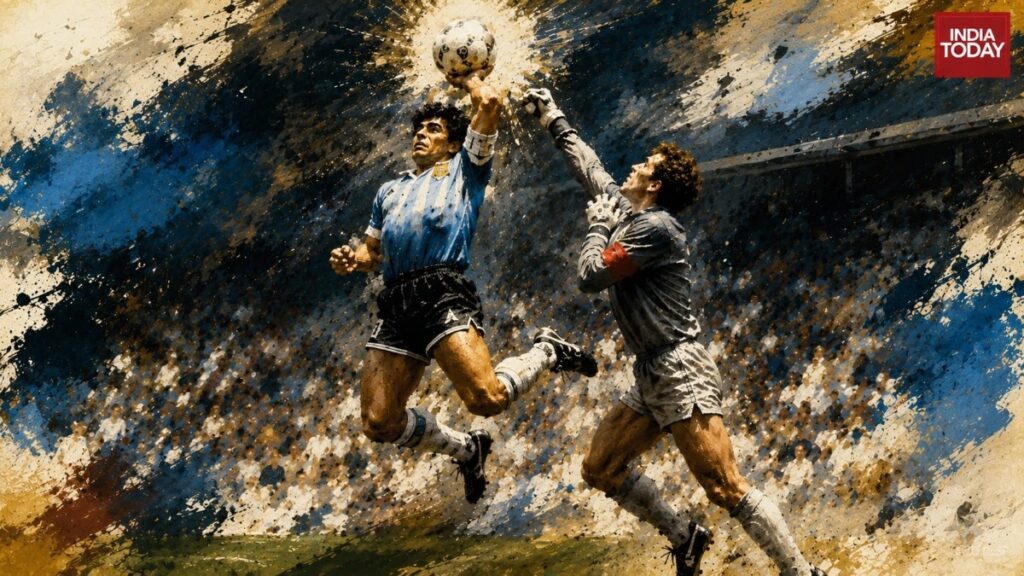
Football has spent the last four decades making sure another Hand of God never happens. Every major tournament now comes wrapped in technology. There are more cameras than ever before, referees have VAR in their ear, goal-line technology removes doubt and semi-automated offside checks dissect every attacking move. A handball like Diego Maradona’s against England in 1986 would almost certainly survive only until the first replay appeared on the stadium screen.
Yet for all the technological advances that have transformed the game, they haven’t diminished the power of that moment. If anything, they have made it even more extraordinary.
Nearly 40 years later, the Hand of God still shapes the way England and Argentina are talked about every time the two nations meet on football’s biggest stage.
So as Lionel Messi prepares to face England for the first time in his international career, with Jude Bellingham and Harry Kane standing between Argentina and another World Cup final, it is remarkable how quickly the conversation drifts back to a moment that modern football simply wouldn’t allow to happen.
THE GOAL THAT CHANGED EVERYTHING
The goal itself lasted barely a second.
Steve Hodge’s sliced clearance ballooned towards the penalty area, Peter Shilton came charging off his line and Diego Maradona, giving away almost eight inches in height, somehow got there first. Well, not quite with his head. His left fist made just enough contact to guide the ball into the net while Tunisian referee Ali Bin Nasser and his assistant looked elsewhere. England’s protests were immediate. The goal stood anyway.
Football has spent the best part of four decades arguing about what happened next.
Maradona never really denied it. Instead, he gave the moment the line that ensured it would outlive him.
“A little with the head of Maradona, and a little with the hand of God.”
The phrase entered football’s vocabulary almost instantly. England saw blatant cheating. Argentina saw genius wrapped in mischief. Somewhere in between sat one of the most extraordinary ironies the game has ever produced.
Because the Hand of God wasn’t even the best goal Maradona scored that afternoon.
Four minutes later, he picked the ball up inside his own half, skipped past five England players, rounded Shilton and rolled the ball into the net after one of the greatest individual runs football has ever witnessed. FIFA would later vote it the ‘Goal of the Century’, while Uruguayan commentator Victor Hugo Morales immortalised the moment with his unforgettable cry of “Cosmic kite, what planet did you come from?”
That sequence has always made the 1986 quarter-final so impossible to separate into neat categories.
One goal was illegal.
The other was immortal.
Together, they became football’s most enduring story.
FOOTBALL HAS MOVED ON. THE MEMORY HASN’T.
The game surrounding moments like that has changed beyond recognition.
Today’s referees work with VAR, goal-line technology, semi-automated offside and more television angles than anyone inside the Azteca Stadium could have imagined in 1986. A handball like Maradona’s would almost certainly be spotted within seconds, the referee sent to the monitor and the goal ruled out before celebrations had properly begun.
Yet technology has solved only one part of football’s oldest problem.
This World Cup has produced its own refereeing flashpoints. Argentina’s Round of 16 victory over Egypt reignited debate after VAR ruled out Mostafa Ziko’s equaliser, while Egypt were left frustrated by the absence of a review for a late penalty appeal. Social media quickly filled with claims that Argentina had benefited from crucial decisions, while others argued those incidents remained subjective and entirely consistent with the Laws of the Game.
The arguments sounded remarkably familiar.
In 1986, there was one decision, one referee and no second chance. Today, every contentious moment is replayed from every conceivable angle before millions deliver their own verdict online. Technology has made another Hand of God almost impossible. It has not made football any less argumentative.
The Hand of God belongs to football’s analogue age.
Modern football, for better or worse, almost certainly wouldn’t let it happen.
THE RIVALRY NEVER REALLY LEFT
That is perhaps why England against Argentina has always felt different from most football rivalries.
Politics have long been impossible to ignore. The wounds of the 1982 Falklands War lingered heavily over the 1986 meeting in Mexico, with both countries viewing the quarter-final through far more than a sporting lens. Maradona himself later admitted the victory felt like “symbolic revenge”, even writing in his autobiography that beating England was “like beating a country, not a football team.”
But football has added enough chapters of its own to ensure the rivalry has survived long after the politics faded from the front pages.
There was Antonio Rattin’s infamous dismissal at the 1966 World Cup, a moment that helped accelerate the introduction of yellow and red cards into the sport. There was Michael Owen’s breathtaking solo goal in Saint-Etienne in 1998, only for David Beckham’s red card after his clash with Diego Simeone to turn him into England’s public villain as Argentina progressed on penalties. Four years later, Beckham found a measure of redemption, calmly converting the penalty that secured England’s 1-0 win in Sapporo – still their last World Cup victory over Argentina.
The countries have met only five times at football’s biggest tournament.
Remarkably, England edge that record with two wins to Argentina’s two, alongside one draw.
Yet numbers have never really explained this fixture.
People remember moments.
A NEW CAST, THE SAME STAGE
Which brings us to Atlanta.
For the first time in his glittering career, Lionel Messi will line up against England in an international match, carrying Argentina’s hopes of defending their World Cup crown.Eight goals into another remarkable tournament, the 39-year-old has once again found himself at the heart of everything Argentina do, turning moments of pressure into moments of inevitability.
England, meanwhile, arrive with two players who have shaped this World Cup in very different ways.
Harry Kane has rediscovered the sort of sharpness that has often deserted him at previous tournaments, his six goals underlining what could well become the finest World Cup campaign of his career. Jude Bellingham, also on six, has once again developed a habit of arriving when England need him most, delivering decisive goals and performances that have reinforced his reputation as one of the game’s defining midfielders.
The semi-final itself adds another layer to an already loaded occasion. It is the first time England and Argentina will meet in a World Cup semi-final, with a place in Sunday’s final against either France or Spain on the line. England are chasing a first appearance in football’s biggest match since 1966, while Argentina are attempting to defend the title they won in Qatar and move one step closer to back-to-back World Cups.
If Messi represents football’s enduring greatness, Kane and Bellingham embody England’s belief that this generation can finally end six decades of waiting.
Before any of those new storylines unfold, though, this fixture inevitably asks football to glance over its shoulder one more time.
Not because the Hand of God will influence what happens over ninety minutes.
Not because Maradona’s shadow still decides England against Argentina.
But because some moments become bigger than the match they belonged to.
Nearly forty years after Diego Maradona’s hand slipped past Peter Shilton, football has evolved in almost every imaginable way. Referees have more help than ever before, technology leaves little room for doubt and another goal like that would almost certainly be erased before it entered the history books.
Yet somehow, every time England and Argentina meet on the World Cup stage, that image still arrives before the teams do.
And perhaps that is the greatest reminder of all.
The Hand of God was never just a goal.
It became football’s most unforgettable memory.
FIFA World Cup | FIFA World Cup Schedule | FIFA World Cup Points Table | Football News
– Ends