Trump mixes jokes with barbs at White House Correspondents' dinner
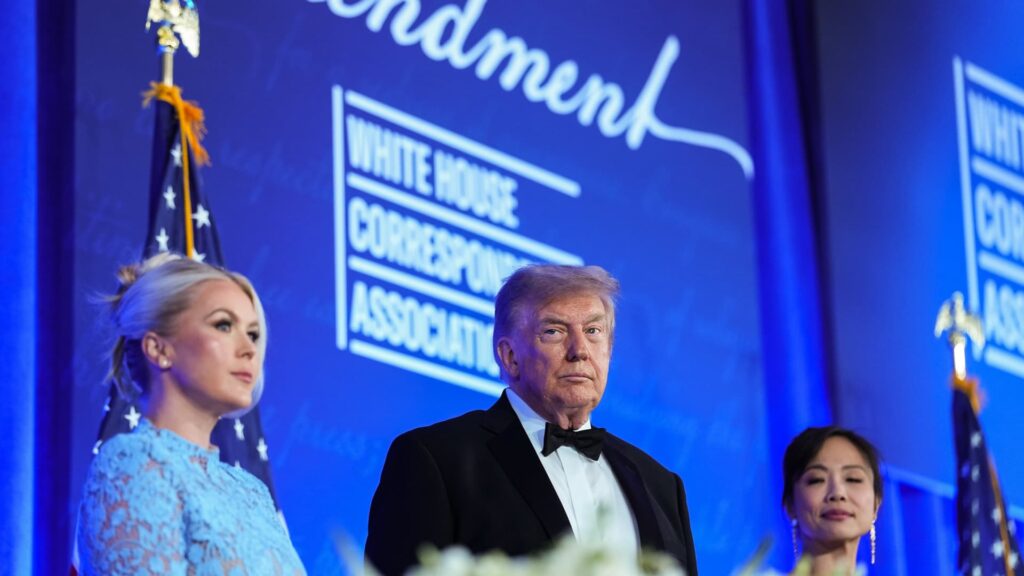
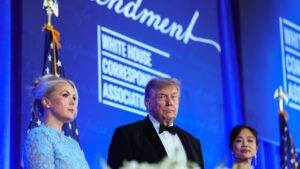
President Donald Trump took aim at the press with humor and barbs at the White House Correspondents’ Association dinner on Friday, mixing in tropes typical of his political rallies at an event celebrating press freedom that was restarted anew after a shooting disrupted the original event in April.
Trump, whose administration has often been at odds with the press, started by mostly going along with the warm and relaxed tenor of the evening.
But much of the speech, which ran over an hour, veered into broadsides at his political adversaries, echoing oft-repeated themes and attack lines.
The black-tie gathering of journalists, politicians and administration officials, intended for April 25 at the Washington Hilton hotel, was called off that night after a man tried to force his way through a security checkpoint and fired a shotgun outside the ballroom where Trump and members of his cabinet were taking their seats.
The suspect, Cole Allen, pleaded not guilty in May to charges including attempting to assassinate the president.
The correspondents’ gala has been an annual fixture on Washington’s calendar for more than a century and raises money for journalism scholarships while celebrating press freedoms guaranteed by the First Amendment of the U.S. Constitution. Several hundred veteran journalists, along with eight professional journalism organizations, signed a letter urging the correspondents association to use the dinner to condemn what they called Trump’s attacks on the First Amendment.
Regardless, the president was afforded typical honors, with only a few awkward moments when he shook hands with journalists winning awards for stories about the Trump administration.
“I hope all of you know that I believe in the free press more than anyone in this room does — maybe not quite. That’s why I’m proud to be the most open and transparent president in history,” Trump said. “They call me that.”
Trump also spoke about the flip side of his attacks on the press: the unprecedented access he has provided by engaging in frequent question-and-answer sessions with reporters and personally taking phone calls from many of them.
“I always find that when you don’t speak to the press, you always get a bad story,” said Trump, whose relationship with the press goes back decades to his rise as a well-known New York real estate developer in the 1980s. “When you do speak to the press, you have a shot at getting a good story.”
As many of the barbs on his teleprompter fell flat, he questioned the ability of his speechwriters, at one point asking, “Does anybody understand this?”
When one joke bombed, Trump remarked, “That was actually the only thing I thought was good in this whole freaking stupid speech.”
Between jokes and insults, Trump returned to topics frequently aired at his political rallies, talking up what he views as his administration’s accomplishments on issues such as Iran and crime in Washington.
He was occasionally self-reflective, for instance acknowledging his own weight problem after making fun of others for their size.
This year’s dual events marked Trump’s first presidential appearance at the correspondents’ dinner. He had boycotted the event in his previous years in office, though he promised to come back next year.
Press freedom advocates have criticized the Trump administration over lawsuits it has filed against media organizations, restrictions on some journalists’ access, and threats of action against broadcasters. He rejects the criticism, saying his administration is promoting accountability and addressing bias.
Friday’s event also honored Secret Service officer Victor Gonzales, who was shot at a security checkpoint outside the ballroom in April and is credited with stopping the attack, and the Washington Hilton staff who assisted guests. Gonzales survived wearing a protective vest.
The dinner was moved to a smaller venue at the Waldorf Astoria hotel under heightened security, and one of the first messages of the night was defiance in the face of the assault.
“We do not yield to political violence … No deranged loser with a gun will ever change that,” Trump said, embracing sentiments expressed by other speakers.
Still, he could not resist casting aspersions on his critics in the press and show business, singling out for attacks journalists such as Don Lemon and Lawrence O’Donnell, politicians like Chris Christie and Adam Schiff, and celebrities including Bruce Springsteen and Jane Fonda.
Typical of the competing messages, Trump thanked his hosts and said he made friends, but stopped short of a full embrace of his frequent antagonists.
“It’s been an interesting evening. I really didn’t know what to expect,” Trump said. “And it’s far worse than I actually thought.”