I drove Lewis Hamilton's Ferrari at Monza and saw F1's future in India
It was a warm Sunday morning on July 26 when I got a call I wasn’t expecting. It was from Mumbai Falcons Racing Limited (MFRL), and the question was a simple one.
*”Would you like to drive your favourite Formula One car around the track you’ve always dreamed of racing on?”*
I was caught off guard for a moment, but the little kid in me didn’t need long to answer. The dream had always been the same — driving a Ferrari around the Temple of Speed, Monza.
I put that dream forward, and MFRL was more than happy to make it happen. There was just one condition.
I had to set my fastest lap on July 30.
The next four days were all about preparing for my big date at Monza. I decided to embrace my inner Sonny Hayes from the F1 movie. Neck exercises suddenly became part of my daily routine. Reflex drills with tennis balls followed. As race day drew closer, I somehow felt more exhausted than ever, despite not even knowing how I was supposed to get to Italy.
Then, just a day before race day, I was told to report to Bharat Mandapam in Delhi for my drive at Monza.
That caught me completely off guard. Monza… in Delhi?
I wasn’t quite sure what to make of it. Anyway, July 30 finally arrived.
I squeezed in a few more neck exercises before booking an Uber to the “racetrack.” It wasn’t exactly the glamorous Formula One driver experience I had imagined, but I tried to make the journey feel a little more authentic with the *F1* movie soundtrack blasting through my headphones.
Hans Zimmer’s F1 Theme and Don Toliver’s Lose My Mind stayed on repeat throughout the ride.
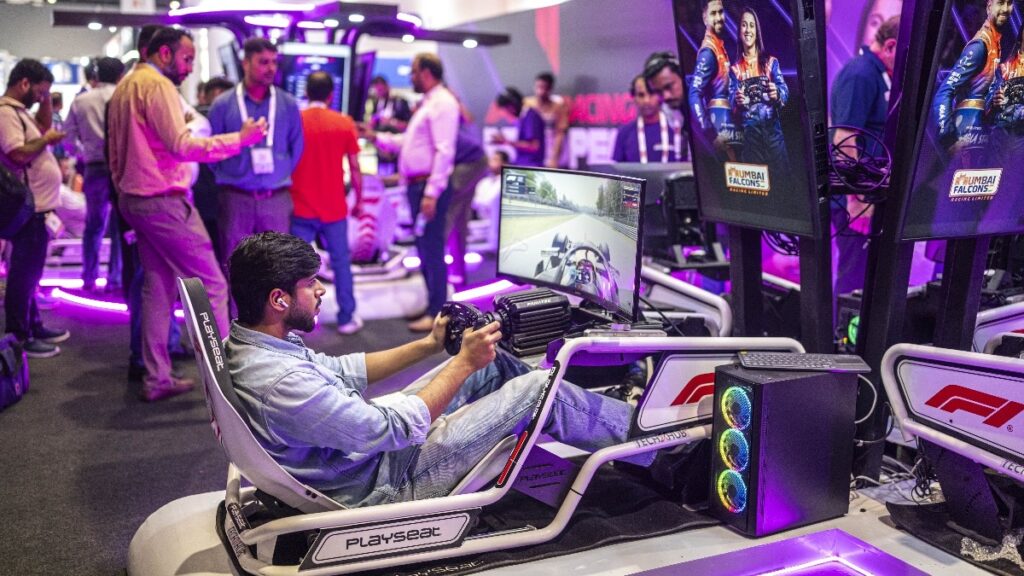
As I reached Bharat Mandapam, I finally spotted a board that read: F1 Sim Racing India Open.
The officially sanctioned F1 Sim Racing India Open 2026 is designed to uncover India’s next Formula One talent by giving aspiring drivers a platform to showcase their pace, precision and racecraft on professional-grade simulators, opening a pathway into professional motorsport.
The tournament carries a total prize pool of Rs. 2 crore, while the overall winner earns a coveted place in Mumbai Falcons Racing Limited’s One in a Billion Hunt, where a Rs. 3 crore Driver Development Fund is available to support their journey into professional motorsport.
MFRL is a team that has helped launch the careers of several drivers currently on the Formula One grid, including 2026 championship leader and Mercedes driver Kimi Antonelli.
As I made my way to Hall 14, where a sports expo was underway, I could already hear the roar of Formula One engines from a distance.
People were driving Lando Norris’ McLaren, Max Verstappen’s Red Bull and several other Formula One cars.
Everyone had the same goal, climb to the top of the leaderboard and prove they had what it took to become India’s next Formula One driver.
With conversations around bringing Formula One back to India gathering momentum, and with no Indian having raced in the sport since Narain Karthikeyan and Karun Chandhok, the search for the country’s next representative feels more relevant than ever.
So I waited patiently for my turn before finally climbing into one of the simulator rigs.
At first glance, it looked like something every Formula One fan has either experienced in an arcade or dreamed of owning as the centrepiece of their gaming setup.
But this felt different.
While waiting, I watched driver after driver struggle to tame their cars. Some found themselves beached in the gravel. Others explored the grass a little too often. A few, perhaps believing the simulator followed Delhi-NCR traffic rules, ended up saying hello to the wall.
THE MONZA DRIVE
Finally, it was my turn.
I settled into the simulator rig and, for a brief moment, it genuinely felt like I was climbing into a Formula One cockpit. The seating position was low, almost hugging the ground. Two pedals sat beneath my feet — one for braking, one for acceleration — while a Formula One-style steering wheel stared back at me, looking just like the ones I’d watched my racing heroes use for years.
The settings were loaded. I adjusted myself in the seat. My Ferrari, or rather, Lewis Hamilton’s Ferrari, was finally ready to tackle Monza.
As the five lights went out, it was just me trying to tame the Prancing Horse. Then came the first corner.
Within seconds, I realised why so many people had struggled to keep their cars on the circuit. The moment I turned into the right-hander, I felt my body being pulled to the left. The force-feedback and motion system immediately gave me a taste of the G-forces Formula One drivers battle every lap.
This wasn’t just another racing game. It demanded precision.
I fought my way around the circuit and eventually posted a 1:28.131. I was genuinely proud of that effort.
Then came lap two. Like every racing driver who believes they’ve suddenly figured everything out, I decided it was time to attack.
I attacked the kerbs a little too aggressively. The gravel welcomed me.
Lap three. Same mistake.
Lap four. This time, I made an acquaintance with the wall.
By lap five, I had finally understood where I had been going wrong. I strung together what felt like my perfect lap and clocked a 1:26.187.
Unfortunately, it never counted. One wheel had briefly touched the gravel, invalidating the lap.
Just like that, what I had expected to be a glorified video game became my first real lesson in Formula One driving. Perfection isn’t optional. It’s mandatory.
That was exactly the lesson Dewansh Mahesh Sadi, an aspiring racer and a student of Vishwashanti Gurukul World School, had also learnt.
“I would usually play F1 on my laptop or just watch races because I’m a huge Formula 1 fan. Once I finally got to experience it on the sim, the force feedback, everything is there. It has been a really great experience. I was mainly struggling in Turns 3 and 4, and also the exit of Parabolica. I wasn’t able to figure out how to start the car with the clutch and get ready for the launch. Once the lights went out and I saw the purple lights, I just let the clutch out and spun out. I don’t know why, but I still came P1 in the race at the end, without any penalties,” said Dewansh.
And that’s exactly the experience MFRL wants aspiring racers across the country to have.
The aim isn’t simply to let youngsters play a racing simulator. The idea is to introduce them to what it actually feels like to sit in the cockpit of a Formula One car and, in the process, identify India’s next generation of racing talent.
“In terms of India, we don’t have an Indian driver. Why don’t we find an Indian driver? This is what we’re doing,” said Phiroze Jhaveri, Director of Race Operations, MFRL.
Ishaan Bhataiya, one of MFRL’s officials, explained that the simulator was never intended to replace racing. Instead, it serves as the first step in building a long-term grassroots programme for Indian motorsport.
“The plan is to use this as a means to identify potential in children in India. It helps us make the sport of racing a lot more accessible because, at the moment, it really isn’t. We don’t have access to racetracks. We don’t have the modern equipment that we need, at least not in the numbers that we require.”
“Then we come down to the question of why we’re not a great motorsport nation. The biggest reason is that we don’t have a structured grassroots pathway. This programme gives us that first base. Instead of taking children to a racetrack, we bring them to the simulators. With the technology that we have today, the simulation is realistic enough to give us a very good idea of the potential that somebody has.”
“So we leverage that technology and take these same simulator rigs around the country. For any national talent hunt, you need one constant. Everybody races on the same track, everybody has the same settings depending on whether they’re in the junior or senior category. That’s the one constant everyone across the country has,” said Ishaan.
BUT WHY SIM RACING?
Max Verstappen isn’t just the best Formula One driver on the planet right now—he’s also one of sim racing’s biggest advocates.
The Dutchman even has his own sim racing outfit, Verstappen.com Racing, and has often spoken about his dream of seeing a sim racer make the jump to Formula One.
“My dream is of having a sim driver move into the real world and making it a success story, and seeing him progress, and seeing him evolve, hopefully in the long term, make him basically a professional driver.
“That he can make his living off it. That is the goal, and that’s something that slowly we’re making ways in,” said Verstappen.
There is good reason behind that belief.
Verstappen himself spends countless hours on simulators, especially when Formula One heads to circuits that are either new or have undergone major changes.
Take the Madrid Grand Prix, for example.
The circuit is yet to be introduced onto most simulator platforms, but once it is, it won’t just be gamers trying it out. Formula One drivers will be among the first to learn every corner, every braking point and every possible racing line before they even arrive at the venue.
That’s exactly the role modern simulators play.
“This year, for example, we’re going to Madrid. It’s a completely new street circuit. Nobody has raced there before. The same goes for Malaysia. So how do drivers learn a new circuit before they get there?
“They do it in the simulator. They learn every corner, every braking point, every racing line. They understand where the grip is. They try different overtaking lines. If somebody covers the inside line, can I go around the outside? All of that gets practised in the simulator,” said Ishaan.
Listening to him made me realise that what I had just experienced wasn’t simply a sophisticated video game.
It was a small glimpse into how modern motorsport actually works.
WHAT ABOUT GO-KARTING?
For decades, go-karting has been the gateway into motorsport.
If you’ve watched the documentary on Michael Schumacher, you’ll know karting was where it all began for him. The same goes for Lewis Hamilton, Sebastian Vettel, Charles Leclerc and almost every modern Formula One great.
Closer to home, India’s newest racing sensation Atiqa Mir is carving out her own path through karting.
So the obvious question is this:
If simulator technology has become so advanced, does it make karting obsolete?
The answer, according to MFRL, is a straightforward no.
“No, but then you won’t touch everyone. There are so many people who have good talent, very good talent, but they just don’t have the funding,” said Phiroze.
Instead of replacing karting, simulator racing simply becomes the first step in the journey.
The reasoning is practical. Karting is expensive.
Not Formula Two or Formula Three expensive, but expensive enough to keep many talented youngsters from even discovering whether they have the ability to succeed.
Beyond buying or renting a kart, there’s maintenance, mechanics, tyres, transport, race entries and an entire team working behind the scenes.
That’s where simulator racing changes the equation.
“When people ask me why we don’t just put kids in real go-karts instead of simulators, I always go back to the basics. Firstly, we don’t have the infrastructure. Secondly, it’s incredibly expensive,” said Ishaan.
He believes karting remains the ultimate test. Simulator racing simply prepares drivers for it.
“The simulator is just the beginning. It’s our grassroots programme. The idea is to create a feeder system. After sim racing comes karting, but we don’t necessarily have to overload kids with karting.”
“Karting is important because that’s where you learn racecraft. Sim racing teaches you braking points, racing lines and how to read a circuit.”
“But when you’re surrounded by thirty other karts, and you’re fighting wheel-to-wheel, that’s something you only really learn in karting.”
“So you still have to do it. The difference is that sim racing allows us to reduce the amount of time and money spent before reaching that stage,” said Ishaan.
The biggest advantage, however, isn’t just financial.
It also allows young drivers to develop other aspects of racing without burning through enormous budgets every weekend.
Instead of spending every available hour in a kart, they can focus on physical conditioning, reaction training and mental preparation before eventually making the jump to the racetrack.
“Kids can spend more time in the gym. They can work on reactions. They can improve physically. Then, when they do get into the kart, they’re making much better use of that expensive track time,” said Ishaan.
“That’s good for development and it’s also much easier on the parents’ budget.”
But there is one thing MFRL makes absolutely clear.
No matter how quick you are on a simulator, you’ll still have to prove yourself on a real racetrack.
“This is just a feeder to the go-kart. It is with a go-kart only you can move forward. You can win everything here, but if you’re not good in a kart, it ends there,” said Phiroze.
WHAT’S NEXT?
So, what happens after a driver tops the leaderboard?
Winning the F1 Sim Racing India Open isn’t the finish line. In many ways, it’s only the beginning.
MFRL has laid out a long-term pathway that it hopes will eventually produce India’s next Formula One driver.
“This is a ten-year-plus programme. As soon as we finish our final, we’ll be starting from scratch again and building up. So this is going to go on. And there’s a structure. You win in Delhi, you go to regional finals.”
“You win there, you’re going to go-karts. Then you’re going into racing go-karts. Then we’re taking you into the Formula 4 Academy. Then you jump to Formula 3. If you show how much promise you have the Formula 2 and Formula 1 will await,” said Phiroze.
The vision goes beyond simply handing out prize money.
MFRL has already worked with some of the brightest young talents in international motorsport, including Kimi Antonelli and Oliver Bearman. That experience gives the team a clear understanding of what it takes to guide young drivers through the various stages of their careers.
The hope is that, if India has another Formula One-calibre driver waiting to be discovered, this programme will find them before anyone else does.
The Delhi leg certainly suggested that the appetite exists.
Nearly 3,000 participants turned up to put in their fastest laps, while Union Sports Minister Mansukh Mandaviya also visited the venue to witness the action firsthand.
“The overwhelming response from Delhi, coupled with the visit from the Union Minister and the Minister of State, reinforces our confidence that India is ready for championing motorsports and make a mark in the Formula 1. Our vision is to build a sustainable talent pipeline and place Indian drivers on the grid. With the support from fans as well as the policy makers, we are determined to identify and nurture multiple promising talents who can progress to the global grid, represent India and make the nation proud,” said Ameet Gadhoke, Managing Director of MFRL.
As I packed up and prepared to leave Bharat Mandapam, I couldn’t resist walking over to one of the officials with a very important question.
Armed with my best lap of 1:28, I wondered if there was still time for a dramatic late-career switch into Formula One.
Maybe. Just maybe.
That dream lasted all of thirty seconds. Then Phiroze looked at me, smiled, and revealed the benchmark.
“You need a 1:20 to qualify.”
Safe to say, my Formula One career ended before it had even begun. But perhaps that’s the beauty of the F1 Sim Racing India Open.
Not everyone who sits in one of those simulator rigs will become India’s next Formula One driver. Most won’t.
But somewhere among the thousands chasing the perfect lap, there might just be a kid who discovers a talent they never knew they had.
And if MFRL’s vision succeeds, India’s next racing star may not begin their journey in a go-kart.
They might just find it on a simulator, chasing the perfect lap around Monza in the car they’ve always dreamed of driving.
– Ends