In the land of vultures: What happened when Kota won its 1st CWG gold medal
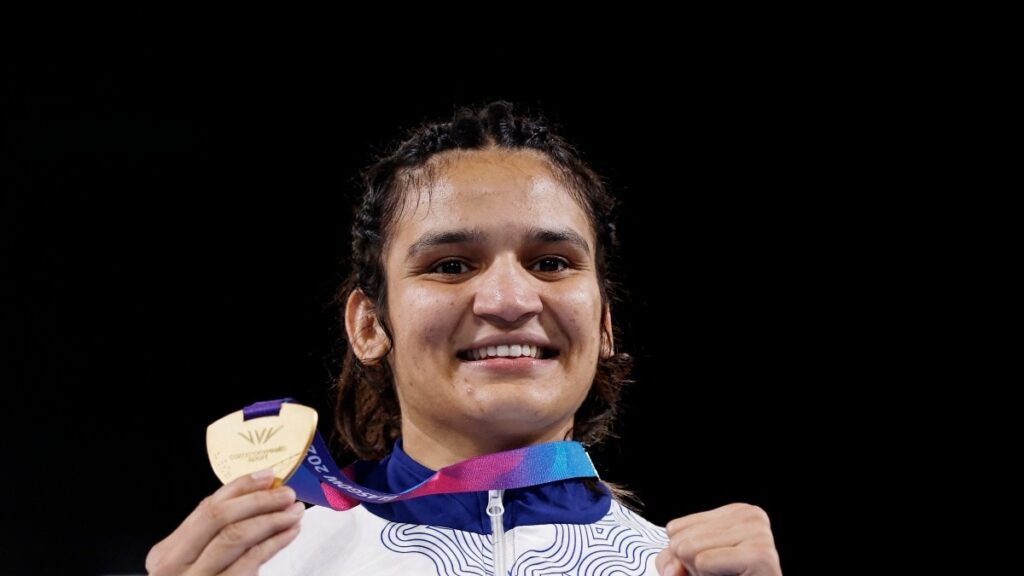
No one wants to be a part of supporting an athlete, but everyone wants to celebrate one.
It could not be truer in the case of Arundhati Choudhary from Kota, who returned home to much fanfare after winning a gold medal in her maiden Commonwealth Games appearance.
Arundhati was part of a dominant 14-member Indian boxing contingent that returned with 10 medals, including seven golds. Six of those gold medallists hailed from Haryana – India’s undisputed combat sports nursery, a state with an established, well-oiled machinery for producing elite champions.
The lone outlier was Arundhati, born in Kota – a city famous not for ring champions, but for IIT exam factories.
Since the early 2000s, Kota’s entire economy has been engineered around a single pursuit: clearing IIT exams. After the boom of Bansal Classes, mega-coaching franchises like Allen, Career Point, Resonance, and Rao Academy sold middle-class India a non-negotiable dream.
“Come to Kota if you want to get into the IITs.”
Hostels, PGs, mess halls, gaming parlours, and shopping complexes grew systematically around keeping thousands of stressed teenagers inside a hyper-competitive bubble. The machinery was so lucrative for local administrators and business owners that no one ever bothered to build anything else.
That Arundhati emerged from this conservative, academic pressure cooker to dominate international sports is a miracle born out of pure defiance.
But on Friday, the very city that offered her zero sports infrastructure opened its arms to claim her glory.
Her house, situated on the outskirts of Kota, became a buzzing place on Friday. Relatives, neighbours and local politicians lined up to congratulate her and, inevitably, a photograph.
Some of these were the same people who had perhaps not been particularly encouraging when her father, Suresh Choudhary, gave his daughter the freedom to pursue sport in Kota.
People circle success very quickly. They are less willing to stand beside it while it is still trying to become successful.
But this is not a story about Kota’s coaching classes or its economy. It is about how India treats athletes like Arundhati, before they earn the gold medal.
AUGUST 5
A knackered Arundhati Choudhary and her family arrived early in the morning at Jaipur airport.
By then, she had become a sensation in Rajasthan for becoming the state’s first boxer to win a Commonwealth Games gold medal.
The family had expected someone from the sports federation to greet them at the airport.
Nobody came.
Family members living close to Jaipur and local media representatives were there to receive them.
During the interviews, Arundhati was asked about the support from the state government and what had been done to enable her journey.
The 23-year-old, still far from media-trained, did not hide her disappointment.
“There are no proper facilities for boxing in Kota. It has been quite some time since I won the medal, but I have still not received any congratulations or encouragement from the state government or the sports minister,” Arundhati said.
“The players who are emerging from Rajasthan are making it on their own,” she added.
AUGUST 6
With no official reception waiting for them at Jaipur, Arundhati and her family did not need to halt there for long. They left to meet relatives in different suburbs and villages on the way to Kota.
Late night on August 6, when they finally reached Kota, her unfiltered airport remarks had rippled through the state’s political corridors.
Calls were made to her father Suresh. Functions were lined up. Politicians and administrators began seeking time with the family to meet and congratulate the Commonwealth Games champion.
AUGUST 7
As the noise outside settled for a brief moment, Suresh sat back, his expression darkening with a quiet, reflective guilt.
“We are a bad generation. We are a generation of bad people,” scoffed Suresh while speaking to India Today at his house.
“Me, my peers, the people that I have worked with were only focused on earning money. We wanted more, more and more, and even today there is no stopping it when we amassed much beyond what can sustain us.”
Suresh spoke with a deep, quiet remorse. It was the precise reason he refused to let his children enter Kota’s commercial rat race. His eldest daughter is now a doctor; his youngest son studies in Delhi.
Putting Arundhati into combat sports was a move of desperation to channel her hyperactive aggression.
“I used to beat up kids my age when I was small,” Arundhati recalled with a slight grin, sitting beside her father. “I used to jump down from the first floor onto the bare ground just to see if I could. I don’t know why I did it. I just had this fire in me.”
Mid-sentence, the interview was interrupted.
A local political leader walked in, flanked by an aide holding a bright party banner. He handed Arundhati a shawl, posed for a photo, drank a quick cup of tea, and left.
There were more. Outside the front door, a line was forming.
Local bank managers who handled the family’s accounts, neighbourhood youth leaders, and self-proclaimed social workers. Each group executed the exact same performative routine.
Does this get tiring? I asked her.
“Not really,” Arundhati shrugged. “It’s not like any of these people ever asked if I was alive before this.”
CITY WITHOUT A BOXING GYM
When the decision was taken to admit Arundhati into boxing at around 12, Kota had almost nothing for the sport.
When Suresh decided to enrol her in boxing at age 14, Kota did not have a single dedicated boxing gym. Funnily enough, it still doesn’t.
Arundhati trained under Ashok Gautam, a self-taught coach who had trained in Wushu by watching YouTube videos.
When he was told that Arundhati wanted to learn boxing, he returned to YouTube.
This time, he was learning the basics of boxing.
As Arundhati trained in Kota, her father travelled to neighbouring states looking for boxing infrastructure. There wasn’t much to find.
At that tender age, Suresh was unwilling to send his daughter to Haryana or New Delhi just so she could train properly. So they made do.
“I don’t have many friends in the boxing circuit in India. Because I do not train in Haryana. I don’t want to, because the vibes do not match. They do not accept me. It is what it is,” Arundhati says.
She had entered a sport whose strongest ecosystem was somewhere else, and she had entered it from a city that barely had an ecosystem of its own.
“When I am in Kota, I have to practise on a cricket ground. That is why I joined the Indian Army and am training there using the facilities available to me,” she said.
The stadium where she trained is itself in a dishevelled state.
The ground-floor structure exists, but the upper level was abandoned mid-construction years ago. Rusting, naked TMT rebar sticks out of the concrete overhead – a constant hazard for the kids running below.
Yet, talent in the desert has a way of defying its environment. Rajasthan is a landscape defined by harsh conditions, where life survives not because the soil is welcoming, but because its people possess a stubborn, bone-deep resilience. They learn to find water in dry rock and build hope out of nothing. Arundhati’s boxing was born from that same arid stubbornness.
Soon, Arundhati became a force to reckon with in Indian boxing, beating athletes from established boxing strongholds. The Haryana boxers from Bhiwani and Hisar were shaken. Coaches began asking the same question.
“Who is this boxer from Rajasthan?”
Arundhati had become an outsider who could no longer be ignored.
To escape the lack of infrastructure at home, Arundhati accepted an offer from the Indian Army and now trains at the Army Sports Institute in Pune – the high-performance hub that produced stars like Avinash Sable, Gulveer Singh and from her own boxing fraternity – Amit Panghal.
She is happy there. So is her father.
AUGUST 8: THE LAND OF VULTURES
The Choudhary family woke up early in the morning.
After two tiring days of travel and meeting people, they had to travel back the same way they came.
Chief Minister Bhajanlal Sharma had organised a felicitation ceremony for the Commonwealth Games champion. There, surrounded by cameras, he presented Arundhati with a ceremonial cheque for Rs1 crore, the financial reward mandated under Rajasthan’s sports policy for major international achievements.
The cheque was part of an existing state policy, introduced six years ago by the Ashok Gehlot government, which increased the prize money for athletes four-fold.
This was the first time Arundhati had received a prize from the Rajasthan government. The state, eventually, had rewarded its champion.
Arundhati’s scathing remarks had achieved what years of silent struggle could not: forcing power to react.
“If my family wasn’t financially comfortable, none of this would have happened,” Suresh reflected before they left. “India is simply not a sustainable place. There is zero baseline support.”
“We are businessmen. But we cannot get a single thing done without doing ‘ji hazoori’ of people in power. Is that any better than any ‘gulami’?”
The sentiment is not just limited to businessmen. The people in power who have it in them to enable sport, the economy and business often put restrictions in place so that the common folk are always at their helm.
How can things work that way?
But it is not the system, or the political apathy that hurts the Choudhary family the most. It is the betrayal by their own that stings.
The bitterest irony in all of this lies at the top of the state’s sports hierarchy. Rajasthan’s Sports Minister is Rajyavardhan Singh Rathore – India’s first shooting medallist at the Olympics.
Rathore knows firsthand the lonely, brutal grind of putting an under-resourced sports discipline on the national map. When he took charge of the sports ministry in late 2023, athletes across Rajasthan hoped one of their own would finally dismantle the bureaucratic apathy.
Yet, on the ground in Kota, bare iron rebar still hangs over broken concrete, and a Commonwealth champion still has to train on a cricket field.
Nobody wants to build an athlete. But once the gold is won, everyone is there to get a piece of it.
– Ends