Iran denies any direct talks with U.S. on opening Strait of Hormuz as Houthis claim attack on Saudi refinery
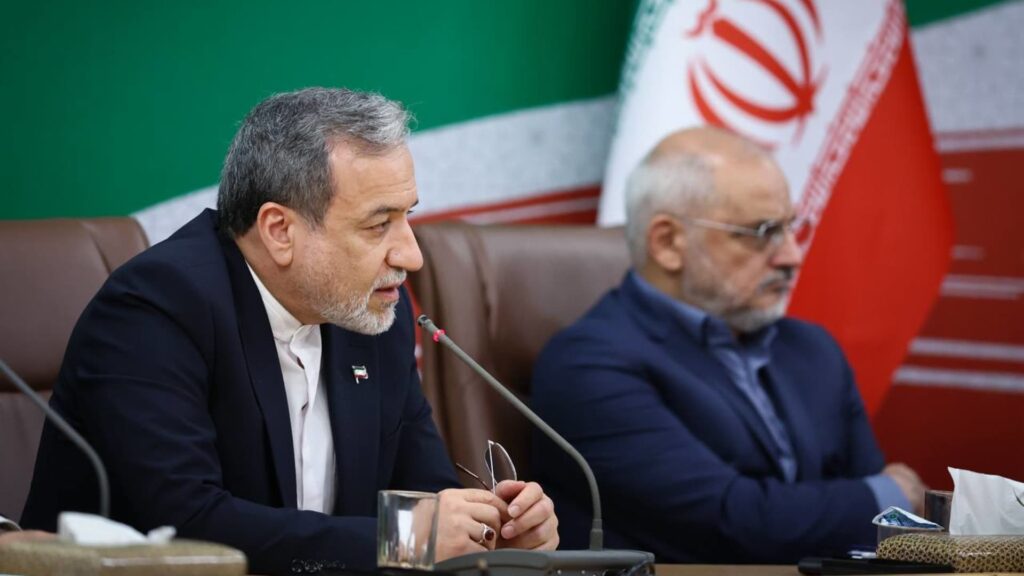
Iranian Foreign Minister Abbas Araghchi speaks during a press conference held at the Ministry of Interior in Tehran, Iran, on Aug. 8, 2026, on the occasion of National Journalists’ Day.
Anadolu | Anadolu | Getty Images
Iranian Foreign Minister Abbas Araghchi said Tehran is not currently in direct talks with the U.S. to end the war with Iran and open the Strait of Hormuz, despite Washington’s assertions that a deal is near.
A brief hiatus in fighting between the U.S. and Iran after a June 17 memorandum of understanding has been followed by weeks of Iranian drone and missile attacks on shipping in the strait and neighboring Gulf countries, as well as counterstrikes by the U.S. on Iranian targets.
Araghchi said Sunday that his country is not engaging in talks with the U.S., but added that “messages are being exchanged through intermediaries,” according to news agency Mehr. Araghchi also reportedly said that if Iran strikes a deal with Oman to secure a trade route through the strait, the U.S. still must meet Tehran’s conditions to reopen the strait.
“Talks with Oman do not mean the Strait of Hormuz will be reopened. An agreement may be reached, but reopening the strait depends on other conditions conveyed through intermediaries,” Araghchi was quoted as saying.
Oman has been a key interlocutor, especially on the thorny issue of the strait, a crucial gateway for about a fifth of the world’s energy supplies.
Iran’s foreign minister said a day earlier that Tehran and Oman, which border the waterway, were close to reaching an agreement on navigation, “specifically the determination of a transit route.”
U.S. Treasury Secretary Scott Bessent told CNBC on Tuesday that an agreement to open Hormuz with freedom of movement could come as soon as Wednesday. President Donald Trump and Secretary of State Marco Rubio had also indicated that an agreement was imminent.

Sweeping demands
On Saturday, Iran laid out sweeping demands to the U.S. for reopening the Strait of Hormuz, according to media reports.
The Secretary of Iran’s Supreme National Security Council, Mohammad Bagher Zolghadr, said reopening the strait would require Washington to lift its naval blockade and sanctions, withdraw U.S. military forces from the region, pay war reparations, and release frozen Iranian assets.
The council also called for an end to U.S. attacks on Iran’s regional allies and to threats against Iran, according to the reports.
CNBC has not independently verified the demands. The White House did not respond to a request for comment.
According to the interim deal signed in June between the U.S and Iran, a schedule to end sanctions and a compensation plan would be part of the final deal, as would negotiations to address frozen assets. The end of a 60-day period agreed to negotiate a final deal will come in just over a week.
Iran and Oman are working on an agreement to define transit routes through the strait, according to media reports. Inbound traffic would transit Iranian waters while outbound traffic would go through Omani waters.
But Iranian state media published a draft plan Thursday that would restrict traffic through Hormuz. The plan is under review by Iran’s parliament, according to the state outlet Fars.
Under the draft plan, Iran would ban U.S. and Israeli ships from transiting the Strait. Other nations that have harmed Iran would not be allowed to transit until compensation is paid, according to the draft.
Oil prices rose Friday as investors waited for an agreement. Ship traffic through Hormuz was down 33% on Friday compared to the day prior, with most vessels using the Iranian route, according to the trade intelligence firm Kpler.
Brent crude futures, the international benchmark, gained more than 1% to close at $83.55 a barrel. U.S. West Texas Intermediate advanced about 1% to settle at $78.18 per barrel. Prices fell more than 7% for the week.
JIZAN, SAUDI ARABIA – 26 JULY 2026: A satellite view of smoke plumes rising from Saudi Aramco’s refinery complex and oil terminals in Jazan/Jizan, Saudi Arabia, after coordinated Houthi strikes launched from Yemen. Imaged 26 July 2026. (Photo by Gallo Images/Orbital Horizon/Copernicus Sentinel Data 2026)
Gallo Images | Gallo Images | Getty Images
Houthi attack on Aramco
Firefighters extinguished a blaze at a refinery belonging to Saudi Arabian oil giant Aramco early Sunday, the country’s government said. Iran-backed Houthi rebels in Yemen reportedly claimed responsibility for attacking the facility.
“The competent authorities are completing the necessary procedures to deal with the incident” at the Saudi Aramco refinery in Jazan, Saudi Arabia’s Ministry of Energy said in a statement on X, adding that no one was injured. The statement did not say what caused the fire.
Iran-backed Houthis reportedly said they carried out a drone strike on the facility.
“Yemen’s Armed Forces said they hit Saudi Arabia’s Aramco refinery in Jizan on Sunday, describing the drone strike as precise and carried out in response to Saudi drone violations of Yemeni airspace,” Iranian state-backed news agency Mehr said in a post on X.
CNBC has not independently verified the claim. The Houthis have claimed responsibility for a number of attacks on the Saudi Aramco facility since the start of the war.
— CNBC’s Tanaya Macheel contributed to this story.