Anatomy of a jinx: Why Indian hockey teams struggle at World Cups
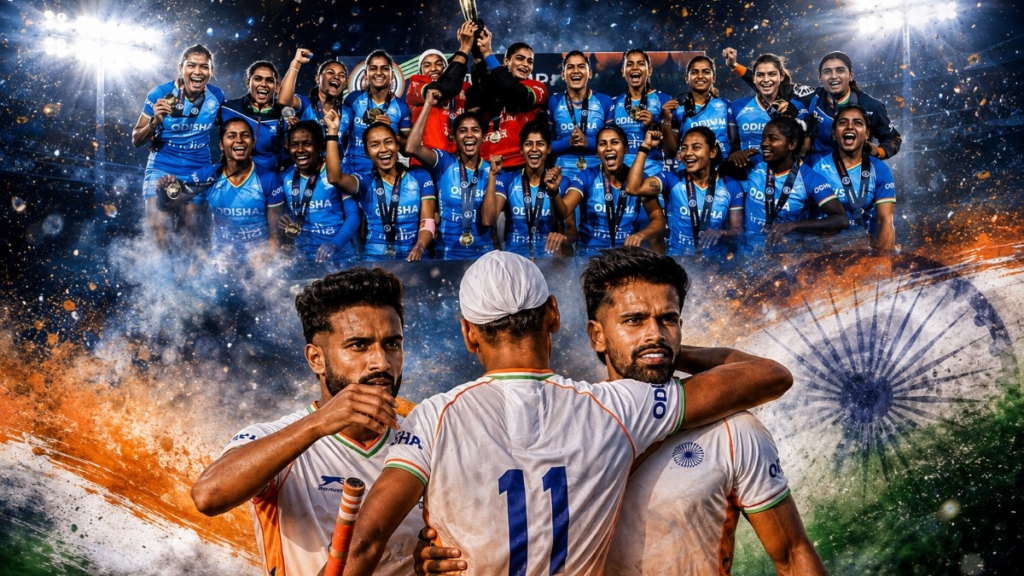
When you think about your favourite team going into a competition or tournament, it is natural to keep your hopes high. It may be their performances in the recent past that make you feel excited, or a tactical tweak that makes you feel they could topple the other giants fighting for top honours.
And as you discuss it with fellow fans or friends, you tend to end the conversation with one simple line:
“Let’s not jinx it.”
For fans of the Indian men’s and women’s hockey teams, they would have said this line for many years now. At times, it has worked out well. The Tokyo Olympics was one such occasion, with the men’s team winning a bronze medal and the women’s team producing an inspiring fourth-place finish.
There has been more success along the way. The men have added another Olympic bronze and continued to collect medals at the Asian Games. The women won an Asian Games bronze in 2022 and have been on a resurgence since Sjoerd Marijne took over following a turbulent period.
Yet there has been one tournament that has remained the kryptonite for both sides.
It is almost as if the supermen and superwomen of Indian hockey just collapse when the World Cup comes around.
That tournament is the FIH Hockey World Cup.
This year, the World Cup will be held in the Netherlands and Belgium, with the men’s and women’s tournaments taking place simultaneously for the first time since Utrecht 1998.
And when it comes to hockey, India once stood as the benchmark simply because of the talent it produced. The period of dominance by the men’s team is part of sporting folklore: eight Olympic golds, with six of them won on the trot from 1928 to 1956.
So, you would think India would have won multiple World Cups as well.
But that opens up a scary chapter, one that will have Indian hockey fans worrying a bit.
The Indian men’s team won the World Cup in 1975 in Malaysia. Since then, they have never made it to the semi-finals of the tournament.
There have been 12 editions since that wonderful day in Kuala Lumpur, and their best finish has been fifth place, twice — in 1982 in Mumbai and 1984 in Sydney. Four of those 12 World Cups were held in India, with the last two taking place in Odisha.
For the women, the performance chart paints an even darker picture.
In the inaugural edition in 1974, India finished fourth. Since then, it has been nothing but group-stage exits.
In fact, their best performance since then has been a seventh-place finish in Madrid in 1978. In the 14 editions since 1974, Indian women did not qualify for or participate in a total of seven World Cups.
In the last two editions they played in, in 2018 and 2022, India won just two of their 11 matches.
So, why does the World Cup feel like a tournament that India just can’t crack?
Does it have something to do with how hockey evolved after the 1970s? Is it a mental block? Is it down to the skill of the current players, or simply bad luck?
We needed answers.
So, we enlisted the help of two Indian hockey legends, Romeo James and Pritam Rani Siwach, to understand what has gone wrong for both teams on the World Cup stage.
THE HISTORY OF A FAILURE
It is widely believed that Indian hockey’s decline began once artificial turf came into the picture. Known for their stick work, attacking hockey and individual brilliance, Indian players struggled to adapt to the new surface as European powerhouses and Australia moved ahead.
But James believes the problem goes much deeper than the surface.
For him, the bigger concern is the stagnation of hockey at the grassroots level in India.
He pointed to Pakistan as an example. The four-time World Cup champions are making a return after eight years, but their decline shows that the surface alone cannot explain what happened to traditional hockey powerhouses.
“Just see the decline of Pakistan because it used to rule the roost and it’s now nowhere. So you can’t say it is because of the surface, because at the grassroots level no one is playing.”
“Like in our time, we used to see it in schools. I’m talking about Mumbai, where we had so many places to play. Now there is hardly anything. I mean, a lot of the hockey clubs have just shut shop,” said James.
For Pritam Rani, this World Cup will be a tournament she follows with a little more pride than usual.
Her son Yashdeep is part of the men’s team, and the former Indian captain is thrilled to see him reach the biggest stage.
But when it comes to the women’s team and its journey, Pritam Rani points towards something that goes beyond talent or tactics: the way the two teams were treated.
On one side was a men’s team carrying the legacy of eight Olympic gold medals. On the other was a women’s team still trying to find its place and build its own identity.
She believes that while both teams receive exposure and opportunities today, it wasn’t always the case. A few years ago, the federation treated the two teams differently.
The former Indian captain feels the women’s team was left without a clear goal or target for a long period simply because it did not have the same status as the men’s team.
“Women’s team did not have that status of being Olympic champions,” said Pritam Rani.
“So one thing is that the men had that target given to them and had a legacy to live up to. The women did not have that because the team itself had not gone to the Olympics. So what would our target be?”
She also recalled an anecdote that reminded her of the Bollywood cult favourite *Chak De! India*.
“Have you seen the movie Chak De India? That happened with us. We were going in the bus for Olympic qualifiers in 1992, I think, and we were called back on the way and they said that ‘we will not send the women, only the men will be sent.'”
“So, we did not think so big. We could not even think that they would send us,” said Pritam Rani.
Going back to James, when asked about the talent available to India, he raised another major red flag: the issue of age fraud.
“It is killing our hockey,” said James.
“If you’re saying I’m 18 years old and you are 22, you have already gone past your prime and by the time you finish your sub-juniors and juniors, you’re already 24 or 25. So how can you improve?”
He also pointed out how other countries have managed to create seamless transitions within their teams, while India continues to rely heavily on veterans such as Harmanpreet Singh, Manpreet Singh and others to deliver on the biggest stage.
“Our Indian teams, earlier in the 70s and 80s, used to have blue, light blue, dark blue divisions. Juniors were also coming up to the senior level, so there was a backup of not just the core group.”
“So the core group has to be increased to at least 150 players and not like 40 or 45.”
“So like whoever is playing well, they come into the senior team for the World Cup, and then the Asian Games are there. So for Asian Games, another 23 are added, those who are playing well at that time.”
“And that is lacking in my opinion. Only 40 and 45 in the core groups won’t do, right,” said James.
THE MENTAL BLOCK
Then there is the issue that perhaps haunts Indian hockey the most: pressure.
Look at the teams of the past and you can see how they have struggled to cope with it when the stakes have been at their highest.
In 2018, India were chasing the game against the Netherlands in the quarter-finals when they lost Amit Rohidas to a yellow card. It eventually proved to be the final nail in the coffin.
In 2022, India were beaten by New Zealand in the shootout. They were cruising at 3-1 at one point before the Black Sticks’ comeback stunned them.
This time, the teams are also entering the tournament amid noise around the jersey, turmoil and infighting within Hockey India and plenty more happening away from the pitch.
Even on the women’s side, Pritam Rani has seen teams she was part of crumble under the weight of pressure.
“There are one or two players in three who take a lot of pressure mentally, and somewhere the match gets spoiled. They are not able to do that much.”
“So somewhere there is an effect of this and we cannot play because of it. And in the crucial matches that we have to win, we take so much pressure on that match that it has an effect,” said Pritam Rani.
But there is one development that both James and Pritam Rani are happy about.
The men’s team are preparing for the World Cup with a three-day camp under renowned mental conditioning coach Paddy Upton.
James does not believe the current side will be intimidated by the biggest names in world hockey.
“I don’t see this team, you know, being cowed down by Belgium and other big teams. They are mentally fit, they’re mentally strong, they’re experienced,” said James.
ASIAN GAMES OVER EVERYTHING?
There is another factor that could play a role in how India approaches this World Cup.
The tournaments will conclude by August 30. But the Indian teams won’t have much time to rest, with the Asian Games kicking off in September and running into early October.
The agenda for the Asian Games is simple for both sides: win gold and seal a spot at the Los Angeles Olympics.
If they don’t, they will have to deal with the pressure of going through the Olympic qualifiers.
That inevitably raises a question: could the Asian Games take priority over the World Cup?
The coaches may insist that every tournament and every game is important, but the reality is that India has traditionally placed enormous importance on the Olympics and the qualification pathway leading to it.
The Hockey Pro League is a perfect example. India have never won the men’s competition, while the women’s team have only recently regained promotion to the top division.
“Asian Games is the main thing. You qualify, and you don’t have to play the qualifiers. Then you can start preparing for the Olympics early. So the main team is always put forward for the Asian Games,” said James.
“The federation may say that we have to put our whole effort into one thing in the Asian Games so that we don’t have to play the qualifiers again and again,” said Pritam Rani.
“So it may be like this. It may be possible. We will not say that it cannot happen. It may happen because you have to put your strength into one tournament. For the qualifiers, we don’t know what competition we may get or where. A problem can come for us there.”
WHAT TO EXPECT?
For all the history, the disappointments and the questions surrounding India’s World Cup record, both James and Pritam Rani believe the jinx could finally be broken.
India are heading into the World Cup as the top team in Asia, while the women’s team have enjoyed a fine run of form, winning the Nations Cup in New Zealand.
There is optimism. But there are also areas that need to be addressed.
For James, discipline will be key for the men’s team.
“Playing with 10 players and having yellow cards is not great,” said James.
“You remember Amit Rohidas’ red card at the last Olympics. We played nearly 40 minutes against Great Britain with 10 players. In modern hockey, playing with 10 players is very tough.”
“If we are playing Belgium, and we’re down with 10 players in the last 10 minutes, I’m sure they’ll lose.”
“So our players have to be clever enough not to take a yellow card.”
For Pritam Rani, the Tokyo Olympics was the watershed moment that gave the Indian women’s team a sense of purpose.
Gone are the days when the team didn’t have a target or didn’t believe it could compete with the best. Now, the expectation is different.
Her message is simple: focus on penalty-corner conversion and defending against opposition PCs.
“Whenever there is a team, first of all, the Pro League that we play, from that we get to know a lot about the teams. Like when you play cards, one card opens and you find out what is in that team.”
“So we have to know, work on our basics, starting with defence. We will have to do good defending against PCs.”
“Plus, we have to make our penalty-corner attack very good. These are two things I am focusing on because we win and lose because of this,” said Pritam Rani.
She believes it is ultimately about peaking at the right time, something she has full confidence in with the current women’s team.
“When you see the teams also, there is not much difference. There is a little bit of difference. Any team can click at any time. Like in the World Cup, the women’s team has beaten England and Holland, and we have also lost to them as well. We have also beaten China, we have lost to them.”
“Now we know that we can beat any team and get a medal. The teams are similar. The team that clicks will play the semi-final,” concluded Pritam Rani.
For Indian hockey, then, the World Cup remains a question of history, belief and execution.
The men’s team have been waiting 51 years to return to a World Cup semi-final. The women have been waiting even longer to rediscover the feeling of being among the world’s best.
The talent is there. The exposure is better. The belief is slowly returning.
Now comes the part where India has to prove it on the biggest stage.
And perhaps, just perhaps, this time the fans can say it without having to worry about the jinx.
– Ends