Stock futures are little changed after a steep sell-off sparked by a move back higher in Treasury yields: Live updates
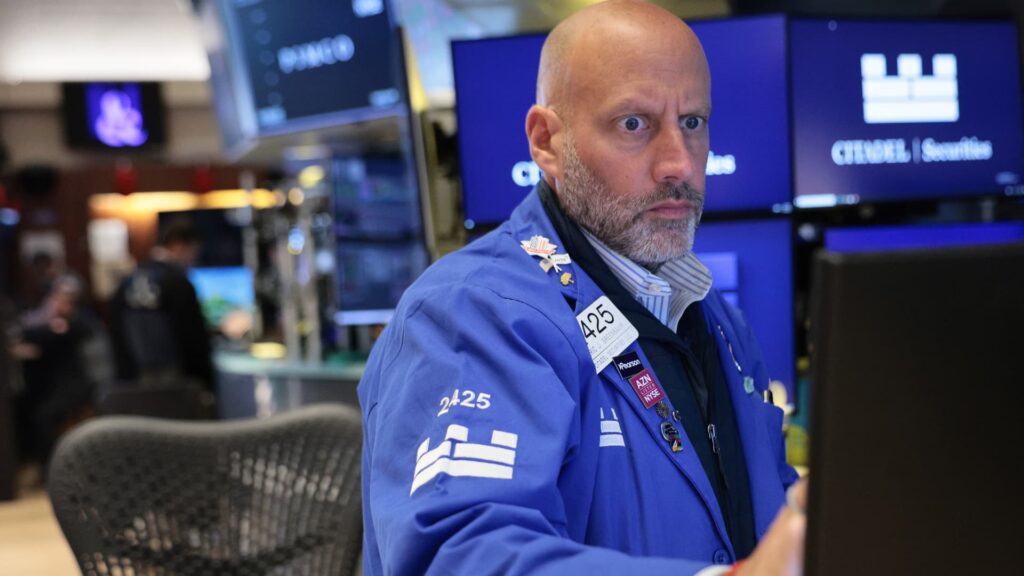
A trader works on the floor of the New York Stock Exchange during morning trading on August 18, 2026 in New York City.
Michael M. Santiago | Getty Images
Stock futures were about flat on early Friday, following a sharp pullback on Wall Street that put the major averages on pace for weekly declines.
S&P 500 futures traded around flat, while Nasdaq-100 futures were 0.2% higher.
The S&P 500 and Nasdaq Composite dropped 0.9% and 1%, respectively. That pullback left the S&P 500 down 1.9% for the week, and the Nasdaq off by 2.5% — putting them on pace to snap a three-week winning streak. The Dow Jones Industrial Average has fallen 1.8% week to date, on track for back-to-back weekly losses.
In Asia, Japan’s Nikkei 225 fell 0.39% while the Topix was flat. The Kospi reversed early losses to rise 0.80%, while the small-cap Kosdaq declined 4.73%. Australia’s benchmark S&P/ASX 200 was 0.31% lower. Hong Kong’s Hang Seng index was up 0.72%, while mainland China’s CSI 300 gained 0.52%.
Thursday’s losses came as long-dated U.S. Treasury yields resumed their march higher, after efforts by the government to stem the recent bond market rout failed to ease investor fears about inflation.
“Unlike QE via the [Federal Reserve], the Treasury cannot create money to fund asset purchases,” wrote Ulrike Hoffmann-Burchardi, chief investment officer of the Americas at UBS. “Any buybacks must be financed elsewhere, most likely through increased bill issuance or adjustments to other parts of its funding program.”
“In effect, the operation reshapes the maturity profile of debt held by investors rather than reducing the amount of debt markets must absorb. It neither removes the government’s financing needs nor resolves concerns about Treasury supply,” she wrote.
Ross Stores shares jumped more than 7% after hours on better-than-expected results for the second quarter.