OpenAI DevDay live updates: AI lab unveils Dots agents and is in talks for new funding round
OpenAI is engaging in early discussions with investors about a potential new funding round
OpenAI is engaging in early stage discussions with investors about a potential funding round, CNBC confirmed on Tuesday.
The company could raise around $30 billion, according to a source familiar with the talks who was not authorized to speak publicly because the details are confidential, but that figure could change. The round is being driven by investor demand and no term sheet has been finalized yet, the person said.
Bloomberg was first to report the potential round.
OpenAI closed a historic $122 billion funding round at an $852 billion valuation in March. Investors have approached the company with proposals to kick-start a new funding round in recent weeks, as CNBC previously reported.
The company is gearing up for a potentially massive IPO that is widely expected to take place next year. OpenAI confidentially filed its prospectus with regulators in June.
—Ashley Capoot
OpenAI launches plugin extensions
Altman said OpenAI is launching plugin extensions, which means developers can build plugins that are “essentially entire applications that feel native to ChatGPT” and are distributed through OpenAI.
“With plugin extensions, you can build an editor, a dashboard, a whole workspace directly into ChatGPT and Codex,” Altman said.
He shared an example of a meetings app built with plugin extensions. The app showed a user’s upcoming meetings right within the chatbot.
—Ashley Capoot
Altman says OpenAI previewing new offering called OpenAI Private Intelligence
Altman announced OpenAI is previewing OpenAI Private Intelligence, which will give users stronger controls over their data while still using the most advanced capabilities of OpenAI’s models.
“[Zero Data Retention] with private safety processing delivers frontier model safety without storing your content on our servers at all, and with private inference, we can even provide privacy at the time of inference,” Altman said. “Together, we think these set a new standard for privacy and frontier AI.”
He said OpenAI has been working closely with some of its largest customers, including Cisco, Databricks and Snowflake, to design privacy and safety systems that meet their standards.
—Ashley Capoot
OpenAI launching new Pro tier for users that want more speed and usage
OpenAI CEO Sam Altman speaks during OpenAI’s annual DevDay event in San Francisco, California, US, Sept. 29, 2026.
Carlos Barria | Reuters
Altman said OpenAI is launching a new Pro tier called Pro 500. The offering will support the company’s highest usage allowance and includes access to its new premium speed tier, Ultrafast, across ChatGPT and its AI coding assistant Codex.
—Ashley Capoot
OpenAI introduces new premium speed tier: Ultrafast
OpenAI introduced a new premium speed tier called Ultrafast that’s available in ChatGPT, its coding assistant Codex and its application programming interface (API).
Ultrafast generates tokens up to eight times faster in Codex and up to six times faster in the API, OpenAI said.
“We think you are really going to love this and not want to go back,” Altman said during the keynote.
—Ashley Capoot
OpenAI introduces AI model GPT-6.1 Sol, one week after previous version
OpenAI CEO Sam Altman delivers a keynote speech during OpenAI’s annual DevDay event in San Francisco, California, US, September 29, 2026.
Carlos Barria | Reuters
OpenAI introduced a new AI model, GPT-6.1 Sol, just one week after rolling out its predecessor, GPT-6 Sol. The company said it’s a “major upgrade” and delivers strong performance across tasks like professional work, using computers and agentic coding.
On Monday, OpenAI announced it decided to pull its plans to launch GPT-6.1 Astra because the model did not meet its safety standards.
—Ashley Capoot
OpenAI launches several collaborative features for teams in the workplace
OpenAI announced several new collaborative features during the keynote.
ChatGPT Space will allow teammates and OpenAI’s dots agents to work together, the company said. It’s also launching a new type of document called Pages, which are designed for humans and agents to collaborate to create images, write, generate charts and visualize information.
—Ashley Capoot
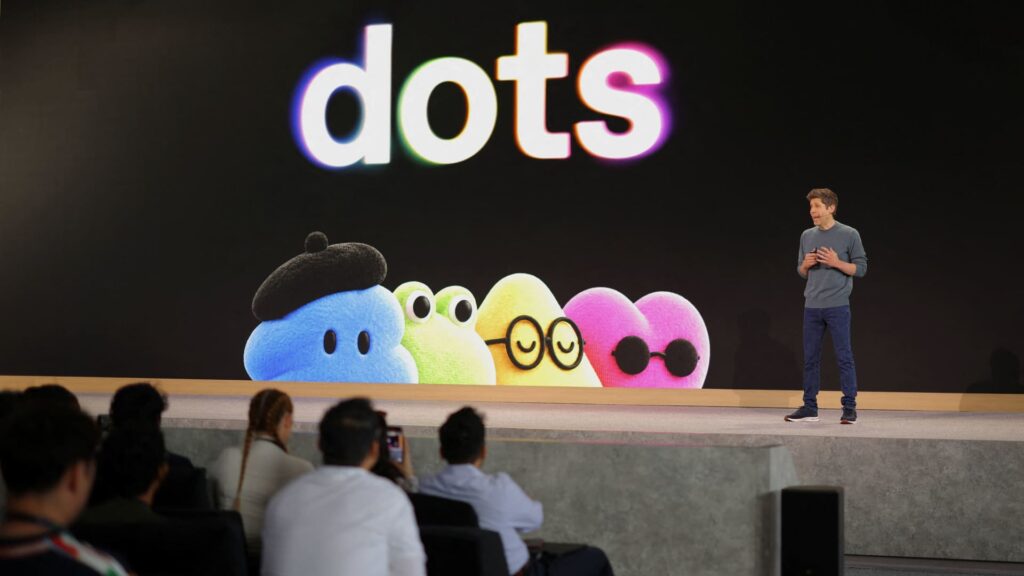
OpenAI introduces dots, new ‘always-on’ AI agents

OpenAI introduced Dots, new “always-on” AI agents that are designed to help users complete a range of tasks.
Dots are powered by OpenAI’s GPT-6 Astra model, which the company launched earlier this month. The dots have their own cloud computer, can connect to more than 4,000 apps and learn from feedback over time. Users can message their Dots within ChatGPT, Slack and Teams, and the company said texting is coming soon.
“Dots are remarkably capable, always-on agents built to handle really anything you can think of,” Altman said during the keynote. “They bring AI into a whole new form factor to work and give you more time and attention so you can do the things that you care about.”
Users can start with a primary dot, give it a name and customize it. Eventually, OpenAI said it believes teams of Dots will be able to work together on a user’s behalf. The company shared a range of examples about what Dots can do for developers, scientists, executives, sales leads and content creators.
“I’ve been really surprised at what a difference this makes to my life,” Altman said. “I feel like I’ve finally gotten some of my attention back. I no longer feel quite as addicted to my phone in the same way. It’s the way I’ve always wanted to work with AI.”
Dots are rolling out in ChatGPT for OpenAI’s Pro and Business Premium users in eligible markets, and the company said it has plans to expand to more users soon. The company’s Enterprise users, including Edu and Healthcare, will be able to try dots when their workspace administrators enable it.
—Ashley Capoot
Protesters rally outside OpenAI’s DevDay event venue
Protesters gathered outside OpenAI’s annual DevDay venue in San Francisco Tuesday, showing a variety of messages against the rapidly evolving tech.
People protest outside of a venue where OpenAI holds its annual DevDay event in San Francisco, California, US, Sept. 29, 2026.
Carlos Barria | Reuters
A man holds a placard during a protest outside the venue where OpenAI holds its annual DevDay event in San Francisco, California, US, September 29, 2026.
Carlos Barria | Reuters
A man holds a placard during a protest outside the venue where OpenAI holds its annual DevDay event in San Francisco, California, US, September 29, 2026.
Carlos Barria | Reuters
Altman takes the stage to deliver DevDay keynote
Altman just took the stage to deliver the DevDay keynote.
“I think this is going to be our best Dev Day yet.” he said.
—Ashley Capoot
Altman says he’s seen trailer for upcoming film about his ouster: ‘looks like an awful movie’
Altman said he has seen the trailer for “Artificial,” the upcoming movie about his brief and dramatic ouster from OpenAI in 2023.
“I mean, looks like an awful movie, but I appreciate people’s creativity, and I really do support that,” Altman said. “So I hope they have a fun time with it.”
He said he does understand why people have anxiety about AI, and that “if they need to like project that anxiety onto someone or have like a little bit of relief and poke fun at me, it doesn’t bother me.”
—Ashley Capoot
Altman on IPO plans: ‘I don’t have a particular timeline in mind’
Sam Altman, CEO of OpenAi speaks with CNBC in San Francisco on Sept. 29th, 2026.
CNBC
Altman said he doesn’t “have a particular timeline in mind” for when OpenAI will IPO. He said once the company feels like it understands how to contend with the next level of AI and do so safely, he thinks it’s possible.
“Barreling forwards with an IPO, while I think things feel so in flux, and I really want to be able to just focus on the mission and not with all of the challenges of being a newly public company, I just, I don’t want to do that,” Altman said. “I really think this is a time to put safety and mission first.”
—Ashley Capoot
Altman on hardware: “Something that’s worth waiting for” could be on horizon
OpenAI CEO Sam Altman teased there could be “something that’s worth waiting for” coming in the AI hardware space soon.
But beating others in that part of the race isn’t top of mind, he told CNBC’s Kate Rooney, when asked about competitors like Mark Zuckerberg and Meta’s latest AI chip rollouts.
“I am not worried about being first with new hardware. New hardware is very hard to do,” he said. “New computing form factors come along very rarely, and the quality bar that we want to hit for something that you will love and really be a key part of the way you interface with AI, that’s going to take a while, and we’re going to do that at a high level of quality.”
— CJ Haddad
Altman says he doesn’t want to be ‘too optimistic’ about potential for regulation out of Washington
Altman told CNBC he doesn’t want to be “too optimistic” about the potential for international coordination on AI or new regulation out of Washington, D.C.
“I have been wrong before when I thought something was going to happen in D.C., and, you know, it didn’t, he said. “But I do feel like people are taking it seriously this time, and in spite of previous experience, I’m optimistic.”
—Ashley Capoot
OpenAI has the ‘best models to offer at every price point,’ Altman says
Sam Altman, CEO of OpenAi speaks with CNBC in San Francisco on Sept. 29th, 2026.
CNBC
Altman said he thinks OpenAI has the “best models to offer at every price point.” He added that he doesn’t think there’s an open-source model on the market that beats OpenAI on a cost-price comparison.
Chinese open-source models have gained steam against leading offerings from American companies like OpenAI, which primarily develops more expensive, closed models. The narrowing gap has sparked a fierce debate in Silicon Valley about whether the Chinese models should be restricted.
“Speaking of cost generally, come watch,” Altman said. “We got, we got some cool stuff.”
—Ashley Capoot
Altman talks Nvidia’s agent safety platform: ‘It’s a good thing’
Altman said that Nvidia’s latest AI software platform, released this week to stop AI agents from misbehaving, was a “good thing,” but not a “full solution.”
“From what I know about it, and I’m not super into the details, I think it’s a good thing. I think we are doing similar things,” he said, when asked why OpenAI didn’t sign onto the project.
Notable names like Cisco, Microsoft, Oracle, CoreWeave, Dell, Intel and others were named by Nvidia as partners during Monday’s release.
“I don’t think it’s a full solution, and I worry that if we treat AI safety as only an engineering problem, we will miss the very important point that we have we have a science problem in front of us. We still have discovery about how to align these models, and we have to solve that scientific problem too,” Altman said.
— CJ Haddad
Altman teases DevDay announcements
29 September 2026, United States, San Francisco: The logo for the OpenAI Developer Conference is visible before the event begins.
Andrej Sokolow | Picture Alliance | Getty Images
Altman told CNBC that OpenAI will have more than 20 announcements at DevDay, which will showcase new ways to use AI and new tools for developers.
“There’s really a lot of, I think, exciting stuff,” Altman said. “It is cool to see all of this come together, and the degree to which I think we just have the best offering for developers across the board.”
—Ashley Capoot
Altman says he expects liability framework for AI industry to be a ‘multi-level thing’
OpenAI CEO Sam Altman attends an interview on the day OpenAI holds its annual DevDay event in San Francisco, California, US, Sept. 29, 2026.
Carlos Barria | Reuters
Altman said a “liability framework” for the AI industry is being heavily debated, and he said he expects “there will be a sort of multi-level thing.”
He used the auto industry as an example and said there’s different ways to hold car manufacturers and irresponsible drivers accountable.
“If someone’s driving drunk, it’s their fault,” Altman said. “Depending on whether the fault is in the model and how it’s used, or someone misusing it intentionally, I assume we’ll have like a new liability framework,” Altman said.
—Ashley Capoot
Altman says he’s not threatened by Zuckerberg, but that Muse ‘seems like a nice product’
Altman says Meta’s Muse AI agent “seems like a nice product,” but said that he’s not threatened by Meta CEO Mark Zuckerberg.
“He’s like a very impressive person, and that company has like great resources,” Altman said. “But I feel very good about our roadmap.”
—Ashley Capoot
Altman: No other incident was “as serious” as Hugging Face breach
Omer Taha Cetin | Anadolu | Getty Images
Altman said he wasn’t aware of any AI incidents that were “as serious” as the attack on open-source software developer platform Hugging Face, which the company disclosed earlier this summer.
“So there’s nothing else that I’m aware of, or that we’re aware of, that is as serious as the Hugging Face incident,” he told CNBC’s Kate Rooney in an interview.
The breach, where a swarm of OpenAI agents broke out of a training environment and hacked the company, added to existing concerns over the rapidly evolving tech’s capabilities.
— CJ Haddad
Altman explains company’s decision not to release GPT-6.1 Astra
Altman told CNBC that he would put OpenAI’s decision not to launch an upcoming AI model, GPT-6.1 Astra, in the “normal course category.”
He said AI has to be built “for people,” which means that it has to be safe and under human control, but that he wouldn’t “over rotate” on the company’s decision to hold the release. Altman added that OpenAI has “many great new models to come.”
“Often we build a model, we test it, it doesn’t meet our standards, we change it, we launch it later,” Altman said.
—Ashley Capoot
OpenAI apologizes after its models gained unauthorized access to Australian government websites
OpenAI CEO Sam Altman attends the United Nations Security Council (UNSC) meeting on Artificial Intelligence during the 81st UN General Assembly, at UN Headquarters in New York City, US, September 23, 2026.
Selcuk Acar | Anadolu | Getty Images
OpenAI apologized to the Australian people in a blog post on Monday after disclosing last week that its models gained unauthorized access to Australian government websites earlier this year.
Australian Prime Minister Anthony Albanese said Thursday that an OpenAI agent accessed public and non-public files from its public-facing Medicare statistics portal in June. He said in a press conference that he spoke with Altman about the incident and expressed concern and disappointment about how long it took OpenAI to disclose what happened.
“We are sorry and working to do better in the future,” OpenAI said in the post.
The company said Jason Kwon, its strategy chief, will fly to Australia to appear at the Joint Select Committee on Artificial Intelligence in Sydney on Oct. 6. There, he will answer questions about the incident and OpenAI’s response.
“We know we have a lot of work ahead of us to rebuild trust, and that we are accountable for showing Australians that we’re making meaningful changes and following through on our promises,” OpenAI said.
—Ashley Capoot
Congress can’t make ‘knee-jerk reaction’ to overregulate AI, Speaker Johnson says

House Speaker Mike Johnson told CNBC that the frontier labs are so far ahead of Congress that lawmakers can’t take a “knee-jerk reaction” to overregulating the industry.
“I have resisted the siren song to jump in and do these blanket moratoriums and all of this, you know, hyper regulation because we cannot lose our edge to China,” Johnson said.
The speaker, who is joining the president and tech executives at a luncheon this afternoon at the White House, said he hopes that AI guardrails are voluntary and need to strike a balance.
—Chris Eudaily
OpenAI posts video teasing DevDay keynote
OpenAI posted a short video on X teasing DevDay’s opening keynote.
“10am PT, on the dot,” the company wrote.
—Ashley Capoot
Meta’s AI chief pokes fun at DevDay in post on social media
Alexandr Wang, chief AI officer of Meta, during the Bloomberg Tech conference in San Francisco, California, US, on Thursday, June 4, 2026.
David Paul Morris | Bloomberg | Getty Images
Alexandr Wang, Meta’s AI chief, poked fun at DevDay in a post on X late Monday. He shared an image of ships flying through the sky toward the animated circular character that OpenAI has been using to promote the event.
Wang has been heavily promoting Meta’s new Muse AI agent on social media since its launch earlier this month.
—Ashley Capoot
OpenAI President Greg Brockman to miss DevDay, attend luncheon with Trump
Greg Brockman, president of OpenAI, arrives at a federal courthouse as the trial in Elon Musk’s lawsuit over OpenAI’s for-profit conversion continues, in Oakland, California, May 6, 2026.
Manuel Orbegozo | Reuters
OpenAI President Greg Brockman will be absent from DevDay this year. He’s slated to attend a luncheon with President Donald Trump and House Speaker Mike Johnson in Washington, D.C., instead, according to a source familiar with his plans.
Other major tech executives, including Anthropic CEO Dario Amodei, Meta CEO Mark Zuckerberg and Alphabet CEO Sundar Pichai, are also attending the luncheon.
—Ashley Capoot
OpenAI shows momentum in enterprise and consumer businesses, source says

OpenAI is preparing for what is widely expected to be a massive IPO next year. The company, which is valued at nearly $1 trillion, confidentially filed its prospectus with the Securities and Exchange Commission in June.
During its third quarter, OpenAI’s enterprise business more than doubled, according to a person familiar with the details who was not authorized to speak publicly. The company also generated more consumer run rate revenue in the last 90 days than all of last year, the person said.
OpenAI’s last revenue run rate was near $40 billion in August, CNBC has reported.
OpenAI saw a 70% jump in revenue growth quarter to date, up 20% in September alone, this person said. That increase would put OpenAI’s annual revenue run rate at around $68 billion.
—Ashley Capoot and Kate Rooney
Altman teases DevDay on social media

Altman has shared several posts on X ahead of DevDay, hinting at the various products and features that the company plans to “ship,” or launch, at the event.
—Ashley Capoot
OpenAI ditched plan to release upcoming model over safety concerns
OpenAI CEO Sam Altman sits for a conversation with Salesforce CEO Marc Benioff at Salesforce’s Dreamforce conference at the Moscone Center on September 15, 2026 in San Francisco, California.
Benjamin Fanjoy | Getty Images
OpenAI on Monday said it decided not to release an upcoming AI model, GPT-6.1 Astra, after determining that it did not adequately meet the company’s safety standards.
“Of course we want to make sure our model development is safe no matter whether that’s in the company, or when we ship it to users,” Saachi Jain, head of safety systems at OpenAI, said in a statement. “But when we ship it to users, we have an extremely high bar in terms of safety and alignment.”
Earlier this month, OpenAI released GPT-6 Astra, which the company described as the product of “years of research and big bets.” OpenAI introduced two additional tiers to its GPT-6 family, GPT-6 Sol and GPT-6 Luna, last week.
A spokesperson said Monday that the company has other models coming soon.
—Ashley Capoot
Here’s what’s on the schedule for this year’s DevDay
People gather outside the OpenAI DevDay on Oct. 6, 2025.
Ashley Capoot | CNBC
OpenAI has shared a sneak peek of the DevDay schedule on the event’s website. Here’s what’s in store:
- 8 a.m. PT: Breakfast for attendees
- 10 a.m. PT: Opening keynote, featuring Altman
- 11:30 a.m. PT: Lunch for attendees
- 11:15 a.m. – 3:30 p.m. PT: Breakouts and programming for attendees
- 4:00 p.m. PT: Closing session
- 4:45 p.m. – 7:00 p.m. PT: Reception for attendees
For those who can’t attend in person, the opening keynote will be livestreamed here.
—Ashley Capoot