Flight fares soar: Delhi-Hyderabad up 68%, Mumbai-Kolkata 51% as fewer services and higher fuel costs squeeze travellers; IndiGo raises fuel surcharge by up to Rs 350
If you are planning to travel this festive season, airfares have just got more expensive. In fact, Indians planning to fly home this festive season or take a domestic holiday towards the end of the year may have to pay considerably more for their tickets.Fares on several major domestic routes have already climbed by as much as 68% compared with a year earlier, as airlines contend with strong passenger demand, higher fuel costs and reduced flight frequencies on some sectors.Data from global aviation analytics firm OAG shows that airlines have scheduled 5% fewer domestic flights for the October-December quarter than during the same period last year.However, total seat capacity has fallen by only 1.2%. This indicates that airlines are operating fewer flights while deploying larger aircraft with more seats, keeping overall capacity relatively steady. At the same time, a sharp increase in jet fuel prices has pushed up operating costs.Also Read | Second Vande Bharat sleeper set to launch this month between Bengaluru and Mumbai; cutting travel time from 24 hours to under 16 hours, 30 year wait for faster connectivity between two cities to end
IndiGo hikes fuel surcharge for domestic, international flights from Oct 6
IndiGo, the country’s largest airline, announced on Monday that it would increase the fuel surcharge on both domestic and international flights as jet fuel prices continue to rise.The revised surcharge will come into effect from October 6, resulting in higher airfares for passengers. For domestic flights, the increase ranges from Rs 100 to Rs 350, depending on the distance travelled. The airline has also revised the surcharge applicable to international services.This marks the second increase in IndiGo’s fuel surcharge since April. The surcharge itself was introduced in March.For domestic flights covering up to 500 kilometres, the fuel surcharge will now be Rs 375. Flights covering between 501 and 1,000 kilometres will attract a surcharge of Rs 600.The charge will rise to Rs 900 for journeys between 1,001 and 1,500 kilometres, while flights covering 1,501 to 2,000 kilometres will have a surcharge of Rs 1,150.According to the airline’s statement, the surcharge for flights travelling more than 2,000 kilometres will be Rs 1,300.For flights within the SAARC region, the revised fuel surcharge ranges from Rs 1,000 to Rs 3,000. The charge will be Rs 6,000 for services to Africa and Rs 10,000 for flights to Europe.Flights to Southeast Asia, the GCC and the Middle East, as well as North and East Asia, will carry a fuel surcharge of Rs 5,500, the statement said.IndiGo said aviation turbine fuel (ATF) prices have been volatile over the past few months, particularly amid the geopolitical developments in the Middle East.The airline said fuel prices have continued to climb, with the latest month-on-month increase exceeding 14%. As a result, ATF costs have reached levels that rank among the highest seen over the past decade.IndiGo currently operates more than 2,200 flights every day.
Airfares surge
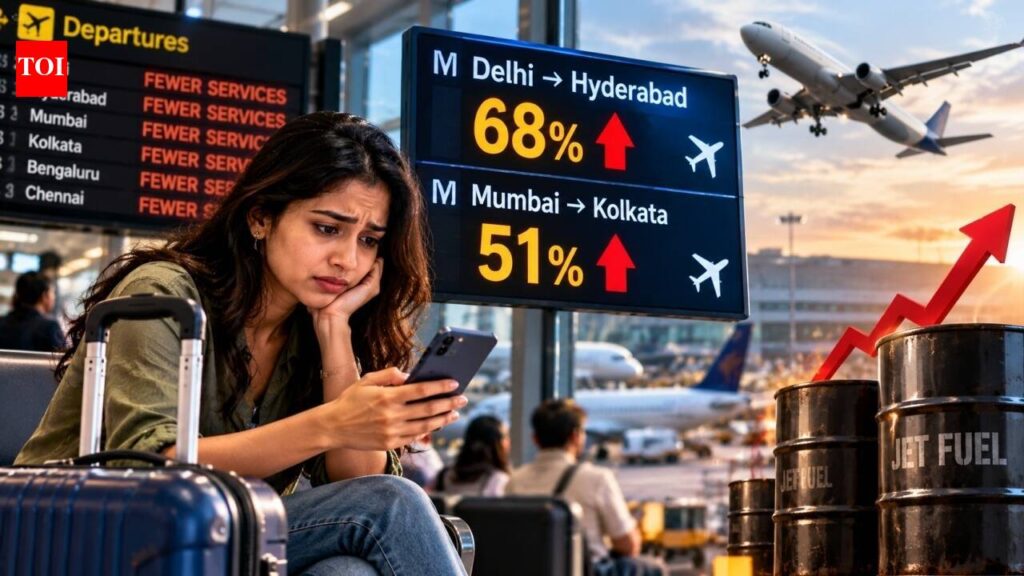
Data reviewed by ET shows that average one-way fares between September 1 and November 10 have increased 68% on the Delhi-Hyderabad route, 51% between Mumbai and Kolkata, 39% between Delhi and Goa, and 37% on the Mumbai-Bengaluru sector.The change in capacity, however, does not point to a widespread shortage of seats across domestic aviation. The situation differs considerably from one route to another. While airlines have increased capacity on some sectors, they have reduced the number of flights on others.“The busiest day for domestic capacity this quarter is expected to be December 7, with 589,386 seats scheduled, below the 603,634 seats on last year’s busiest day,” said John Grant, chief analyst at OAG.OAG’s figures highlight the sharp variation between different markets. Capacity on the Mumbai-Jamnagar route has more than tripled, rising to 102,520 seats from 32,452 a year earlier. On the Delhi-Navi Mumbai route, capacity has jumped to 142,600 seats from just 8,158 as the new airport increases its operations.In contrast, capacity on the Ahmedabad-Kolkata route has fallen 20.9%, while the Hyderabad-Jaipur sector has seen a 33.1% decline.For travellers, the reduction in flight frequency can be significant because it means fewer choices of departure times on busy travel dates, even when airlines maintain overall seat availability by operating larger aircraft. On routes where passenger demand remains high but the number of flights is limited, ticket prices can rise more sharply.Higher fuel costs are putting further pressure on fares. Domestic aviation turbine fuel (ATF) prices increased by Rs 16 a litre from October 1, reaching around Rs 137 a litre from Rs 121. This followed an increase of Rs 6.28 a litre in September and another Rs 5 a litre rise in August. According to ICRA, fuel typically accounts for 30-40% of an airline’s operating expenses.Domestic ATF prices were already around 20% higher than a year earlier in August after oil marketing companies increased prices by Rs 5,000 per kilolitre, ICRA said. Airlines also carry substantial costs denominated in dollars, including aircraft leases and maintenance. This leaves their expenses vulnerable to changes in both fuel prices and the value of the rupee.“While traditional domestic favourites such as Goa continue to see healthy demand, with bookings up 10% year-on-year, destinations such as Leh, Dehradun and Amritsar are also seeing strong growth this festive season,” said Aloke Bajpai, co-founder and group co-CEO of ixigo. “Higher ATF prices could put upward pressure on domestic airfares, particularly around peak-festive travel dates, while easier visa access and improving connectivity are giving international travel an added push.“Yatra said domestic airfares are currently 30-40% above last year’s levels, while international fares have increased by 30-50%. Domestic searches and bookings have remained largely stable, with considerable demand on routes such as Delhi-Mumbai, Delhi-Bengaluru, Mumbai-Delhi and Mumbai-Bengaluru. Routes linking major metropolitan cities with Patna and Kochi are also seeing strong interest.The travel company expects fares on routes witnessing high demand to climb by another 15-20% as the departure dates draw closer. The increase is likely to be more pronounced on sectors where available capacity remains limited.International flight schedules, meanwhile, are growing at a slightly faster pace. OAG data shows that the number of international flights scheduled for the October-December quarter is 3% higher than a year ago, while the number of seats has increased by 2%.Planned capacity to Saudi Arabia has risen 22%, whereas capacity to Thailand has declined 8%. Airlines have also increased planned capacity to Canada by 27%, while the capacity scheduled for China has increased fourfold.Travellers are also showing a growing preference for overseas leisure destinations. Ixigo’s bookings for Hanoi have more than doubled from a year earlier. Bali has recorded an 89% increase, followed by Colombo at 76% and Bangkok at 74%. Bookings for Abu Dhabi have risen 38%, while Singapore has registered a 12% increase.Yatra, however, said searches and bookings for international travel have moderated, even as Southeast Asia and West Asia continue to attract strong demand.