Japan’s MMX moon mission to launch on Oct 20, bring Phobos samples back by 2031
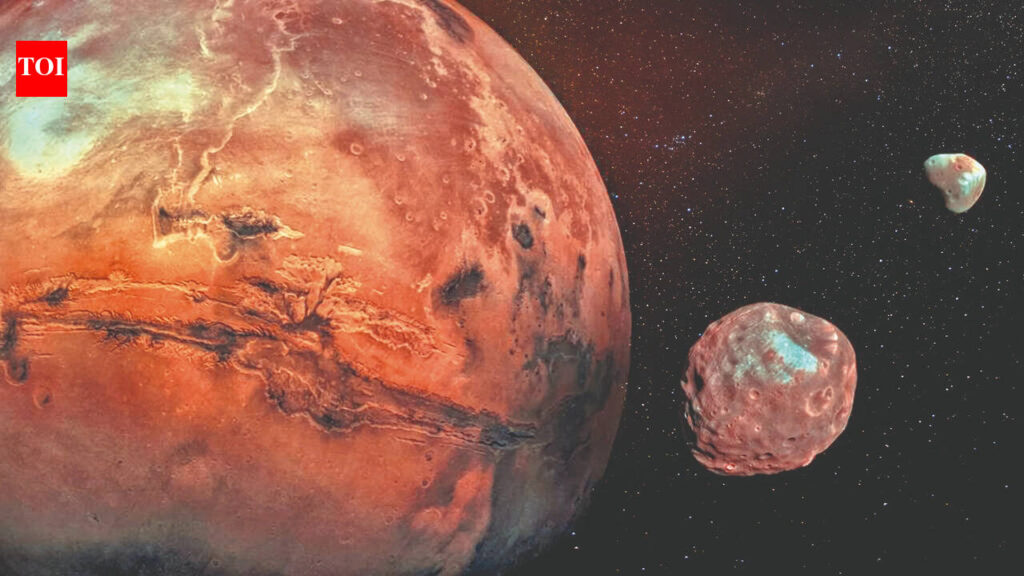
A Japanese space mission is set to lift off on October 20 with an ambitious goal: collect a sample from Phobos, one of Mars’ two moons, and bring it back to Earth for detailed scientific analysis.If successful, the mission will mark the first time material from Mars or either of its moons has been brought back to Earth.Led by the Japan Aerospace Exploration Agency (JAXA), the Mars Moons Exploration (MMX) mission is expected to reach the Martian neighbourhood in August 2027. Scientists hope the mission will help resolve a long-standing question about the origins of Phobos and Deimos.The MMX spacecraft will study Deimos while travelling through the Martian system before turning its attention to Phobos. The mission will deploy a small rover to survey the moon’s rocky terrain and help identify a suitable landing site for the main spacecraft.“No one has ever landed a rover on such a small moon,” Russell said, explaining that the competing gravitational influences make it difficult to place a rover safely on the surface.After the rover surveys the terrain, the spacecraft will descend onto Phobos and use a robotic arm and two sampling devices to collect material from the surface.The mission aims to gather approximately 10 grams of moon dust. The material will be sealed in a capsule and transported back to Earth, with the return scheduled for 2031. The capsule is expected to land in South Australia’s Woomera region.How did Mars get its moons?One of the mission’s primary objectives is to determine how Phobos and Deimos formed. Scientists are currently considering two leading explanations.According to the first theory, a large object struck Mars billions of years ago, scattering debris into space that eventually formed the two moons. The alternative explanation suggests that Phobos and Deimos were asteroids travelling through the Solar System before Mars captured them through its gravitational pull.Researchers expect the returned material’s chemical and mineral composition to help distinguish between the two possibilities.“When we get the sample back, we’ll be able to look in detail at its chemistry and its mineral composition – and the two hypotheses will produce very distinct results,” Russell said.Scientists have long sought to study samples collected directly from Mars and its surroundings, as laboratory analysis can reveal details that spacecraft instruments may not be able to establish conclusively.The MMX spacecraft is scheduled to launch from Japan’s Tanegashima Space Center at 4:41 am local time on October 20.