Scientists develop an advanced whole-Earth simulation to understand how planets evolve without life and help astronomers identify distant worlds whose atmospheres could reveal signs of extraterrestrial life
Scientists searching for life beyond Earth have developed a new way to understand what makes a planet appear suitable for living organisms. Researchers at the University of Washington have created a detailed computer simulation of Earth that tracks how chemicals move between the planet’s core, mantle, crust, surface and atmosphere over billions of years. The model deliberately excludes life, allowing scientists to examine how a planet’s environment could develop through natural geological and atmospheric processes alone.The research was published on September 18, 2026, in The Planetary Science Journal. The paper, titled A Whole-planet Model of the Earth without Life for Terrestrial Exoplanet Studies, describes how the simulation tracks Earth’s geochemical evolution without biological influences. Separately, the University of Washington announced the research on November 2, explaining how the model could help astronomers distinguish between planets that have conditions suitable for life and those that actually contain living organisms.
Why scientists created a virtual Earth without life
The search for extraterrestrial life involves more than identifying planets that have temperatures suitable for liquid water. Scientists also need to understand whether the gases detected in a planet’s atmosphere could have formed without the presence of living organisms. Earth provides an important example. Its atmosphere contains oxygen and methane, two gases that react with each other through atmospheric chemical processes. However, biological processes, including photosynthesis and methane production by microorganisms, continually replenish these gases. Their continued presence together may therefore provide clues that biological activity is influencing the planet’s atmosphere.But not every atmospheric feature that appears unusual necessarily indicates biological activity. Geological processes, heat from a planet’s interior and radiation from its host star can also influence atmospheric composition. Scientists need a reliable picture of how these non-biological processes work before they can confidently identify possible signs of life. To address this challenge, the University of Washington researchers developed a virtual version of Earth with one major difference: it has no life. The simulation provides a baseline for understanding how the planet’s different systems could evolve without biological activity changing them.
How the whole-Earth simulation works
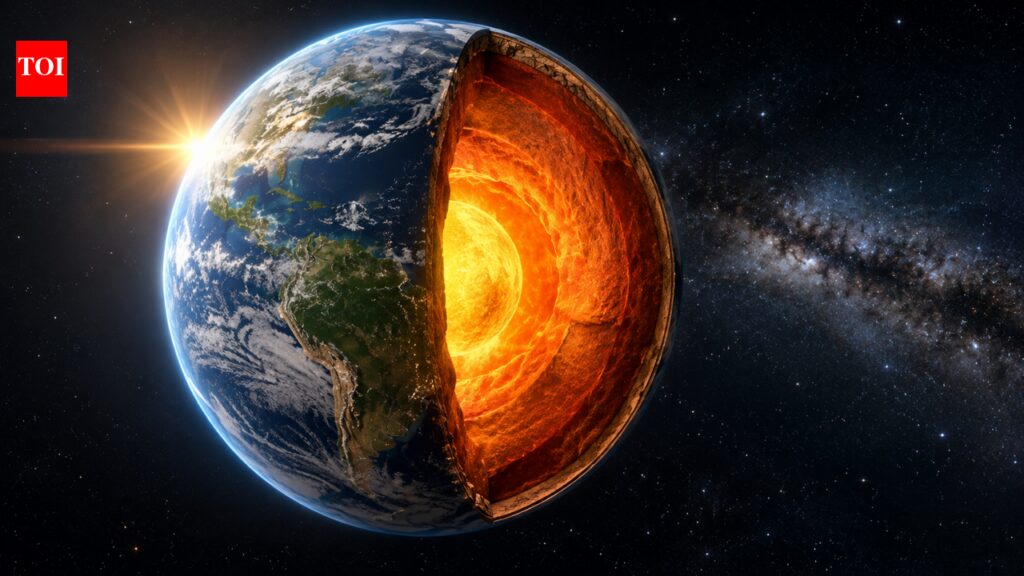
The researchers modelled the movement and exchange of chemicals across five interconnected parts of the planet: its core, mantle, crust, surface and atmosphere. These systems influence one another over geological timescales, affecting the planet’s temperature, chemical composition and environmental conditions.The simulation covered approximately five billion years of planetary evolution. It began with Earth’s formation around 4.5 billion years ago and extended roughly 500 million years into the future. By modelling this long period, the researchers aimed to understand how Earth’s physical and chemical properties could change without the influence of life.According to the University of Washington’s announcement, the model reproduced 19 key observations of pre-industrial Earth within estimated measurement uncertainties, including heat flow through the mantle. This helped researchers establish that the simulation could represent important features of Earth’s geological systems while excluding biological influences. The work also builds on an earlier model developed in the laboratory of senior author Rory Barnes, an associate professor of astronomy at the university. Previous versions included the planet’s core, mantle, crust and radiation from its star, but did not fully account for its surface and atmosphere. Gilbert-Janizek expanded the model to include these additional systems, creating a more complete representation of the planet.The findings also suggest that life may not be necessary to maintain habitable surface conditions over long periods. This indicates that a planet could remain suitable for life even without biological activity, an important distinction in the search for inhabited worlds.
How the model could help identify life on other planets
The researchers believe the simulation could become a useful tool for studying rocky planets outside our solar system, commonly known as exoplanets. Astronomers have identified thousands of these distant worlds, and some have atmospheric conditions that make them interesting candidates in the search for life. Using the new model, scientists can enter basic information about an exoplanet and simulate how its atmosphere might develop without biological activity. They can then compare the predicted atmospheric composition with observations collected by telescopes.If the model successfully reproduces the observed atmosphere without life, the detected gases may have a non-biological explanation. However, if scientists cannot explain the atmospheric conditions through geological and other natural processes, the planet could become a more interesting candidate for further investigation. Lead author Samantha Gilbert-Janizek explained that the model could help researchers understand how non-living but habitable planets might resemble worlds containing life. Senior author Barnes also described the work as an important step towards developing more reliable simulations of distant planets.
A step towards future space telescopes
The research could also support the development of future instruments designed to investigate planets beyond our solar system. The University of Washington researchers said their model could help inform the design of such future telescopes by improving scientists’ understanding of the atmospheric signals they should investigate.The study does not identify a planet containing extraterrestrial life, nor does it confirm that life exists elsewhere in the universe. Instead, it provides a scientific reference for separating natural planetary processes from possible biological influences. As astronomers continue discovering distant worlds, understanding how a planet can develop without life may become just as important as identifying the conditions that allow living organisms to survive.