INS Vikrant gets a French touch: What changed aboard India's aircraft carrier for Rafale M
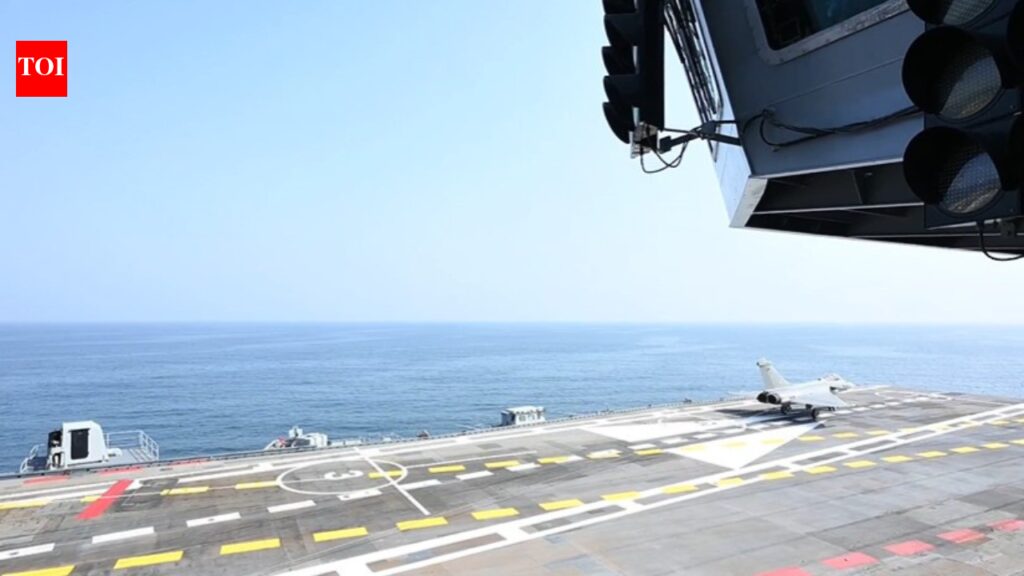
The Indian Navy‘s INS Vikrant, the first aircraft carrier built domestically, has undergone some changes as the ship prepares to induct the Rafale M. The first of the 26 naval variants of the fighter is scheduled to be inducted in the navy from 2028 onwards. Recently, the Rafale made its first landing on the INS Vikrant. Changes were made to the flight deck of the 45,000 tonnes ship, the largest of any warship made in India, ahead of the maiden landing of the aircraft on the sailing airbase. The Indian Navy has made a triangle landing aid on the ship, similar to the one found on the French aircraft carrier Charles de Gaulle.
Why a carrier landing is so unforgiving
A land runway runs to thousands of feet. A carrier’s landing area is a fraction of that, and it sits on a deck that pitches and rolls with the sea. The jet comes in at roughly 240 kmph, and its tailhook has to catch one of the four arresting wires, which stops the aircraft in about one to two seconds. Pilots go to full power the moment the wheels touch down, so that if the hook misses the wires, a case known as a bolter, they can take off again and go around. Many of these landings are conducted at night or in poor weather, with pilots relying on the optical landing system and the landing signals officer who guides the pilot to stay on the right flight slope. The triangle marking is a supplementary visual reference for judging the approach and does not replace the optical landing system.The optical landing system is a key visual aide which guides the pilots on the prescribed glide path for the aircraft on to the desired touch point on the carrier. Th system projects light in such a manner that the pilot will only see the correct pattern of lights in the desired glide slope. Th lights will look improperly aligned if the aircraft is approaching either too shallow or too high, the system also provides visual cues for both these situations.
What the first landing showed
The Rafale M landed on Vikrant on October 29, at the first attempt, a week after trials began at the shore-based test facility at INS Hansa in Goa, which recreates a carrier’s ski-jump and arresting wires. It is part of a first flight campaign, and a second is planned next year.The jet was designed for the French carrier Charles de Gaulle, which launches aircraft with catapults. Vikrant has no catapult and uses a ski-jump for take-off, with arrested recovery for landing. The Rafale M’s non-folding wings, about 10.9 metres across, also make movement between the deck, lifts and hangar harder, and work is under way to modify the lifts.India ordered 26 Rafale M jets for about Rs 63,000 crore in April 2025, with deliveries due from late 2028. The landing shows the ship and the aircraft can work together, but deck handling, maintenance and weapons integration still have to be proven before the jets are ready for operations.