Woman visited bank to access locker, but found it surrendered without knowledge despite rent payments; commission orders bank to pay Rs 47 lakh for missing jewellery, 6% interest and Rs 3.5 lakh costs
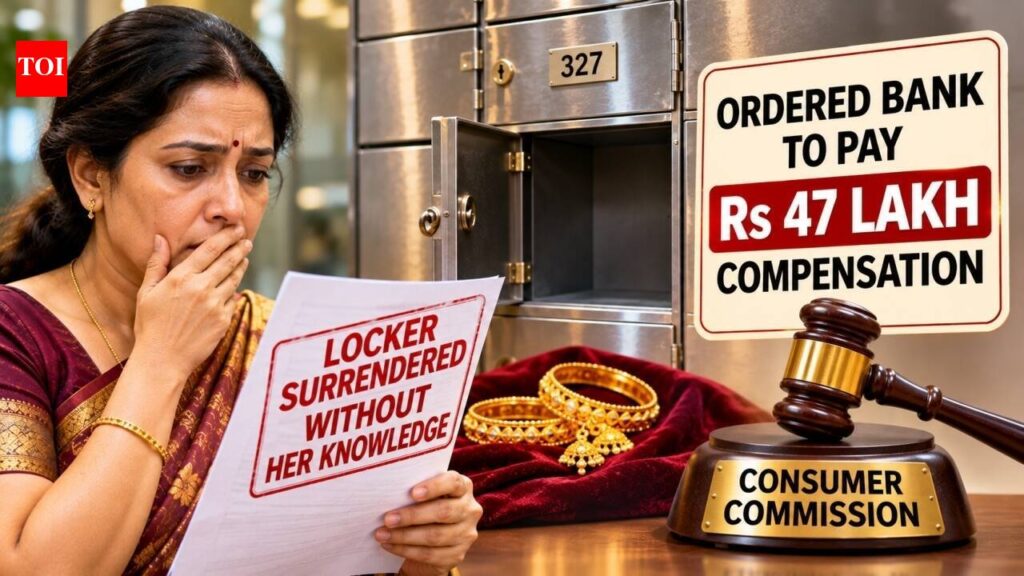

Can your bank locker be surrendered without you being aware? And is the bank liable then for items you claim were in the locker that was surrendered without your knowledge?In one such case, a woman who tried to access a joint locker was told by the concerned bank that the locker had already been surrendered.Now, the Delhi State Consumer Disputes Redressal Commission has directed the bank to pay her compensation for the jewellery she said was missing, along with interest, and mental agony and harassment, and litigation costs.The commission found that the bank had failed to produce records establishing that the locker had been properly surrendered or that its contents had been returned. It rejected the bank’s claim that the locker had been surrendered several years ago, noting that locker rent continued to be debited even years later.
What the case is about
A woman held a joint locker with her father-in-law at a bank in Delhi. According to the complaint, the locker arrangement dated back to 1998. Her father-in-law, who operated the locker in 2005, died on August 29, 2010.On September 1, 2018, the woman approached the bank to access the locker. She alleged that the bank informed her it had been surrendered on January 22, 2015. She maintained that she had never requested its surrender and had received no notice that the locker had been closed or allotted to another customer.The woman claimed that jewellery worth approximately Rs 47 lakh was missing from the locker. Alleging deficiency in banking services, she filed a consumer complaint in 2019, seeking the value of the jewellery with interest, compensation for mental agony and litigation expenses.The bank disputed her allegations. In its written statement, it claimed that the locker had been surrendered on May 21, 2005. It described the continued deduction of locker rent as a bona fide mistake and argued that it accepted only empty lockers when customers surrendered them. It also challenged the commission’s jurisdiction and maintained that the complaint was time-barred.
Why the commission ruled in favour of locker holder
The commission first rejected the bank’s jurisdictional objections. It noted that the woman had claimed Rs 48 lakh in total compensation, bringing the complaint within its pecuniary jurisdiction under the Consumer Protection Act, 1986. The bank’s Naraina Vihar branch was in Delhi, giving the commission territorial jurisdiction as well.On the main dispute, the commission examined the bank records showing that locker rent continued to be debited from the woman’s account, including on September 25, 2018. It found that the bank had not produced a receipt establishing the locker’s surrender.The commission observed: “Even if the mistake on the part of the Opposite Party Bank was Bonafide, the Opposite Party has also failed to place on record any receipt of surrender of the locker in question”.It also found no evidence that the woman had communicated a request to surrender the locker. Nor had the bank produced a receipt showing that the jewellery or other contents had been handed over when it claimed the locker was closed.As the order states: “Further, there is no receipt of the items in the locker of the Complainant and her deceased father-in-law provided by the Opposite Party at the time of the alleged surrender of the said locker”.On that basis, the commission rejected the bank’s contention that the locker had been surrendered on May 21, 2005. It concluded that the bank had failed to establish that the woman had surrendered the locker or received its contents back. The commission held that “the belongings of the Complainant were misappropriated by the Opposite Party”.The commission directed the bank to pay Rs 47 lakh, with simple interest at 6% per annum calculated from September 1, 2018, to October 27, 2026, provided payment was made by December 27, 2026. If the bank failed to pay by that deadline, the amount would carry interest at 9% per annum from September 1, 2018, until realisation.The bank was also directed to pay Rs 3 lakh for mental agony and harassment and Rs 50,000 towards litigation costs.According to Amitraj Kaushal, Advocate at Supreme Court of India, the RBI’s directions on safe deposit lockers lay down a prescribed procedure that banks must follow, including giving prior notice before terminating a locker agreement or opening a locker.Surrendering a locker is generally a formal process involving both the bank and the customer. It ordinarily requires a written request from the customer, along with the return of the locker key and an acknowledgement of the handover.“Silence from the customer is not consent. A surrender done without informing you can be challenged as deficiency in service,” he told ET.“Rent was still being debited from her account which shows the locker was live in the bank records. The Commission treated this as deficiency in service and held that the jewellery had been misappropriated by the bank,” explained Amritraj Kaushal.
What documents should you preserve for your bank locker?
Keeping records of financial transactions and important agreements is essential, and a bank locker is no exception. Kaushal advised customers to retain their locker agreement and all receipts for rent payments.“Bank statements showing the rent debits were relied on by the Commission in this case so save them too.”Customers should also make it a point to visit their lockers at least once a year and maintain a record of each visit. Before placing valuables inside, they should take photographs bearing the date and keep purchase invoices or valuation documents at home rather than storing them in the locker.If a joint locker holder dies, the bank should be informed in writing and the necessary formalities completed promptly. Similarly, anyone surrendering a locker should obtain a surrender receipt signed by the bank, ensure that it mentions the date and subsequently verify that locker rent is no longer being deducted.