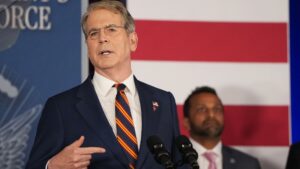
Bessent moved to military base amid 'growing threats' from Iran

U.S. Treasury Secretary Scott Bessent has moved from his Washington home to a military base for his safety amid growing Iranian threats against him.
Bessent’s move, first reported by The New York Times and confirmed to CNBC by a person familiar with the situation, came as the U.S. war against Iran remains locked in an uneasy stalemate punctuated by intermittent fighting.
Concerns about Bessent’s security were heightened after The Wall Street Journal “published an article featuring an online photo that allowed the location of the secretary’s Georgetown home to be geo-located,” the person told CNBC on condition of anonymity to discuss the nonpublicized move.
The Journal published an aerial view of Bessent’s $12.5 million Georgetown mansion in late January 2025, shortly after he bought it.
Those security concerns have forced Bessent “to relocate to a military base for his safety,” the person said, admonishing the news media to “act responsibly amid growing threats against public officials.”
Wall Street Journal publisher Dow Jones did not immediately respond to CNBC’s request for comment on the person’s statement.
The Times reported that U.S. officials have recently seen Iran’s plots against American targets reach a more advanced stage and that Bessent’s leading role in the ongoing U.S.-Iran war has made him a top target.
Bessent has led Operation Economic Outcast, a Treasury campaign launched in August to isolate Iran economically through sanctions and other financial measures, in addition to the U.S. military actions.
A Treasury Department spokesperson told CNBC that Bessent “will not be deterred by the Iranian regime’s threats.”
The Cabinet secretary “remains committed to executing Operation Economic Outcast and maintaining the blockade, which together are collapsing Iran’s economy,” the spokesperson added.
Bessent’s move comes as the Department of Justice said late Tuesday that three Iranian nationals had been indicted on terrorism-related charges.
The department said the three were allegedly involved in nearly 20 attacks and attempted attacks across Europe and the United States.
The alleged plots included an attack in September targeting the British Royal Air Force Base in Fairford, England, where U.S. military personnel were stationed.
“Anyone who plans a terrorist plot on a military base housing American service members will be prosecuted by the United States government,” Attorney General Todd Blanche said.
Earlier in October, British Prime Minister Andy Burnham said Iran was involved in the incident at RAF Fairford that led to the arrest of five men on suspicion of explosives and terrorism offenses.
Iranian Foreign Minister Abbas Araghchi then rejected the allegation, writing on X that Burnham was “barking up the wrong tree.”
RAF Fairford, in Gloucestershire, is a key U.S. Air Force operating location in Europe and has supported deployments of American strategic bombers and other aircraft.
The Journal reported Monday that the U.S. evacuated its aircraft from another RAF base in England following a threat from Iran.
Stalled negotiations
Separately, Secretary of State Marco Rubio reportedly said military action against Iran may not be necessary if economic sanctions and Washington’s naval blockade are working.
On Monday, President Donald Trump said on Truth Social that “Qatar, Saudi Arabia, UAE, Bahrain, Kuwait, and others, would prefer the status quo, in other words, a continuation of the Greatest Naval Blockade in History.”
“We are seeing positive momentum toward an end to this Conflict,” Trump added.
Asked Tuesday why he would not simply declare an end to the Iran war, Trump said he wanted to ensure that U.S. allies in the region were “not hurt” and that there was a “long-term solution.
However, Iranian officials have denied that negotiations are underway. Security chief Mohsen Rezaei said claims that talks were continuing were aimed at “easing economic pressures and reducing oil prices.”
Brent and West Texas Intermediate crude prices edged higher during Wednesday’s Asia trading session, at about $92 and $86 per barrel, respectively.