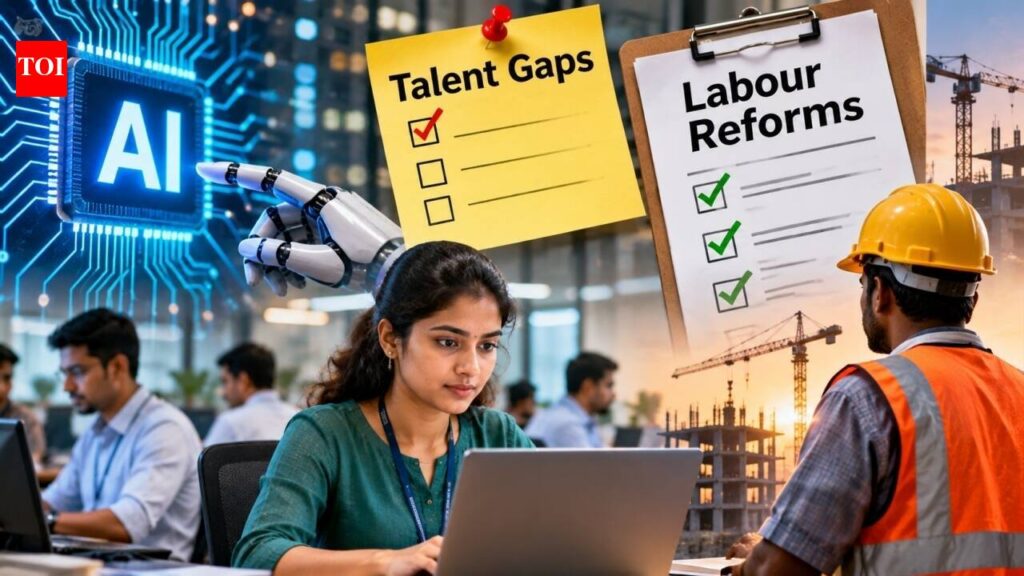
AI, talent gaps and labour reforms: Forces redefining India's employment landscape
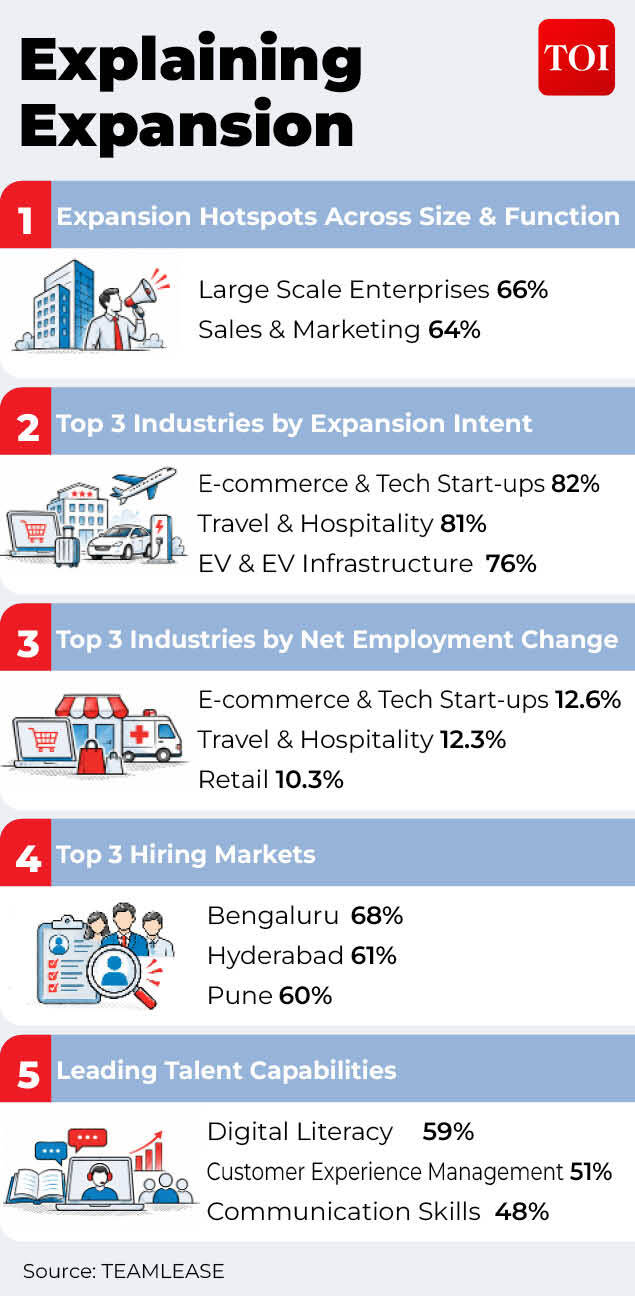
By Balasubramaniam AIndia’s employment landscape is undergoing a fundamental shift. The conversation is no longer limited to how many jobs the economy can create. It is increasingly about the nature of these jobs, the skills they demand, the security they offer and how prepared India’s workforce is to participate in this changing world of work.Three forces are driving this transition: the rapid adoption of Artificial Intelligence (AI), an expanding gap between the skills employers need and those available in the workforce, and the implementation of new labour codes. Together, they are changing not just how organisations hire, but also how people work, earn and build their careers.The latest TeamLease Employment Outlook Report for HY2 FY 2026-27 offers some interesting insights into this transition. Based on a survey of 1,239 businesses across 23 industries and 20 cities, the report projects a Net Employment Change of 5.4%, up from 4.7% in HY1 FY 2026-27. While 60% of employers plan to expand their workforce, compared with 58% in the previous half-year, the nature of this expansion is becoming increasingly selective.For employees, this means that opportunities are growing, but the expectations attached to them are changing.
Explaining Expansion
AI is expanding the possibilities of work
Artificial Intelligence is opening up new possibilities across India’s employment landscape. From improving operational efficiency and enabling better decision-making to changing how routine tasks are performed, AI is influencing how people contribute to business outcomes. As organisations integrate AI into their workflows, employees are increasingly expected to work alongside these tools, adapt to changing processes and develop capabilities that complement automation.The Employment Outlook Report highlights that 85% of employers report some workforce use of AI or Generative AI tools. However, only 13% report adoption across more than half their workforce, while 54% restrict usage to a quarter of employees or fewer. The most common adoption level is between 11% and 25% of the workforce, indicating that AI deployment remains largely concentrated within specific functions rather than being embedded across entire organisations.For employees, this points to a transition that is still taking shape. AI is increasingly being layered onto existing roles rather than fundamentally changing every job. Applications such as routing and scheduling in logistics, assisted diagnostics in service networks and query handling in customer operations illustrate how technology can support everyday responsibilities.The opportunity lies in ensuring that employees are equipped to work effectively with these tools. As AI adoption deepens, organisations will need to focus not just on technology deployment but also on helping their workforce understand, adopt and use these capabilities responsibly.
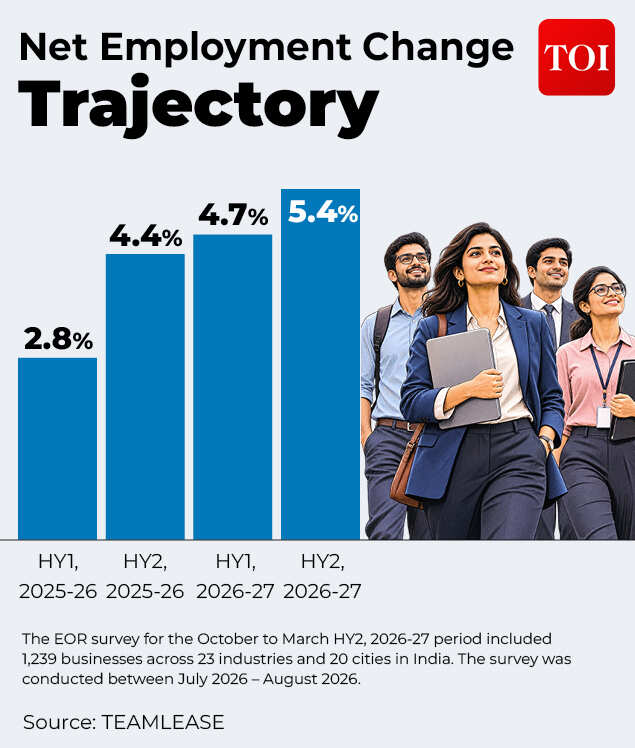
Net Employment Change Trajectory
The real employment challenge is the skills gap
One of the biggest challenges facing India’s labour market is the growing disconnect between available talent and the capabilities employers require.The report identifies digital literacy as the most sought-after workforce competency, with 59% of employers identifying it as a priority. Customer experience management follows at 51%, while communication skills stand at 48%. Teamwork and collaboration and adaptability both feature at 44%.What is particularly interesting is that these are not skills limited to technology professionals. Digital literacy is increasingly becoming a baseline requirement across blue-collar and white-collar roles alike. A warehouse worker may need to navigate digital inventory systems, while a retail employee must increasingly work with digital payment, reporting and customer engagement platforms.
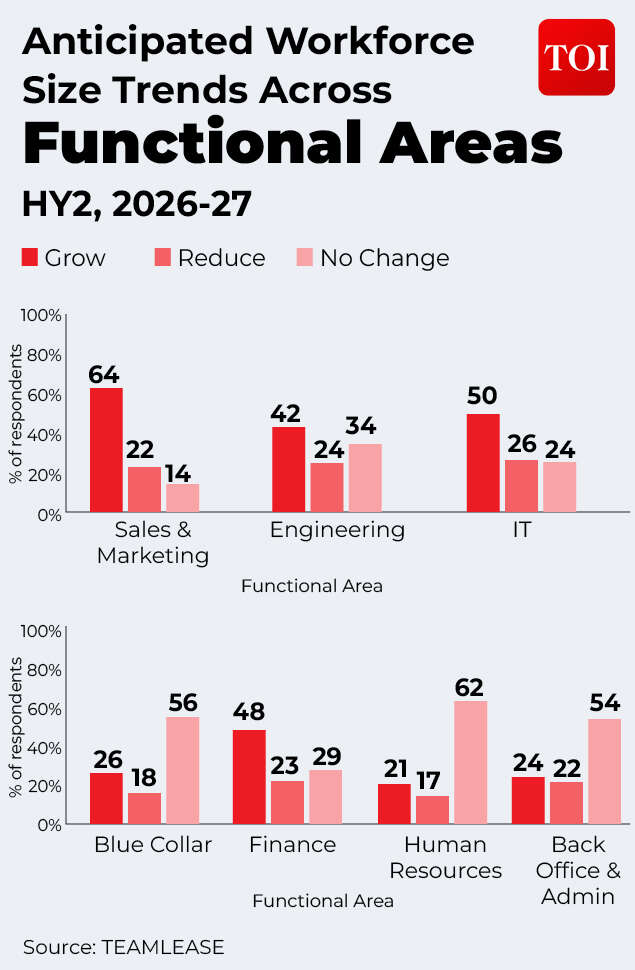
Anticipated Workforce Size Trends Across Functional Areas
This tells us something important about the future of employability. Being skilled will no longer mean simply being proficient in one particular trade or function. It will mean having the ability to combine domain knowledge with digital fluency, communication and adaptability.However, the challenge extends beyond identifying the skills required. The report finds that 72% of employers planning workforce expansion anticipate significant or moderate difficulty in achieving their hiring numbers. The challenge is particularly visible in IT, where 39% of employers report hiring difficulty, followed by Sales and Marketing at 38%, Engineering at 32% and blue-collar roles at 31%. Among employers anticipating hiring difficulty, IT roles are the most commonly cited at 39%, followed by Sales and Marketing at 38%, Engineering at 32% and blue-collar roles at 31%.This highlights an important disconnect: while employment opportunities are growing, finding people with the right capabilities remains a significant challenge.The opportunity for India lies in its demographic scale. However, a large workforce alone does not guarantee a competitive advantage. We need to invest in continuous skilling, accessible vocational education, apprenticeships and industry-aligned training.Equally important is making reskilling accessible to people already in employment. A worker should not have to wait until their role becomes redundant to acquire new skills. Employers, educational institutions and skilling ecosystems must create pathways that allow people to transition into emerging opportunities without disrupting their livelihoods.The emphasis must shift from training people for their first job to preparing them for multiple career transitions over their working lives.
Labour reforms must translate into better outcomes for workers
The third force shaping India’s employment landscape is labour reform. The four new Labour Codes, which came into effect on 21 November 2025, consolidate 29 central labour laws and represent an important step towards simplifying India’s employment framework, strengthening formalisation and bringing greater consistency to employment practices.However, the impact of these reforms will ultimately be measured by how they change the experience of workers.The TeamLease report indicates that 39% of employers identify increased compliance and payroll administration effort as the leading impact of the Labour Codes. This is followed by higher employer statutory contribution costs, reported by 35% of employers. Further, 28% anticipate moderation in salary increments due to higher employment costs, while an equal proportion foresee a possible reduction in employee take-home pay due to salary restructuring.These changes have direct implications for employees. A restructuring of salary components can influence the relationship between take-home pay and long-term social security contributions. Where existing salary structures have a lower basic pay component and higher allowances, aligning compensation with the statutory wage definition may increase the base for contributions.This is where transparency becomes critical. Employers must communicate compensation changes clearly, helping employees understand not just what their salary structure looks like, but also what it means for their monthly earnings and financial security over time.The reforms also bring an opportunity to strengthen formal employment practices, improve compliance and extend greater protection to workers. For India’s large workforce, including those in contractual and emerging employment arrangements, the focus must be on making formalisation meaningful.The growth of gig and platform-based work makes this particularly relevant. With more people participating in flexible and technology-enabled employment models, the conversation around social security, worker protection and access to benefits must evolve alongside the nature of work itself.
The future of work must be built around people
India’s employment outlook is encouraging. The report shows that hiring momentum is strongest in digital-first and consumer-facing sectors, with e-commerce and technology start-ups projecting strengthening across sectors, with e-commerce and technology start-ups recording a Net Employment Change of 12.6%, Travel and Hospitality 12.3%, and Retail 10.3%. Automotive and EV and EV Infrastructure are also witnessing strong hiring momentum, with Net Employment Changes of 10.1% and 9.7%, respectively.But the larger opportunity is not simply to create more jobs. It is to create an employment ecosystem where people can access opportunities, develop relevant skills, earn fairly and build sustainable careers.This requires a collective effort. Employers must invest in their workforce beyond immediate hiring requirements. Governments must ensure that policy reforms translate into meaningful worker protection. Educational institutions must align learning with the changing demands of industry. And employees must be encouraged and supported to embrace lifelong learning.We must also ensure that the benefits of this transition are not concentrated in a few sectors or metropolitan centres. Emerging industrial hubs, Tier-2 cities and digitally connected smaller markets can play a significant role in distributing employment opportunities more widely.Ultimately, AI will change how we work, skill gaps will determine who can participate in emerging opportunities, and labour reforms will influence the quality and security of employment. These forces are interconnected, and addressing them in isolation will not be enough.India stands at an important moment in its workforce evolution. Our demographic advantage will deliver its full potential only when people have the skills, opportunities and protections needed to succeed. The future of employment should not just be about building a more productive workforce. It should be about building a more empowered one.(The author is Senior Vice President, TeamLease Services)