In 1843, an Ohio couple gave 2.63 acres for 10 cents on condition it remain a public square; 183 years later, a court left the restriction enforceable as developers seek access through part of it
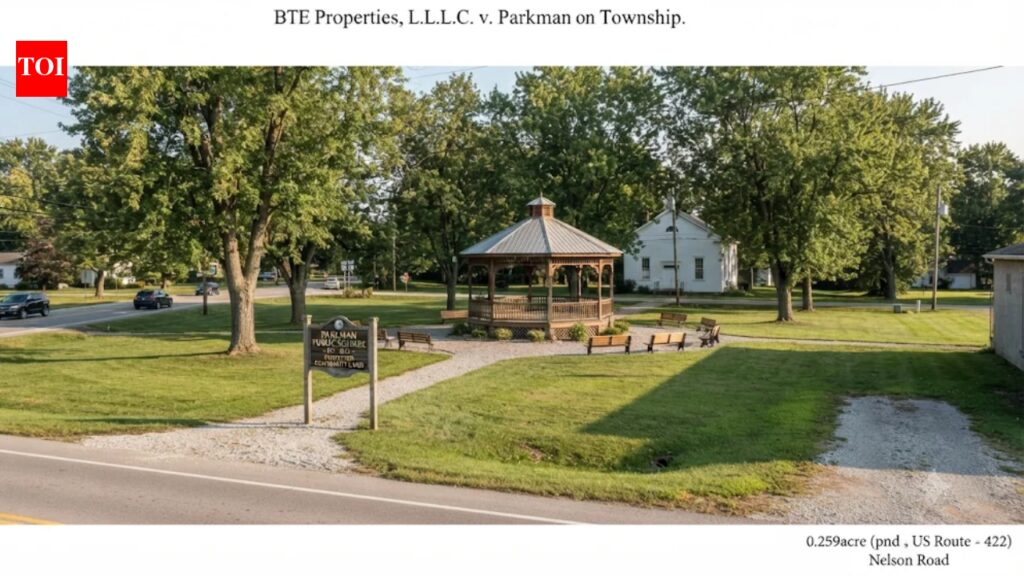
An Ohio court has upheld a land-use rule from 1843, keeping a piece of town land safe as a public square more than 180 years after a couple sold it to a local township for just 10 cents. On 16 November 2026, the Ohio Court of Appeals for the Eleventh District ruled that the rule on the land is still valid and can be enforced, even after developers tried to fight it in court. The case focuses on 2.63 acres given by Simon and Nancy Perkins to Parkman Township, Ohio, on the condition that local people could use it as a public square or open green space.The ruling also turned down an appeal from A.L.L., Inc., a nearby property owner that wanted to join the legal battle to protect the land. The appeals judges agreed that Parkman Township was already speaking up for the same things A.L.L. wanted to protect. According to the court ruling published by Justia, the case involved BTE Properties, L.L.C., ABC Development, L.L.C., A.L.L., Inc. and Parkman Township. Judge John J. Eklund wrote the decision, and Presiding Judge Matt Lynch and Judge Scott Lynch agreed with it. The appeals court backed the earlier ruling of the Geauga County Court of Common Pleas, which had kept the rule in place and rejected the developers’ effort to have it thrown out.
A 10-cent land deal dating back to 1843
The fight started with a land deal on 7 June 1843, when Simon and Nancy Perkins gave 2.63 acres at the corner of Nelson Road and US Route 422 to Parkman Township. The deed was officially recorded on 8 June 1857. It noted that the couple was paid 10 cents by the people living in the township. They also chose to give up the land because they wanted to help the local community grow and do well.The deed set a strict rule on how the land could be used. It told the township leaders and those who came after them to hold the land in trust for local residents and visitors from outside Ohio, so it could be used as a public square or open area. The paper also banned buildings and other structures on the ground, allowing only railings along a public footpath.According to the Eleventh District Court of Appeals, the land has been used as a town park ever since the deal. A bandstand went up there in 1887, and a gazebo stands in that spot today. Benches and walking paths are also on the site. Because of this, the old rule stayed at the heart of the fight more than 180 years after the Perkins family gave up the land.
Developers seek access through part of the land
The court fight picked up speed when BTE Properties tried to buy a 0.2596-acre piece of the original Perkins land. The firm wanted to use this strip to reach a nearby piece of land that had no other road access. According to court papers, a driveway had been on that smaller strip for an unknown amount of time. On 22 January 2018, Parkman Township signed over the smaller piece of land to BTE. However, the 2018 deed pointed straight back to the old rule recorded in 1857. It said the land was still bound by all past easements, limits and rules. It also repeated the condition that the ground must stay a public square or open space with no buildings or structures, except for railings along a public path. BTE part-owner John Yoder admitted he knew about the rule written in the deed.Later, BTE joined nearby plots together to form a business lot measuring 2.6298 acres, which took in the smaller strip of the Perkins land. On 12 December 2023, ABC Development agreed to buy land from BTE that included this disputed strip. However, the old deed rule caused a problem with the property’s legal title. Seeing this issue, BTE and ABC changed their sales contract on 1 March 2024. They made the sale depend on fixing the title problem first. On 16 April 2024, the two firms filed a lawsuit in the Geauga County Court of Common Pleas. They asked the judge to rule that the 1843 condition was no longer valid and could not be enforced. Their lawsuit named Parkman Township, through its leaders, and any unknown heirs of Simon and Nancy Perkins as the other side.
Neighbouring property owner joins the legal fight
Another group stepped into the case in May 2024. On 22 May, A.L.L., Inc. asked the court for permission to join the lawsuit. The company owned land right across the street, north of the Perkins lot. A.L.L. said it had a strong stake in keeping the rule alive. It wanted the park to stay clear of buildings and other structures, just as the 1843 deal promised. ABC Development objected to the request, while BTE did not file any protest. On 12 June 2024, the trial judge first let A.L.L. enter the case. The company then filed its own legal claim, asking for a court order to stop anyone from breaking the rule and a ruling confirming that the condition was still active.Parkman Township filed its official reply on 3 July 2024. The other sides also answered A.L.L.’s claim, and the lawsuit moved into the stage where both sides gather facts. Parkman Township and A.L.L. each asked the judge to rule in their favour without a full trial, and BTE and ABC filed a joint request for the same thing. On 17 February 2026, the trial judge handed down a decision. The court ruled that A.L.L. could not stay in the lawsuit as an outside party because its property did not directly border the land at the centre of the fight. Still, the judge also turned down BTE and ABC’s request and ruled in favour of Parkman Township. The court declared that the rule written in the 2018 deed was valid, stayed attached to the land and could be enforced against BTE, ABC and any future buyers who knew, or should have known, about it. A.L.L. challenged that decision in the Eleventh District Court of Appeals.
Appeals court explains why the restriction stands
A.L.L.’s appeal centred on one key point. It claimed the trial judge was wrong to remove it from the case just because its land did not directly touch the disputed strip. The company argued that owning property right across the street gave it a clear stake in protecting the public square rule. The appeals judges looked at the state rules that decide when a person or group can join an ongoing lawsuit. Under Ohio Civil Rule 24(A), an outside party has the right to step in if it has a real stake in the case, the outcome could hurt that stake, and no one already in the lawsuit is properly protecting it.The judges decided that this last test was not met. When A.L.L. first asked to join the fight, Parkman Township had not yet filed its answer to the developers’ lawsuit. At that moment, A.L.L. had a fair reason to say no one was standing up for the 1843 rule. Things changed, however, once the township filed its reply and worked actively to defend the rules on the property. The appeals court pointed out that Parkman Township went on to win a court ruling that protected the land-use rule. Because of that, the township’s actions covered the exact same goals A.L.L. wanted to defend. The judges also noted that A.L.L. never claimed the township was doing a poor job of protecting those goals. In its written ruling, the court noted that its decision applied only to the specific facts of this case. It ruled that A.L.L. had no automatic right to join the lawsuit because its interests were already well protected. As a result, the judges rejected the company’s appeal and upheld the trial court’s ruling.
Historic land-use condition remains enforceable
The 16 November 2026 ruling means the old rule stays in effect. BTE Properties and ABC Development failed to overturn the lower court’s decision that the condition is valid and enforceable. The appeals court did not look at A.L.L.’s other complaints because the company’s failure to meet the legal test to join the case was enough to settle its appeal. The court also ordered A.L.L., Inc. to pay the legal costs of the appeal. The case is listed as BTE Properties, L.L.C. v. Parkman Township, under case number 2026-G-0009, and citation 2026-Ohio-4537. The original 1843 deal stays at the heart of the matter: 2.63 acres handed over for 10 cents, on the condition that the land remain a public square for the community.