A doctor makes his Asiad debut: Kartik Karkera's unusual route to Asian Games
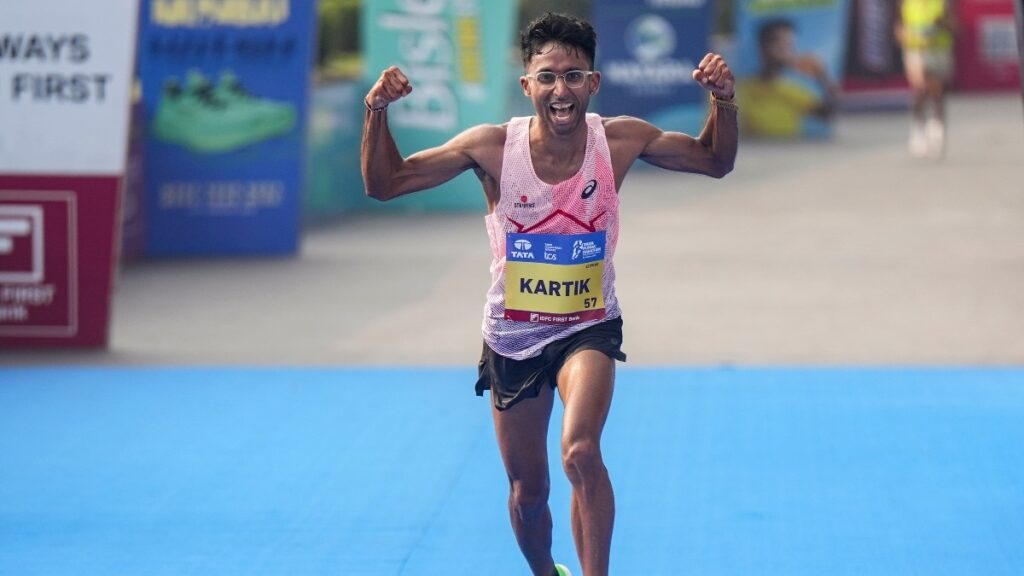
“What’s the point in hitting your personal best if you do not finish on the podium?”
Kartik Karkera was musing in his room at the SAI Hostel in New Delhi, just a day before flying to Japan for his first Asian Games. The 29-year-old is not your typical athlete who grew up dedicating his life to sport. An orthopaedic surgeon by profession, Karkera only transitioned to full-time marathon running recently.
In just two years of running the format professionally, he now holds the third-fastest time ever by an Indian, with his personal best of 2:13:10.
“I can definitely improve my times. And if I am able to do that, I should be in contention for a podium in the Asian Games,” Karkera said.
The confidence is understandable. Karkera and his compatriot Sawan Barwal were so dominant this season that they took India’s two men’s marathon spots for the upcoming Games, leaving Olympian T Gopi and former Asian champion Man Singh out of the squad.
WHO IS KARTIK KARKERA?
Born and brought up in a middle-class family in Mumbai, Kartik Karkera used to love athletics as a kid. He was fairly good as well.
But when he turned 15, he was asked to make a simple choice, one that many kids from middle-income families get: higher studies or sports?
Karkera knew which answer was expected of him. So he chose studies and eventually landed in Russia in 2016 to pursue an MBBS. He would spend the next eight years there, becoming a doctor.
He would also, unexpectedly, rediscover his love for running.
For much of his time in Russia, running remained a hobby. Then the Covid-19 pandemic arrived. His university shut down, classes moved online and Karkera suddenly had something he had rarely had before: time.
Living close to his university’s 400-metre track, he began running almost every day, sometimes covering 20 or 25 kilometres alone.
That year changed the way he looked at running.
He went on to win the Russian university 1500m title in 2021 and 2022, work with Olympic champion Yuriy Borzakovskiy and finish sixth in the Moscow Half Marathon in 2023.
But when Karkera returned to India after eight years in Russia, he was still an unknown commodity in Indian athletics.
He was working as a resident at a hospital in Nashik, balancing long shifts with marathon training and sacrificing sleep to fit in the miles. Then came the breakthrough in 2026.
He was the best Indian runner in the Tata Mumbai Marathon, finishing in 2:19:55, before winning the Delhi Marathon in a sensational 2:13:10. He beat Olympian T Gopi and former Asian champion Man Singh and, almost overnight, found himself at the front of India’s marathon conversation.
“People are calling me an overnight success. They do not see the 10 years of hard work,” Karkera had said.
Now, the doctor who once had to choose between studies and sport is preparing for the biggest race of his career.
TRAINING IN KENYA BEFORE ASIAN GAMES
Once Karkera was identified as a marathon prospect, the support followed. The Reliance Foundation athlete, who is also signed with Adidas, was flown to Kenya, where he trained alongside elite runners capable of breaking 2 hours and 6 minutes, a level no Indian marathoner has reached.
Karkera believes that his 1500m background had already given him the speed. What he needed was the ability to hold that speed over 42.195 kilometres. That was what he set out to build in Kenya.
His stint there, however, was cut short by 15 days. The Athletics Federation of India wanted the marathoner to prove his fitness in India, so he was called up for the Continental Tour Silver meet in August.
Karkera returned from Kenya and made himself available in Bhubaneswar. He ran a 5K in 15:07.49, nearly a minute off his usual pace, but it was enough for the AFI to believe that the newcomer to the national ecosystem was ready for his first Asian Games.
STINT IN SAI BENGALURU
Leaving Kenya two weeks early did not bother him either. Neither did the relatively slow 5K. A big reason was a piece of advice from long-jumper Murali Sreeshankar.
“When I came down from Kenya, I thought it would be difficult to continue training at the same level. I was considering travelling to Ooty for training but then Murali Sreeshankar advised me that I should go to SAI Bengaluru,” Kartik said.
“I am really glad that I went there. Athletes are well taken care of, my training is going well. I am able to do my miles, and they are even acclimatising us with Japanese food,” Karkera laughed.
MARATHON DOCTOR IN ASIAN GAMES
Karkera chuckled as he recalled how his father, who once asked him to choose between studies and sport, is now overjoyed to see his son represent India at the Games. He will be flying to Japan to watch Karkera make his debut for the country.
On September 26, Karkera will line up in Nagoya for the biggest race of his career, running his first Asian Games marathon for India. He knows the 42.195km will demand more than the speed that first made him believe he could be an athlete, or the endurance he went to Kenya to build.
But Karkera has spent years making sense of the distance between where he was supposed to be and where he wanted to be. At 15, he chose the safer path and left for Russia to become a doctor. Years later, it was running that brought him back to the starting line.
The challenge in Nagoya will be significant. Japan’s Ichitaka Yamashita and Yuya Yoshida are both 2:06 runners, significantly faster on paper than Karkera. But neither has run those times in Nagoya, where the heat and humidity could make the race a very different proposition.
Kartik Karkera will take them on in the wee hours of September 26 for Indian viewers. If he can handle the conditions and hold his nerve, the Marathon Doctor will not be in Japan simply to chase another personal best. He will be racing for the podium.
– Ends