Asian Games accommodation hit by delays, India ready for the challenges
With four days to go for the opening ceremony of the 2026 Asian Games in Aichi-Nagoya, India is confident that its athletes will not face any major accommodation-related problems despite some last-minute logistical challenges surrounding the Games’ unusual housing arrangements.
Sports Ministry sources said there had been delays in the allocation of some container accommodation, but stressed that the issue was not limited to the Indian contingent. Several foreign teams have also faced delays as organisers work to finalise accommodation under a model that is different from previous editions of the Asian Games.
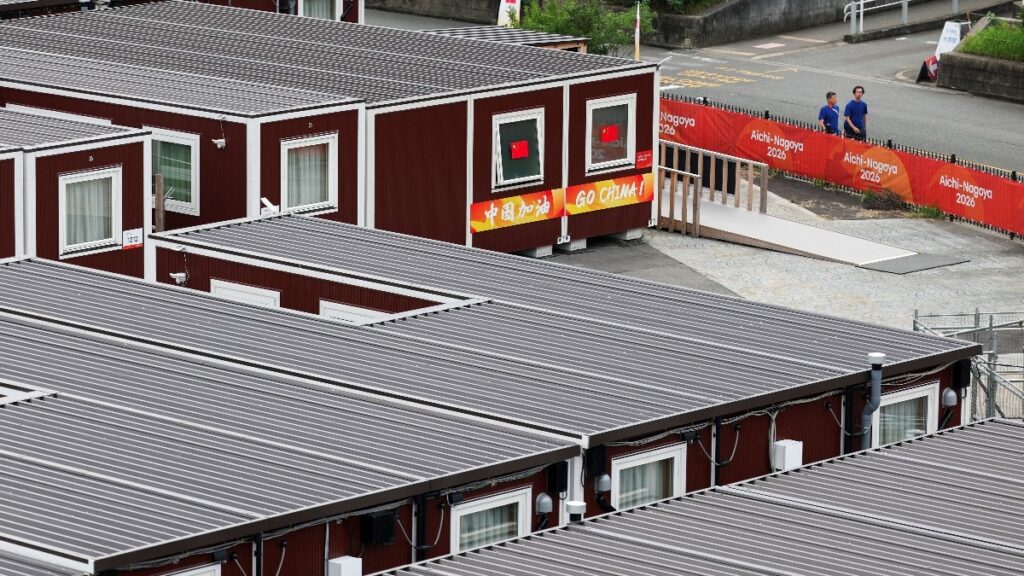
There will be no conventional Games Village in Aichi-Nagoya. Instead, athletes and support staff will be spread across hotels, a cruise ship and temporary container-style accommodation. The cruise liner is scheduled to dock at Kinjo Pier on Tuesday, four days before the September 19 opening ceremony, while container homes at Garden Pier will form another part of the accommodation set-up.
Sports Ministry sources said India’s Chef de Mission has kept the Ministry informed about the accommodation-related challenges, but there is confidence that the remaining issues will be resolved without causing major disruption to the Indian contingent.
INDIA PREPARED AND READY FOR ANY CHALLENGES
The Ministry had also prepared for the possibility of last-minute accommodation complications. Sports Ministry sources said hotel rooms were booked in advance as a contingency measure, giving India an additional option if there are delays in the allocation or movement of athletes between the different accommodation clusters.
The unusual system is partly driven by the way accommodation has been planned around competition schedules. Under the Games’ accommodation rules, rooms are provided from two days before an athlete’s event until one day after the completion of that event. This means accommodation will work on a rotation system rather than having every athlete remain in one location throughout the Games.
A number of Indian athletes have already reached Japan for acclimatisation and competition, with their respective federations taking care of their accommodation during the early-arrival period. Sports Ministry sources said the athletes who have arrived ahead of their competition schedules are being looked after properly.
The preparations in Nagoya, however, were also tested by extreme weather last week.
RECORD RAINFALL HITS NAGOYA
Record rainfall hit Nagoya on September 8, with around 104 mm of rain falling in one hour. Roads were flooded, public transport was disrupted and water entered some Games venues. Around 400 athletes and officials staying in converted shipping containers were temporarily evacuated to higher ground as a precaution. They were able to return after the evacuation order was lifted, and no injuries were reported.
The flooding also affected some of the temporary accommodation, with water entering container units, according to Sports Ministry sources. Organisers subsequently addressed the affected areas.
Despite the disruption, Nagoya mayor Ichiro Hirosawa said the situation was not serious enough to threaten the Games, while organisers continued with preparations for the September 19 opening.
For India, the unusual accommodation model is not something the athletes have encountered for the first time in Japan.
SAI HAS ITS ATHLETES PREPARED
The Sports Authority of India (SAI) had already set up container-style accommodation at its centres in Bengaluru and Patiala to give Asian Games-bound athletes an opportunity to experience the conditions they would face in Aichi-Nagoya.
The exercise was designed to make an unfamiliar environment familiar before the athletes travelled to Japan. SAI officials prepared a roster under which athletes would spend a night in the simulated accommodation, wake up there the following morning and then continue with their normal training routine.
The units were designed to replicate the kind of accommodation Indian athletes could expect in Japan. At SAI’s Bengaluru centre, the air-conditioned units include twin bedrooms, bathrooms, a small kitchen and a living area.
The simulation followed a recce of the accommodation arrangements in Japan by a Ministry-SAI team. SAI officials said the exercise was intended not merely to test the physical space but also to ensure athletes were mentally prepared for the change from the conventional Games Village model.
Two-time Asian Games champion Tajinderpal Singh Toor was among the athletes who experienced the simulation. The exercise also gave athletes an opportunity to provide feedback on the facilities and understand how they would manage their space and equipment in the more compact accommodation.
SAI Deputy Director General Vineet Kumar had said the objective was to ensure that accommodation did not become a psychological distraction for athletes once they reached Japan.
The preparations are now being put to the test as the Games enter their final days before the opening ceremony.
While accommodation allocation continues to be fine-tuned for contingents, Sports Ministry sources remain confident that India’s advance planning, including the hotel contingency and the SAI simulation exercise, will allow the athletes to focus on competition rather than logistics.
The OCA and Aichi-Nagoya Asian Games Organising Committee have also said that all more than 17,000 registered athletes and officials have been provided Games-appropriate accommodation, pushing back against reports of a broader failure to secure housing for participants.
For India, the priority now is to ensure that the unconventional accommodation model remains just that: an unusual feature of the Games, rather than a distraction from the country’s medal campaign.
– Ends