CNBC Workforce Executive Summit live updates: Can New York City lead the way in AI regulation?
Silencing your inner critic and celebrating your inner coach
Dan Harris, author, podcaster and former ABC News anchor, spoke with CNBC’s Susan Caminiti at the 2026 CNBC Workforce Executive Councill Summit in New York on October 27, 2026.
CNBC
This era of optimization and hyper-productivity may be doing more harm than good, both at work and in our personal lives.
So how do you learn to be a little kinder to yourself while still being kickass effective?
Dan Harris, author, podcaster and former ABC News anchor, said the challenges that the social media landscape, amplified by the loneliness epidemic and other factors, make listening to that inner critic very easy.
However, he said, that can be done by rewiring what he called “your talk track.”
“Learning how to rewire your inner talk track is just something you can do as you move through life. Next time you notice yourself kicking your own ass, just pause and say what you would say to a good friend,” he said.
For added emphasis, place your hand on your heart or giving yourself a hug, and use your own name when you speak to yourself, he said.
“You don’t have to be stuck with the inner dialog that you are now stuck with. You can consciously rewire it,” he said.
— Ian Thomas
The difference between a good and great leader in the AI era

As AI technology evolves, people who thrive in ambiguity and are willing to experiment are becoming increasingly attractive to companies across all industries.
That includes at the senior leadership level. Two CNBC Workforce Executive Council members — Care.com CHRO Wes Burke and The Team Managing Director Amy Segal — told CNBC’s Sharon Epperson about how their organizations have shifted their views on executive hiring in the age of AI.
Burke said more emphasis is being put on what he called the “ability to problem solve very quickly and collaborate within that,” something that his company learned from the way it had been hiring engineers.
“That now shows up in a hiring process where we give the same sort of prompts and we say, ‘Look, there’s no right or wrong answer. We’re just curious how you’re going to approach this and what you think about it,'” he said. “We do that assessment process with other employees who join them there. So it goes from the traditional, ‘Tell me about a time,’ to ‘Help me solve this problem and let’s talk about it together.'”
In Segal’s role, she is often tasked with helping find leaders for rising sports leagues or organizations that are aiming to create new revenue lines.
“People have really talked about adaptability, but I think understanding how to challenge the status quo is super important. It used to be that everyone just looked for the experiences that someone had, and that that was really enough,” she said. “While a perspective on the way things have been done before is helpful, really understanding how to use those experiences to disrupt is what’s differentiating good from great.”
— Ian Thomas
What WEC members think about the rapidly evolving workplace
We asked CNBC Workforce Executive Council members for their take on the rapidly changing workplace. Some of their answers are as follows:
What are you doing to help employees adapt to change while keeping them engaged and supported?
“I think it’s just level-setting with employees so they understand that they are the most important asset. While the tools are there and the technology is available, really centering our people and reminding them that they matter and that this helps us all overall. It really has helped to not only boost morale but drive more innovation and creativity with employees to start to lean into the tools a little bit more, recognizing that the tool is nothing without the human intelligence aspect of it. So it’s just education, lowering the barriers a little bit and creating a safe space for people to feel comfortable trying and getting things wrong.”
-Sandy Choute, J.P. Morgan
How is AI changing the way you think about skills, hiring, and career development?
“I think it’s changing a lot. First of all, we’re looking at hiring in a little bit of a different way. I think we’re trying to hire folks that have more curiosity and adaptability, because we know that they’re going to need to do a lot more learning as the tools and the technology change at this at this rapid pace … I think we’re also looking at ways that we can put more power in the hands of our employees by deploying some of these AI tools and giving them that freedom and permission to experiment, because the folks that are going to be able to solve some of these challenges are the ones that are closest to the action.”
-Mason Argiropoulos, Paychex
How is AI changing the way you think about your skills, hiring, or career development at your organization?
“We’re thinking about the future. What does the future recruit look like? We’re thinking about how do we need to attract our talent, how do we need to develop and train our talent, and ultimately, what do we need to engage and retain them? So we are considering all those factors right now as we go through this stage of technology.”
Theresa Richardson, Withum
Can New York City lead the way on responsible AI regulation?

New York City Council speaker Julie Menin is hoping New York City can provide a blueprint for other localities when it comes to regulating AI.
“The best would be for the federal government to regulate,” Menin told CNBC’s Leslie Picker. “So you have one uniform regulation, and you don’t have different regulations based on varying jurisdictions, but let’s be clear: there has been really no federal regulation of AI emanating from the federal government, and even at the state level,” she added.
Menin said that New York City has introduced 10 different bills. One of them, she said, would set up third-party validation free of conflict of interest.
“The conflict of interest part is very important because you can’t have an independent third-party test that is basically captive to the company, that is basically truly not independent,” she said.
Another bill, Menin said, would pay whistleblowers a significant amount of penalties. “If you have a swarm of 5,000 or 6,000 or 7,000 AI agents, it’s $25,000 per AI agent. So these penalties will indeed add up, and our bill gives the whistleblower a significant portion of those penalties.”
“The regulations that we are looking, the laws that we’re looking to pass here in New York, can be a national paradigm, really, for what responsible, sensible AI regulation looks like,” Menin said.
-Colleen McKown
The challenges different aged workers face in the AI era

The introduction of AI into the workplace has introduced workplace challenges for workers for all ages.
For young workers, are there still opportunities to learn from company veterans or long-held processes?
For older workers, are they able to reskill with these new tools?
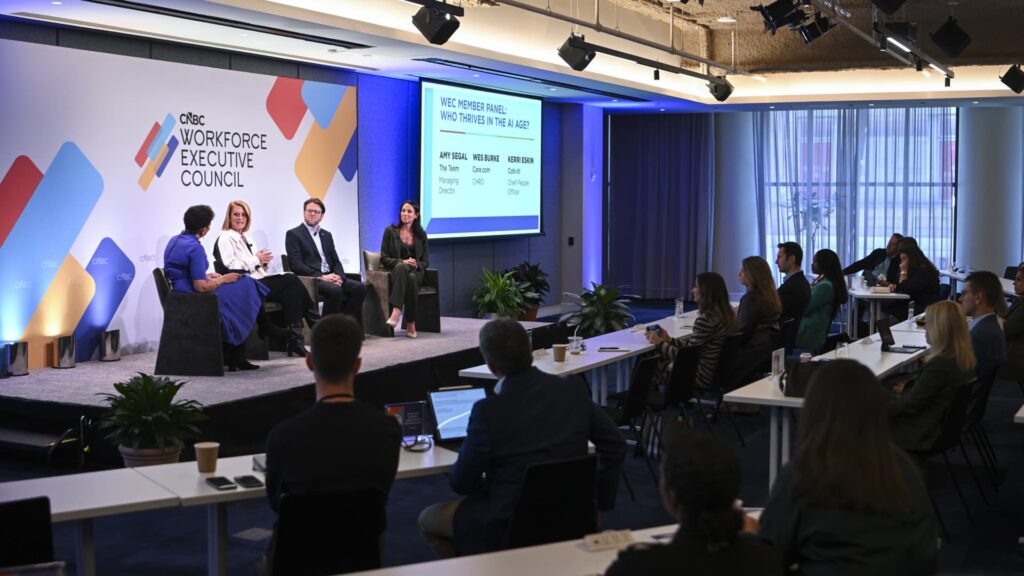
Three CNBC Workforce Executive Council members — Care.com CHRO Wes Burke, Cotiviti Chief People Officer Kerri Eskin, and The Team Managing Director Amy Segal — spoke with CNBC’s Sharon Epperson about how their organizations are ensuring workers are succeeding with AI, regardless of age or experience.
— Ian Thomas
Why a ‘human-in-the-loop’ AI strategy should be replaced by ‘human-in-the-lead’
Jill Bruning, Amentum Chief Technology Officer, speaks with CNBC’s Susan Caminiti at the 2026 CNBC Workforce Executive Council Summit in New York City on October 27, 2026.
CNBC
Amid the rise of AI, a prevailing strategy has been to keep a human in the loop, or essentially allowing human judgment, review, or intervention over any AI action.
But Jill Bruning, chief technology officer of Amentum and a member of the CNBC Technology Executive Council, said at the CNBC Workforce Executive Summit that strategy should be evolved to be humans in the lead.
“There’s an AI curve, and we see it. It’s going up and it’s going fast and has a lot of attributes to it; it’s quicker than anything we’ve seen before,” Bruning told CNBC’s Susan Caminiti. “So when you think about people on that curve … that gap is getting bigger every day.”
Bruning said she doesn’t know if leadership is adapting fast enough to the technology, and that is creating additional challenges with upskilling as well as what tasks are being delegated to AI.
“So your delegation skills are different, and then how do we tell the agents what to do? How do we define that role? She said. “That’s human over the loop, not in the loop. We’re still in charge.”
— Ian Thomas
Walmart says AI training is boosting confidence with the technology among its 2.1 million associates
Maren Waggoner, Walmart senior vice president and chief people officer for associate experience and digital, speaks with CNBC’s Leslie Picker at the 2026 CNBC Workforce Executive Council Summit in New York City on October 27. 2026.
CNBC
As enterprise AI investment continues to grow, companies of all sizes are trying to figure out how employees feel about the technology in the workplace.
Walmart, the biggest private employer in the world, asked its 2.1 million associates in June that exact question for the first time, trying to get a sense of how one of the most diverse workforces is experiencing AI.
What it found, based on more than 1.7 million survey responses, is that while workers have different levels of familiarity and comfort with AI, training and experience with the technology matters.
Seventy-seven percent of Walmart’s office-based associates said are excited about AI’s potential to improve their work, Walmart Chief People Officer for Associate Experience and Digital Maren Waggoner told CNBC’s Leslie Picker at the 2026 CNBC Workforce Executive Council Summit in New York City.
And as for Walmart’s U.S. frontline associates, 84% said they are confident using digital tools, a reflection of the AI-powered tools that many of them are now using in their roles, she said.
“We’ve given them certificates, we’ve given them training programs and tools, and so they’re using it in their day-to-day,” Waggoner said.
In the last 13 months, Walmart has partnered with both Google and OpenAI around learning and AI certification programs for associates at no cost. Waggoner said that associates who went through OpenAI training said they had a 27% confidence gain using AI.
That has helped Walmart buck some of the larger trends around AI across the country. While about 52% of U.S. adults say they are more concerned than excited about AI, according to an August 2026 Pew Research Center poll, Walmart associates report greater comfort and excitement, Walmart data showed.
“Providing the tools, providing the training; they feel more confident,” Waggoner said.
— Ian Thomas
The actual cost of rising GLP-1 costs

Skyrocketing demand for GLP-1 drugs are driving up healthcare costs for companies.
James Lucania, HealthEquity CFO, told CNBC’s Annika Kim Constantino, “we’ve seen employers do different things, whether that’s restricting coverage, dropping it altogether, expanding it.”
Lucania said that around 40% of companies are covering GLP-1s for weight loss, and that almost all companies cover it for diabetes indications.
“Those of you who are still paying for it, I mean, it’s a wonderful blessing for your teammates to be able to have this. But we can see it getting out of control,” he said.
“We had a meeting with the CEO of one of our large clients who told us their GLP bill is $350 million dollars on a $3.5 billion total claim base. So it is a huge percentage of it, and obviously that’s growing way faster than than even their 10% medical claims inflation.”
When asked what companies can do, Lucania said they can take baby steps, like creating an HRA product where they cover it in a different manner outside of the plan.
Or, he said, “You can you can just rip the band-aid, do it inside the HSA, and make up the difference with the contributions. So we’re seeing a lot of that, more and more changing each year.”
“I do think the right way, the right way forward is that it should be a cash pay sort of structure, and when people have skin in the game, they will take more control over their health outcomes,” he said.
-Colleen McKown
How Walmart is leveraging AI across its stores

While AI is perhaps the biggest technological revolution that Walmart has gone through over its 64-year history, Waggoner said the company’s approach to transformation has remained the same.
“We have a pretty bold mission statement around being a people-led, tech-powered omni-channel retailer that is ultimately dedicated to helping save money,” she said. “The people-led and tech-powered piece has been around for a while.”
Many workers across the economy say they are afraid of AI replacing their jobs. While Waggoner said Walmart is finding ways to use AI to automate processes in fulfillment centers, for example, the retailer’s efforts with the technology are to “reduce some of that friction and use robotics to help, and then really focus the work on human judgement.”
In fact, Waggoner said, at the company’s innovation lab in Dallas, Texas, automated efforts to reduce the physical tasks previously performed by humans have instead created more quality assurance-type roles as opposed to broader job losses.
And on the front lines of stores, Waggoner said Walmart has found that its customers “actually like talking to a human at checkout.”
That has allowed associates to focus their efforts on using AI to solve customer challenges.
Waggoner pointed to a store manager in Mexico that she met earlier this year who built his own AI agent to look at reports and drive fresh produce sales.
“He’s using the tool, but he’s still running the store,” she said. “The store manager job is still there. He’s using the tools and technology to drive his business. And by the way, his fresh sales are through the roof.”
— Ian Thomas
The future of wellness spending versus sick care in benefit plans
HealthEquity CFO James Lucania speaks with CNBC’s Annika Kim Constantino at the 2026 CNBC Workforce Executive Council Summit in New York City on October 27, 2026.
CNBC
Healthcare costs are soaring, placing a heavy burden on both U.S. companies and individual employees.
James Lucania, HealthEquity CFO, told CNBC’s Annika Kim Constantino that he sees the healthcare market moving towards wellness.
“I’m wearing an Oura ring. I see seeing a bunch of Whoop straps today. Lots of Apple watches.”
“[People] are taking control of their health more and more each year,” he said. “So I view this market as a wellness spending market. People are going to spend for their wellness out of their own pocket, or their HSA, or their FSA in a tax advantaged manner.”
Lucania thinks insurance will evolve to be more about sick care, “like your health coverage is for when you end up in the hospital or you end up in the urgent care,” he said.
“Wellness, which I would put with GLP-1s, medical weight loss, and skin health and sleep studies and all these diagnostics and the functional health … many of these are going to be cash pay markets, and I think that’s the right solution, and it will help manage the cost structure in your benefit plans.”
–Colleen McKown
How to evaluate new hires in an AI era
Steve Cadigan, Human Advantage Framework Creator and Author, speaks at the 2026 CNBC Workforce Executive Council Summit in New York City on October 27, 2026.
As the scope and scale of jobs shift as AI rolls out across the workforce, companies need to change how they hire, former LinkedIn chief human resources officer Steve Cadigan said at the CNBC Workforce Executive Council Summit.
“I think we all agree there’s promise [with AI] … but how do we realize that requires a complete change in how we think about our relationship to work on every level in the organization,” Cadigan told CNBC’s Leslie Picker. “Instead of your job being to do, your job is to rethink how you do what do you.”
Cadigan said that view, which is “so orthogonal to how we think about every employee’s relationship to work,” is what scares a lot of people.
“It’s not just deliver now; it’s change what you do,” he said.
That’s why, he said, the hires of the next five years will not be about “what they know, but more based on what they can learn, because jobs are changing that quick.”
Cadigan said the companies he’s working with now are assessing the ability of new hires to learn new things, and are trying to find out if these people are early adopters, have taught themselves something new, or perhaps pushed themselves in different ways, like living in a different country or learning a different language.
“Do I have a high belief in your ability to adapt? I think that’s what we’re going to start to look for,” he said.
— Ian Thomas
The benefit workers want the most? “Paid on time,” says DailyPay’s Chai
DailyPay CEO Nelson Chai speaks with CNBC’s Sharon Epperson at the 2026 CNBC Workforce Executive Council Summit in New York City on October 27, 2026.
CNBC
The majority of Americans are living paycheck-to-paycheck. DailyPay CEO Nelson Chai told CNBC’s Sharon Epperson that in light of this, their top priorities are not benefits like “the gym membership or pet insurance or some of those things that are things they can add on to.”
“They mostly want to get paid on time. They need to figure out how to get to work. They need to figure out how to put food on the table,” he said. “So those are the things we’re really focused in on.”
The way companies provide health insurance, too, Chai said, is already beginning to evolve. “Healthcare is continuing to migrate to a menu where [companies] give them healthcare dollars and you pick out how you’re going to allocate your dollars,” he said.
Over time, he said, “it’ll be more efficient for employers to not offer things that don’t really add value, and it’ll be way more impactful for the folks who need access to their paychecks.”
-Colleen McKown
Steve Cadigan: Mistake companies are making is “using the old tech playbook”

As AI integrates itself into workplaces, Steve Cadigan, Human Advantage Framework creator and author, told CNBC’s Leslie Picker that companies are struggling to realize the promise of the technology.
“I think the mistake a lot of us are making is we’re using the old tech playbook, which is to use technology to go faster, do more, and save money,” he said. “Do I think AI can deliver, go faster, do more, save money? 100% it can. But I think where the real value is is in finding ways to create more.”
Cadigan pointed out that leadership is more burnt out than ever.
“It’s an all-time low. I mean, it’s blinking red, flat line, code red, and we have a growing level of distrust,” he added.
He pointed to another decades-old technology — email — that we haven’t completely figured out how to leverage for productivity yet either, which should caution executives as to the quick impact that AI could have.
“Half of you right now are sitting here going, ‘Man, how many emails are we going to have to deal with?’ We’ve weaponized it to get more behind, and so we’re walking a million miles an hour towards this AI nirvana, and we haven’t even solved email productivity yet.”
What tech should do, Cadigan said, is “deliver a more beautiful world experience. Isn’t that what we want technology for? More beauty, more joy, more time. And now we’re seeing more anxiety, more depression, more suicide, more people freaking out.”
“The creation, the ability for us to create new technology, and that dissonance, I think, is a big, big problem,” he added.
–Colleen McKown
DailyPay’s Nelson Chai: On-demand pay can help workers with financial strain

Americans are increasingly finding themselves strapped for cash amid the rising costs of groceries, gas and everyday expenses.
That is leading more companies to begin to offer earned wage access as a benefit, which allows employees to access money they’ve already earned ahead of payday
Nelson Chai, the CEO of on-demand pay platform DailyPay, told CNBC’s Sharon Epperson about how the company’s model works.
“We have over 2,000 of the largest companies, including many that you’ve heard of, and we really go in and partner with them,” he said.
“If you had to wait 14 days to get paid, tomorrow you could go in and you could have access to your wages,” he said.
Employees are able to access their wages in a few different ways, he said. One option is to use the Daily Pay debit card, another is to do an ACH transfer, and another is to do a transfer to the bank of the employee’s choice.
“After you’ve taken out what you want to take out, then we send you the remainder of pay at the time of the normal paycheck,” he said.
“It’s about meeting the workers where they are,” he added.
–Colleen McKown
Digital transformation is “two of the worst words ever used in the history of work” – former LinkedIn CHRO Steve Cadigan
Steve Cadigan, Human Advantage Framework Creator and Author, speaks with CNBC’s Leslie Picker at the 2026 CNBC Workforce Executive Council Summit in New York City on October 27, 2026.
CNBC
When Steve Cadigan was LinkedIn’s chief human resources officer, he told CNBC’s Leslie Picker at the 2026 CNBC Workforce Executive Council Summit that a common trope at the networking platform was that whenever another company announced it was going through a digital transformation, that meant job cuts were on the horizon.
“Let’s look at all the people in the company that just announced a digital transformation and see who’s looking for a new job,” Cadigan told Picker. “When you tell employees we’re going through a digital transformation, you’re basically saying, ‘Well, we care about the technology, not about you.'”
While companies have heavily invested in AI tools, Cadigan said many have not “built the trust to get people to the point where they can say, ‘Yeah, just go ahead and reinvent your job; we got your back.'”
As more companies signal AI-driven job cuts, Cadigan said many employees see the first implementation of AI as “cutting people in the name of AI.”
Instead, Cadigan stressed that organizations need to promise to workers that they are investing in their growth and development, and that while they can’t predict how AI will change their jobs or their future employment, these companies will “grow and develop you … we’re going to make you a better human being and a better professional, and if things don’t work out here, you’re going to be a better person on the other side.”
“That’s a bigger promise,” he said.
— Ian Thomas
The CNBC Workforce Executive Council Summit is underway!
The entrance of the 2026 CNBC Workforce Executive Council Summit in New York City on October 27, 2026.
CNBC
The programming has kicked off here in New York: first up is Steve Cadigan, the creator and author of the Human Advantage Framework, a research-informed framework for understanding, assessing, and developing the human capabilities that matter most in the age of AI.
Cadigan will be speaking with CNBC’s Leslie Picker about how AI is reshaping work and how employers need to equip employees to adapt to this fast rate of change.
Health insurance costs are growing, with no end in sight

Most Americans under age 65 — about 166 million people — get health insurance via employer-sponsored health plans.
That is generally subsided by their employers, who cover a large portion of the monthly premium payments workers pay. The average worker paid $6,850 of annual premiums in 2025, while employers contributed more than $20,000 per worker, according to KFF.
In 2027, the cost for employers to provide health benefits will rise by an estimated 8.2% per worker, on average. That represents the largest increase since 2003, even with additional cost-reduction measures by employers, according to Marsh.
Aon, another consulting firm, expects employer costs to jump 9.5% in 2027 — the fourth consecutive year of “elevated” healthcare costs, “extending one of the most sustained periods of health care inflation employers have faced in decades,” the firm said in a press release in August.
Growth in the cost of deductibles and family premiums has each outpaced inflation over the past decade, rising 54% and 53%, respectively, versus an overall inflation rate of 36%, according to KFF.
All of those cost increases are likely leading to cuts in benefits next year for workers who are covered by plans from their jobs: Nearly 6 out of 10 employers — 59% — plan to make cost-cutting changes to health benefits in 2027, including by adding higher deductibles, according to Marsh. It polled more than 1,800 employers from June 10 to August 10.
HealthEquity CFO James Lucania will be speaking later today at the CNBC Workforce Summit about how CHROs and benefits managers can use AI to streamline healthcare costs, and at the same time, make out-of-pocket payments easier for employees to understand and manage, all while helping each of them get the care they need.
AI is fueling uncertainty in the job market
A sign on the Microsoft campus in Redmond, Washington, US, Oct. 26, 2026.
David Ryder | Reuters
There are many forces changing the workplace. But few are having the impact that AI is, shifting roles and job expectations, as well as headcount.
Microsoft announced this week that it is offering voluntary buyouts to 60,000 employees, a measure that comes as the company strives to balance a costly AI build-out with efficiency.
The software company has been ramping up its spending on data centers to accommodate high AI computing demand as it supplies cloud services to a number of AI companies. The offer follows a voluntary retirement program announced at Microsoft this past spring and 4,800 jobs cut in July.
American Express said last week that it would be cutting thousands of employees as the leading credit card company prepares for artificial intelligence to take over more of its internal processes.
Amex is eliminating 5% of its global workforce and taking a $336 million restructuring charge, CEO Stephen Squeri told analysts Friday on the company’s third-quarter earnings call. The firm had almost 77,000 employees at the end of 2025.
Chief Financial Officer Christophe Le Caillec told CNBC in an interview that the restructuring was to make American Express “leaner, more agile, and also to prepare for AI.”
“You don’t want to automate processes that are not optimally structured,” Le Caillec said. “So what we’re doing here is to reduce layers and increase spans of controls, so that we can automate and take advantage of AI in the coming quarters and the coming years.”
The Amex announcement reflects a broader trend across financial services, where banks are working to replace repetitive roles with AI automation. On Thursday, Barclays confirmed plans to trim 5,000 jobs — also roughly 5% of its staff — in another tech-driven cost initiative. The moves come even as the sector is enjoying robust profits from growing consumer spending and resilient credit.
Skydance also announced voluntary buyouts following its $110 billion acquisition of Warner Bros. Discovery, a step driven largely by the consolidation, but it also comes as executives acknowledge that AI will transform the company.
In addition, Qualcomm cut jobs earlier this month as the company pivots towards AI data centers and non-smartphone markets.
–Colleen McKown
What role do cities play in AI oversight?

Earlier this month, the New York City Council held a legislative investigation concerning artificial intelligence safety risks, with senior leaders from Anthropic, OpenAI, Google and Meta testifying under oath about the potential dangers of the technology and outlined current safety measures.
The hearing took place amid the intense debate surrounding the risks posed by advanced AI models. It also came as the questions over who is responsible for keeping the technology in-check also grow.
With concerns over the federal government’s oversight of AI abound, cities are stepping up. New York City Council speaker Julie Menin opened that hearing by singling out the federal government’s light-touch approach to AI after President Donald Trump signed a voluntary accord with tech leaders in Washington last week.
“The idea that artificial intelligence is going to self-regulate defies all reason,” she said at the hearing.
Menin, who is appearing at today’s Workforce Executive Summit, told CNBC’s Kelly Evans on “The Exchange” following the hearing that one of the biggest takeaways was that the AI labs “really weren’t able to answer some of the most rudimentary questions, such as what is the risk of a cataclysmic event happening? What do they feel the risk is? Will they agree, for example, not to release any new model that hasn’t passed an internal or third-party validator safety check?”
“I think what really came out of the hearing is the need for regulation,” Menin told Evans. “We have to remember that the pharmaceutical industry doesn’t self-regulate; they have the FDA. The airline industry doesn’t self-regulate; they have the FAA, and similarly, we need to ensure that with artificial intelligence, we have smart safeguard rails in place.”
Menin told Evans that much of the responsibility when it comes to legislating AI will fall to localities, and she hopes that some of the legislation New York City is putting into effect will serve as a blueprint for other jurisdictions.
“We certainly hope the federal government will opt to regulate,” she said, adding that she sees one of the most important regulations as the issue of third-party regulation. “You cannot have these companies self-select a validator,” she said.
Menin added that she does not want to stifle innovation, but cautions that “with innovation, really comes responsibility, and I think it actually instills faith and confidence in the products that these companies are releasing, the new models that they’re releasing, if we have smart and sensible safeguards in place.”
–Colleen McKown
What’s on the agenda at CNBC’s 2026 WEC Summit
Jada Pinkett Smith in conversation with CNBC’s Carl Quintanilla at the Workforce Executive Council Summit in New York City on Nov. 14, 2023.
CNBC
CNBC has convened workforce leaders and industry experts to discuss the variety of forces changing the workplace.
Here are some of the discussions on today’s agenda:
Steve Cadigan, Human Advantage Framework creator and author, is joining CNBC’s Leslie Picker for a conversation about how AI is reshaping a workforce ready for change, how leaders can bolster the people skills AI cannot provide and ways to equip employees to successfully adapt and adjust to the rapid pace of change.
Nelson Chai, DailyPay CEO, will join CNBC’s Sharon Epperson to discuss the challenges employees face staying financially afloat amid the rising costs of groceries, gas and everyday personal expenses. Chai will share ways employers can help workers deal with ongoing financial strain.
Maren Waggoner, Walmart’s chief people officer of digital & associate experience, will speak with CNBC’s Leslie Picker about why Walmart is “people-led and tech-powered,” why AI is a work design issue and not a technology issue and how talent leaders can ensure that they’re not just deploying AI to employees but rather giving them the ability to use AI to redesign their own work.
Jill Bruning, Amentum chief technology officer and Jacob Pat, Lovesac chief technology and digital transformation officer, two members of CNBC’s Technology Executive Council, will join CNBC’s Susan Caminiti to share their tech-centric perspectives on how companies can harness the power of AI while keeping the human needs of the workforce front and center.
James Lucania, HealthEquity CFO, joins CNBC’s Annika Kim Constantino for a discussion on ways CHROs and benefits managers can use AI to streamline healthcare costs, and at the same time, make out-of-pocket payments easier for employees to understand and manage, all while helping each of them get the care they need.
Wes Burke, Care.com CHRO, Kerri Eskin, Cotiviti chief people officer, and Amy Segal, The Team managing director, join CNBC’s Sharon Epperson to discuss how AI is redefining what makes a great employee and how they’re attracting the right workers in this tech-powered moment.
Julie Menin, New York City Council speaker, recently brought leaders from the biggest AI companies together to answer questions under oath on safety and the risks of things going wrong. She’ll join CNBC’s Leslie Picker to discuss what cities can do if the federal government fails to act.
Dan Harris, author, podcaster and former ABC News anchor, will join CNBC’s Susan Caminiti to discuss how we can turn down the volume on our inner critics, let go of the relentless push to do more and learn to be a little kinder to ourselves while still being effective.
–Colleen McKown