CWG: Her late father fixed cycles for a living. Judoko Asmita Dey won a historic Gold
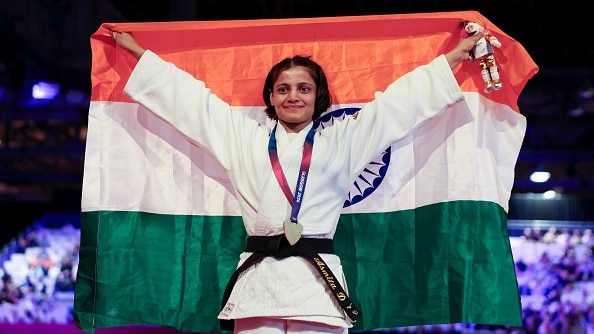
As Asmita stood on the podium, tears welled in her eyes. The pride of making history was tempered by the sorrow that her father, Arjun Dey, was not there to witness it. Earlier in December 2025, he died after suffering a brain stroke, just days before Asmita qualified for the Commonwealth Games at the selection trials in New Delhi.
On Friday, Asmita scripted history by becoming the first Indian judoka to win a gold medal at the Commonwealth Games, defeating Canada’s Heidi Quach 2-1 by yuko in the women’s 48kg final at Glasgow 2026. The victory marked a watershed moment for Indian judo, ending the country’s long wait for a Commonwealth Games champion.
The final began cautiously, with both judokas engaged in physical exchanges along the edge of the mat. Quach took the lead midway through the contest with a yuko before Asmita, despite picking up a shido penalty, responded with a sharp throw to level the scores. Growing in confidence, the Indian pressed forward with a series of attacks and remained in control despite Quach threatening on the counter.
With the scores locked at the end of regulation time, the contest moved into Golden Score. Asmita held her nerve and produced a superb throw near the edge of the mat to score the decisive point, sealing India’s first-ever Commonwealth Games judo gold. Earlier in the day, she had beaten Scotland’s Sarah Adlington in a tense Golden Score semifinal after opening her campaign with an emphatic ippon victory over Scotland’s Eva Ewing in the quarterfinals.
‘EVERYTHING HAD FINISHED AFTER MY FATHER DIED’
Born on March 22, 2003, in Belonia, the district headquarters of South Tripura, Asmita’s rise has been a remarkable story of perseverance. The daughter of a bicycle repair shop owner, the 23-year-old overcame modest beginnings and limited exposure to competitive sport to reach the top step of the podium.
The one person Asmita wanted to share her historic triumph with was the person she no longer could.
Her father, a cycle mechanic who earned barely Rs 300 a day and raised his family in a modest mud house in a small village in Tripura, died of a brain stroke earlier this year.
For a few moments, the celebrations gave way to memories of the man who had believed in her long before the rest of the country did.
“I am from a very small village in Tripura. People there don’t dream this big. But Papa always supported me,” she said.
Money was always scarce, with her father’s daily earnings barely enough to keep the household running. Yet he never allowed financial hardship to stand in the way of his daughter pursuing the sport she loved. When a severe knee injury threatened to derail her career, he took her to Delhi for treatment, bought her medicines, and did everything within his means to ensure she could return to the mat.
“He brought me to Delhi for treatment and bought medicines,” she recalled.
His death left Asmita devastated. The man who had been her biggest supporter and constant source of reassurance was gone, and with him, she felt, went her dream of competing on the biggest stage. But while Asmita struggled to come to terms with the loss, her mother quietly stepped into the role her husband had left behind.
Just 10 days after the funeral, her mother asked her to return to training. “If I stop you today, your father will think I am shattering your dreams,” she told her.
Asmita packed her bags and returned to the Sports Authority of India centre in Bhopal. Ahead of the Commonwealth Games, she was full of anxiety and endured sleepless nights. “I have worked so hard for this. Before this medal, I was unable to sleep in India. I used to stay awake thinking about the fights. Even if my body was tired, I was not able to sleep. I used to feel restless and then wake up for training at 5.30.”
The nerves stayed with her after she arrived in Glasgow. “When I reached here, I felt very anxious thinking about what would happen. I just kept telling myself I had to beat everyone and win,” said Asmita, who joined the Uttar Pradesh Police in 2023.
That determination extended beyond the training hall. Even small pleasures became reminders of the goal she was chasing. Her favourite sweet, laung latta, bought by her brother, remained untouched in the refrigerator back home.
“I would see it in the fridge and many times I almost ate it, but then I stopped myself,” she said with a smile. On Friday, every sacrifice found its reward as the gold medal rewrote Indian judo’s record books.
– Ends