Dow tumbles 600 points after hot inflation report, mounting concerns about AI impact: Live updates
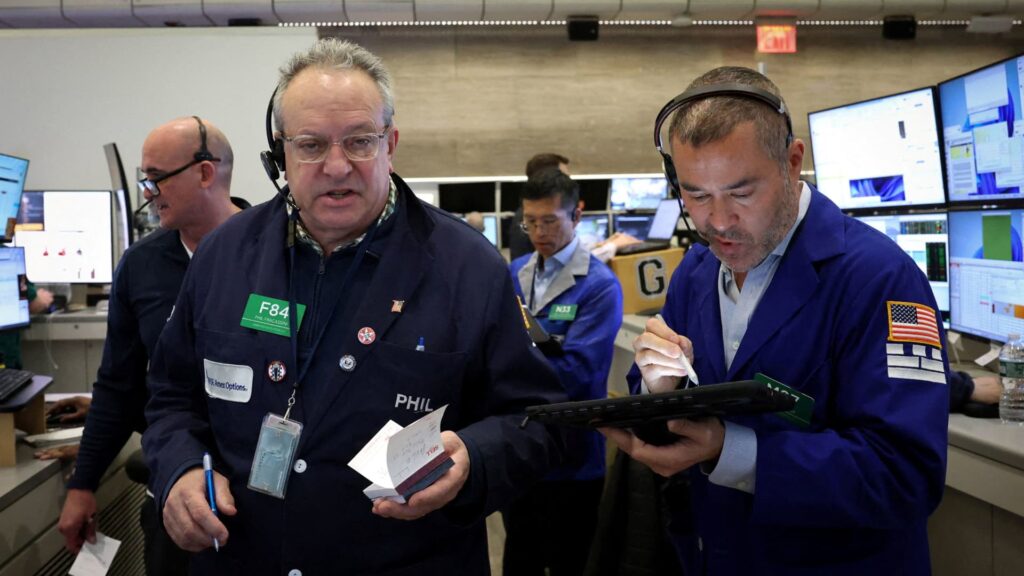
Traders work on the floor at the New York Stock Exchange (NYSE) in New York City, U.S., February 25, 2026.
Brendan McDermid | Reuters
Stocks dropped on Friday after the latest producer price index data came in much hotter than expected, adding sticky inflation to a list of concerns that has caused market turbulence this month.
The Dow Jones Industrial Average dropped 604 points, or 1.2%. The S&P 500 fell 0.6% while the Nasdaq Composite lost 1%.
All three benchmarks are in the red for February amid growing fears about the impact of artificial intelligence on specific industries and the overall economy. Those fears were exacerbated after Jack Dorsey’s fintech company Block said it’s laying off more than 4,000 employees — nearly half of its workforce. Stocks in the financial sector and other areas of the market tied to the economic cycle pulled back Friday.
Stocks linked to private credit were under pressure again as investors anticipated that they could be potentially suffer as a result of UK mortgage provider Market Financial Solutions’ collapse. Apollo and Jefferies were among the laggards, dropping 8% and 10%, respectively. Shares of Blue Owl, which has been hit recently in the wake of its liquidity curbs and asset sale, fell 6%.
Notable software names suffered losses as well Friday as they close out a terrible month. Salesforce tumbled 3%, while Microsoft retreated 2%, weighing on the Dow. Cybersecurity company Zscaler shed 13% after deferred revenue and billings in the fiscal second quarter missed expectations. CoreWeave fell 21% on disappointing guidance.
Nvidia extended its post-earnings slide with a 3% fall Friday. The stock shed more than 5% on Thursday, a surprise to many investors who remain bullish on the chipmaker given its blowout fourth-quarter results and upcoming product cycle. Market participants attributed the decline in shares to doubts around Nvidia’s deal with OpenAI, weak sentiment over the AI trade and skepticism about whether hyperscalers’ lofty AI capital expenditures are sustainable.
Fueling the downbeat sentiment, January’s producer price index — a measure of wholesale inflation — showed a 0.5% increase for the month. Economists polled by Dow Jones saw the headline reading coming in at 0.3%. Perhaps more concerning is that the core PPI reading, which excludes food and energy prices, recorded a 0.8% gain, much more than the 0.3% rise economists anticipated.
Stephen Kolano, chief investment officer at Integrated Partners, views the PPI report as an additional complication for investors on top of the already-existing anxieties surrounding not just AI capex and the risk of its disruption to industries but also other factors such as stress in the private credit market. Noting that the inflation reading seems to be more services driven, he thinks it’s a sign companies are possibly starting to pass through the cost of tariffs to the end consumer in order to maintain their margins.
“Inflation isn’t solved yet,” he said, adding that it creates this conundrum for the Federal Reserve of deciding whether to cut interest rates to spur growth or to hold steady to continue to fight inflation. “It just creates this uncertainty around which way is policy going to go in the remainder of the year.”
That’s not to mention the state of the labor market as another worry, Kolano said. Even though job growth last month was much better than expected, the investment chief said he isn’t sure that the labor market is stabilizing given that layoffs have been picking up. In fact, Challenger, Gray & Christmas reported earlier this month that layoffs in January hit their highest total for that month since the global financial crisis.
“I don’t see a clear sign that unemployment is not going to move higher just yet,” he said.
The Nasdaq is on pace for a decline of more than 3% in February and its worst monthly performance since last March. The iShares Expanded Tech-Software ETF (IGV) is down 10% for the month, bringing its year-to-date losses to 23%. The S&P 500, meanwhile, is on track for a more than 1% loss in February, while the Dow is on pace for a 0.2% decline.
— CNBC’s Jeff Cox contributed reporting.