Families in danger, camps disrupted: How war-torn Iran won Kabaddi silver at Asian Games
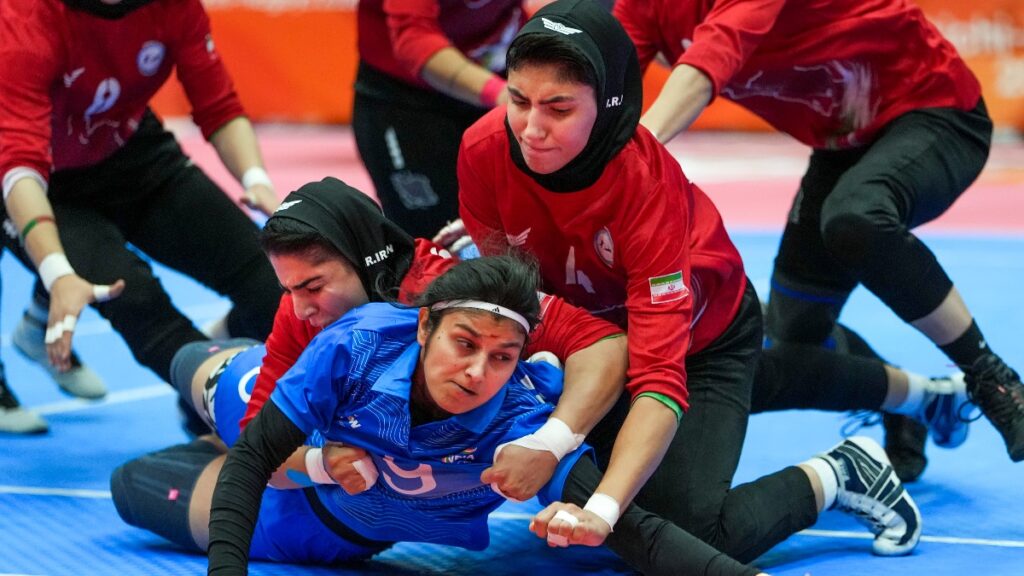
For Iran’s women’s kabaddi team, preparing for the Asian Games was never simply about training for a medal.
Over six months, the team changed camps three times, trained at around 10 different bases and lost nearly two months of preparation as war disrupted life across Iran. The players were also trying to focus on the biggest tournament of their careers while worrying about whether their families were safe back home.
And somehow, they still made it to the Asian Games final.
Iran pushed India all the way before eventually losing 37-34 on Saturday, taking home the silver medal. For coach Ghulam Raza Mazandrani, the circumstances behind that medal made the achievement particularly significant.
“This is not easy. You prepare everything together, this side is war, your family in danger and you should focus on the game,” Mazandrani said after the final.
HOW DID WAR DISRUPT IRAN’S PREPARATION?
Mazandrani had only six months to build a largely young Iranian side. But the team’s preparation was repeatedly thrown off course as the conflict disrupted different parts of the country.
“In six months we had around 10 camps,” he said.
The team had to relocate three times because of the situation. After facing problems in southern and central Iran, the squad eventually moved its camp to the north, where conditions were more manageable. Even then, finding suitable courts and training facilities remained a problem.
“I had only six months’ time and in between happened the war in Iran and two months completely everything finished,” Mazandrani said. “So we had very less and short time.”
Asian Games Live: September 26 updates
The pressure was not restricted to the training ground. Players were in daily contact with their families, checking on their safety while trying to keep their minds on kabaddi.
“All players every day call their family and speak together, and they ask if they are safe or not,” Mazandrani said.
HOW DID IRAN KEEP ITS PLAYERS FOCUSED?
The team also brought in a psychologist to help the players deal with the pressure.
“We had a psychologist and she helped us very good and kept them in the right frame of mind because of the war,” he said.
For a squad whose average age was below 22, that support was particularly important. Mazandrani said some of his best raiders were only 19 or 20, leaving them to deal with circumstances far beyond the sporting environment.
“You have too many experiences and you can understand, okay… but these young people, they can’t understand this. Mostly pressure on them,” he said.
The disruption also deprived Iran of something every developing team needs: matches.
Mazandrani said sanctions made it difficult to invite teams to Iran or travel abroad for international friendlies. Attempts to arrange matches against teams such as Chinese Taipei, India and Japan came to nothing.
“When you call Chinese Taipei, they don’t come, you can’t go. When you call India, they don’t come, you can’t go. When you call Japan, they don’t come, you can’t go,” he said.
“So team without any friendly match.”
For Mazandrani, that lack of exposure was a major disadvantage. He said Iranian players could take part in only two or three competitions a year, far fewer than their Indian counterparts.
“International players can learn only in competition, not in practice, not in the hall. Only in competition they can learn and improve and we need more competition,” he said.
IRAN WIN SILVER AT ASIAN GAMES
Iran ultimately fell three points short of gold, but its run to the final offered a glimpse of what the young side could achieve despite the disruption to its preparation.
Mazandrani felt the gap between the two teams was not necessarily huge in terms of ability, but India’s greater exposure to competitive kabaddi gave the hosts an advantage.
“My feeling, not too much difference between India or Iran. Our team also played well, but they have good chance because you have too many competitions in India,” he said.
Mazandrani believes the experience will help the young Iranian squad in the years ahead. Almost the entire team is under 24, apart from two players around 30.
“After four years they will be better than this because their experience coming up, their body should be stronger and their mind also a little wide,” he said.
Even after the final, however, uncertainty remained. The players did not know whether they would be able to fly directly back to Iran.
“We are here but we don’t know, we can’t go with direct flight to Iran or not,” Mazandrani said.
They had arrived at the Asian Games after a preparation interrupted by war, moved camps three times, trained across roughly 10 bases, lost two months and struggled to find international opponents.
They left Nagoya with an Asian Games silver medal.
– Ends