Hong Kong protest leader flees as government warns calls for ‘revolution’ are now illegal

“The choices I have are stark: to stay silent from now on, or to keep engaging in private diplomacy so I can warn the world of the threat of Chinese authoritarian expansion,” he said. “I made the decision when I agreed to testify before the US Congress.”
The Hong Kong Autonomy Act would impose sanctions on businesses and individuals that help China restrict Hong Kong’s autonomy. It will now go to US President Donald Trump for his signature before being enacted.
On Wednesday, Hong Kong’s top official, Chief Executive Carrie Lam, pushed back against foreign critics of the law, saying it was a “crucial step to ending chaos and violence that has occurred over the past few months” in the city.
“The national security law is the most important development in securing ties between China and the Hong Kong Special Administrative Region since the handover,” she said, framing criticism of the law as “vicious attacks.”
Glory to Hong Kong
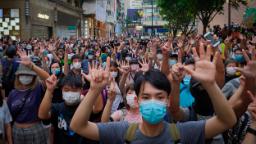
The anthem references the slogan “liberate Hong Kong, revolution of our times.” Plastered across graffiti, posters, t-shirts, and even political advertisements, it has been one of the most popular slogans of the protests which began last year. Use of it going forward, however, could result in a sedition charge under the new law, the government said Thursday.
“The slogan ‘Liberate Hong Kong, the revolution of our times,’ nowadays connotes ‘Hong Kong independence,’ or separating the Hong Kong Special Administrative Region (HKSAR) from the People’s Republic of China, altering the legal status of the HKSAR, or subverting the State power,” a spokesman said, adding that the new law “prohibits secession, subversion of state power and other acts and activities which endanger national security.”
Police said all but one of those arrested have now been bailed until July. They are facing charges of inciting or abetting others for the commission of secession or subversion, which could carry with it a fixed-term sentence of five years in prison.
Chilling effect
Much about how the new security law will be applied remains unclear, and this has left many people nervously policing their own behavior and avoiding action that could step over the new invisible red lines.
Many shops and restaurants that had been vocally supportive of the protest movement could be seen removing posters and slogans from their walls, for fear of potential prosecution. People have also been scrubbing their social media and deleting WhatsApp chats, and journalists have begun to face much more trepidation from sources about speaking on the record about the law.
Speaking at a protest on July 1, one woman who declined to give her name said “it will be hard not to self censor when there’s something like this going on.”
“I feel like most people would be more cautious with what they say,” she added.
One thing she said would change would be how Hong Kongers use the internet, adding she was planning to use a VPN and secure apps more often. Samuel Woodhams, Researcher at the London-based internet research firm, Top10VPN, said in an email that there had been a 321% rise in demand for VPNs on June 30 compared the rest of the month’s daily average.
Tam Yiu-chung, the sole Hong Kong member of China’s National People’s Congress Standing Committee, which drafted the security law, said that “social media should not be used to incite crimes or fear or other forms of chaos and turbulence in society.”
He added however that fears about the law were overblown and people would not find their lives overly constrained by it, suggesting there was a need for greater “education” about the new regulations.
CNN’s Eric Cheung, Vanessa Chan and Philip Wang contributed reporting.