How long you will live is mainly decided by your genes: Study | India News – The Times of India


NEW DELHI: You can eat right, exercise daily and avoid every bad habit — but your genes may still have a major say on how long you live. A major new study suggests that nearly half of human lifespan is determined by genetics, challenging the belief that lifestyle and environment shape longevity the most.Published in Science, the research shows that once deaths caused by accidents, infections and other external factors are excluded, about 55% of the human lifespan is heritable, meaning that more than half of the observed variation in longevity across a population is attributable to genetics. That is a much greater proportion than the previous estimates of 10-25%, according to the research, published on Jan 29.
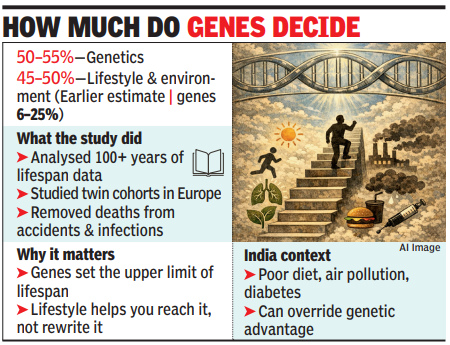
How much do genes decide
The findings are based on an analysis of more than a century of lifespan data from large Scandinavian twin cohorts in Denmark and Sweden. Researchers studied identical and non-identical twins raised together and apart, as well as siblings of US centenarians. Most participants were born between 1870 and 1935, a period marked by high mortality from infectious diseases and accidents.By separating such “extrinsic” deaths from those linked to biological ageing, the study found the true influence of genetics on longevity had been masked. Once these external causes were accounted for, lifespan similarities between identical twins became far stronger. It also helps explain why genetic influence on lifespan appears clearer today. As deaths from infections, violence and accidents have declined over time, role of genes in determining longevity has become more visible.Indian experts say the findings carry important public health implications. Dr Anoop Misra, chairman, Fortis C-DOC, said genetics plays a major role in biological ageing but warned that Indian conditions could blunt this advantage. “About half of human lifespan is genetically determined once external causes are excluded, but poor nutrition, air pollution, and rising diabetes and obesity can override genetic advantages and accelerate biological ageing,” he said.Dr Ambrish Mithal, group chairman, Endocrinology and Diabetes, Max Healthcare, said longevity reflects a balance between inheritance and environment. “Genetics provides a broad upper limit for lifespan, while epigenetics and lifestyle determine how close one comes to that limit,” he said, explaining that environmental factors can switch genes on or off without altering DNA itself. Scientists caution the findings do not mean that lifespan is fixed at birth. Nearly half of lifespan variation is still shaped by lifestyle, healthcare access and living conditions. However, the study suggests that genes set the biological ceiling — and the environment determines whether people reach it. Researchers say the findings could reshape debates on ageing and longevity, while reinforcing the urgency of tackling risks that shorten the biological lifespan.