Jamie Dimon says markets underestimate risks and he wouldn't buy stocks or Treasurys at current prices

JPMorgan Chase CEO Jamie Dimon said investors are underestimating the risks facing the global economy and that he wouldn’t buy either equities or long-dated U.S. Treasurys at their current prices.
In an hourlong interview with Wilfred Frost released late Monday, Dimon said markets aren’t fully accounting for a growing list of geopolitical and fiscal threats.
“I do think those risks are probably bigger than other people think,” Dimon said, pointing to wars in Ukraine and the Middle East, tensions between the U.S. and China, and rising military spending in a time of mounting government deficits.
Asked whether markets are underpricing the chance of a major shock, Dimon said it’s difficult to know exactly what risks are already reflected in asset prices.
“It’s possible something’s baked in, but what’s not baked in is what actually happens,” he said.
Dimon, who leads the world’s largest bank by market cap, often warns the public about the economic risks he sees.
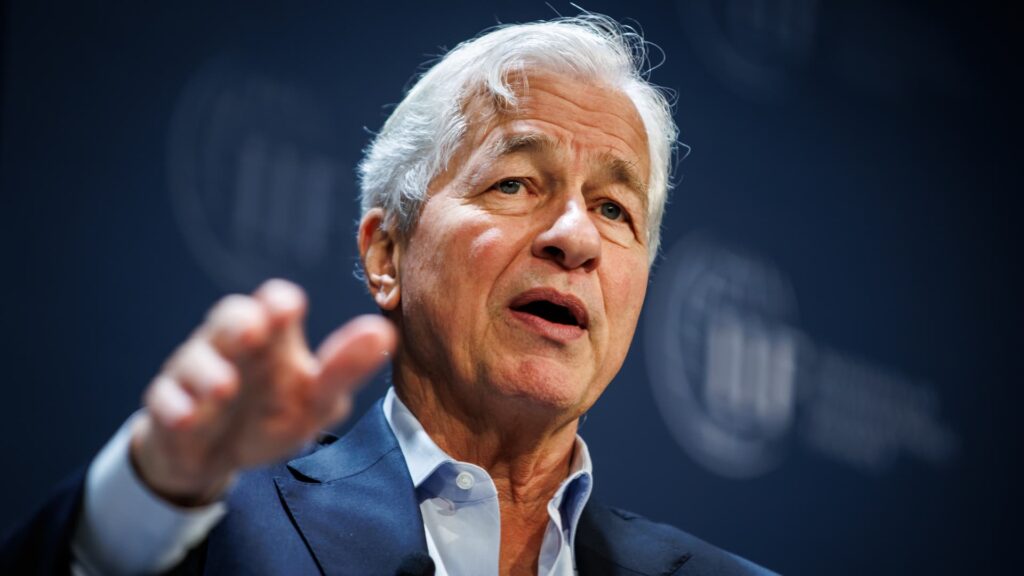
Jamie Dimon, chief executive officer of JPMorgan Chase & Co., speaks during the 2025 Institute of International Finance annual membership meeting in Washington, Oct. 16, 2025.
Samuel Corum | Bloomberg | Getty Images
His latest comments contrast with investors’ recent willingness to look past wars, tariffs and other shocks. The S&P 500 has returned nearly 10% this year as consumers continue to spend, inflation has moderated and investors have embraced the artificial intelligence trade.
Last week, JPMorgan Chase and its peers posted blockbuster quarterly results powered by surging trading and investment banking revenue, reinforcing the view that the U.S. economy has weathered recent geopolitical turmoil better than many expected.
Dimon acknowledged in the interview with “The Master Investor Podcast” that the global economy has become more resilient because of a lower energy dependence than in previous decades, but warned that doesn’t eliminate the possibility of a sudden inflection point.
“You may need more straws in the camel’s back to cause that tipping point,” he said. “Even this current war starting up again, maybe that’s not enough to do it.”
Persistent U.S. budget deficits will eventually force a reckoning, potentially driving interest rates higher, Dimon said.
“My view is it will become a problem,” he said, predicting higher interest rates as so-called bond vigilantes demand greater compensation to finance the government’s debt.
Stocks, AI cycle
When asked, Dimon said he wouldn’t purchase long-dated Treasurys: “Personally, no,” he said.
Even if inflation falls back to the Federal Reserve’s 2% target, “the 10-year bond should probably be at 4% to 4.5%,” he said, adding that he sees little upside for Treasury prices.
He was similarly cautious on stocks. While he would consider an individual stock if it was “a great investment,” Dimon said he wouldn’t be a buyer of the broader market at current valuations.
Dimon also struck a measured tone on artificial intelligence, comparing today’s spending boom to the early days of the internet.
“The amount of money being spent is huge. Will it in total pay off? Probably, just like the internet did,” Dimon said.
He also pointed out that during that internet boom, big early players such as Yahoo and Netscape faded while eventual winners such as Google and Facebook emerged later.
“Will it pay off the way you expect and the timetable you expect? Definitely not,” Dimon said.