No helmet off, no celebration: Rohit Sharma lets his Lord's hundred do the talking
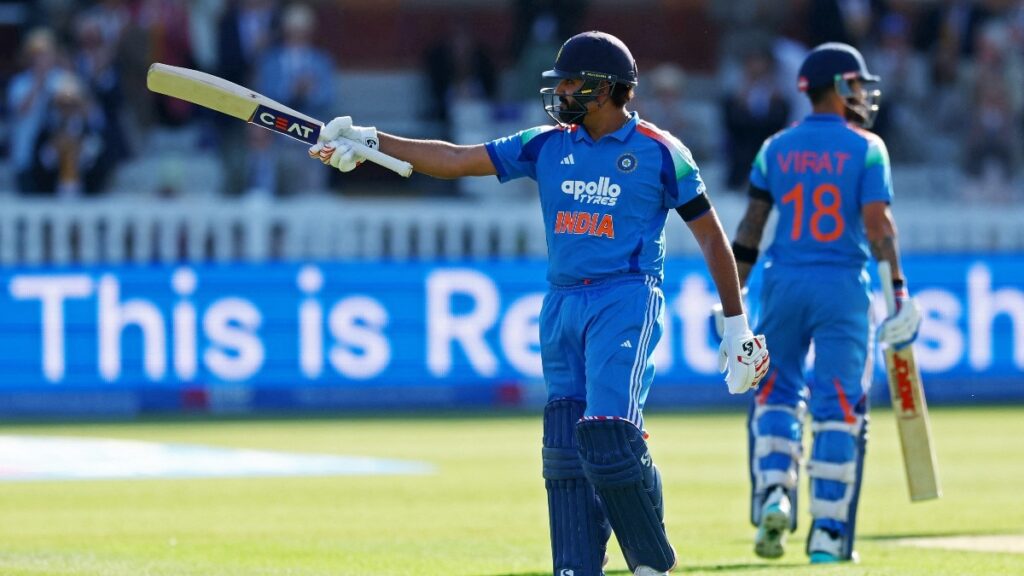
Rohit Sharma responded to the retirement rumours surrounding him with a fearless century at Lord’s on Sunday, leading India’s charge in a daunting chase of 388 against England in the series-deciding third ODI.
For days, the focus had shifted away from his batting and towards his future. Reports suggesting this could be his final ODI, coupled with a lean run of scores, had sparked fresh debate over what lay ahead for the 39-year-old. At the Home of Cricket, Rohit chose not to answer with words. He answered in the only way he knows, with an innings that kept India firmly in the contest and reminded everyone why he has remained one of the country’s finest ODI batters.
India vs England, 3rd ODI: Updates | Scorecard
There was no extravagant celebration after he reached the landmark. Rohit did not throw his helmet into the air or punch the sky. He simply raised his bat, acknowledged the applause from every corner of Lord’s and took guard again. India were chasing 388, and he knew the job was far from over. The celebration lasted only a few seconds, but it reflected the moment perfectly. There was satisfaction in reaching three figures, but there was an even bigger task still waiting.
The applause around Lord’s only grew louder. The Indian dressing room rose to acknowledge the innings, head coach Gautam Gambhir clapped from the balcony and Virat Kohli walked over to embrace his long-time teammate. Rohit accepted the appreciation with his trademark calmness before settling back into position. The helmet stayed on because, in his mind, the chase remained unfinished.
Much of the build-up to the series decider had revolved around Rohit’s future. Questions over whether Lord’s would mark his final ODI appearance had overshadowed the contest itself. His recent run of scores had only fuelled the discussion.
Every press conference, every team announcement and every practice session seemed to bring another round of speculation. Rohit, however, never publicly engaged with the debate. When the moment arrived, he allowed his batting to provide the response.
The innings was far from an all-out assault from the very beginning. England’s seamers asked questions with the new ball, and Rohit was content to play within himself during the opening overs. He respected the conditions, left well outside off stump and waited patiently for scoring opportunities. Alongside Shubman Gill, he ensured India did not lose early wickets while chasing what would have been the highest successful ODI chase at Lord’s.
Once the ball softened, the familiar Rohit Sharma returned. The effortless pull shots, the crisp drives through the covers and the lofted strokes over the infield began to flow. Boundaries arrived with increasing regularity as India’s chase gathered momentum. Rohit and Gill stitched together a commanding opening partnership that steadily reduced the pressure, giving India genuine hope of pulling off something special.
Gill’s departure after a well-made innings brought an end to the opening stand, but Rohit refused to let the momentum slip. He continued to find the gaps, rotated the strike smartly and punished anything loose. The pressure that had surrounded him before the match seemed to disappear with every boundary.
The milestone arrived against Adil Rashid. The leg-spinner floated one on middle and leg, and Rohit immediately dropped onto one knee before slog-sweeping him over deep midwicket. The ball bounced over the rope to bring up his 34th ODI century from just 84 deliveries. It was not the cleanest connection of the afternoon, but it hardly mattered. Lord’s erupted, the Indian dressing room celebrated and teammates applauded an innings that had kept the chase alive.
Even then, Rohit resisted the temptation to make the moment about himself. There was no animated celebration, no prolonged acknowledgement of the crowd and no emotional release. He briefly raised his bat, exchanged a hug with Virat Kohli and prepared for the next delivery. India still had plenty of work left, and the opener’s focus never drifted away from the chase.
The century carried historic significance. Rohit became the first Indian batter to score an ODI hundred at Lord’s, eclipsing Sourav Ganguly’s 90 against England in 2004 as the highest individual score by an Indian at the venue. It was another landmark at one of cricket’s most iconic grounds, adding yet another chapter to a remarkable ODI career.
There was another record to celebrate as well. At 39 years and 80 days, Rohit became the oldest batter to score an ODI century at Lord’s. He also became the oldest Indian cricketer to score an international hundred across all formats, underlining his ability to continue performing at the highest level despite questions over his future.
Most ODI hundreds in a visiting country
8 Rohit Sharma in England
7 Sachin Tendulkar in UAE
7 Saeed Anwar in UAE
7 AB de Villiers in India
7 Quinton de Kock in India
The innings also strengthened Rohit’s outstanding record in England. It was his eighth ODI hundred in the country, the most by any visiting batter in a single nation. He went past Sachin Tendulkar, Saeed Anwar, AB de Villiers and Quinton de Kock, all of whom finished with seven centuries in a visiting country. Among batters in England, only Joe Root, with 10 ODI hundreds, has scored more, while Marcus Trescothick also has eight.
Whether Lord’s eventually proves to be Rohit’s final appearance in ODI cricket will only be known in the months ahead. The debate over his future may continue, but on Sunday the conversation belonged entirely to his batting. At a venue where so many careers have produced unforgettable moments, Rohit added another of his own. The helmet never came off, the celebrations remained understated and there was no attempt to turn the spotlight towards himself. He simply got on with the job, and for one memorable afternoon at Lord’s, that was all the answer anyone needed.
– Ends