Nvidia, Microsoft, Meta warn against 'premature restrictions' of open-weight models
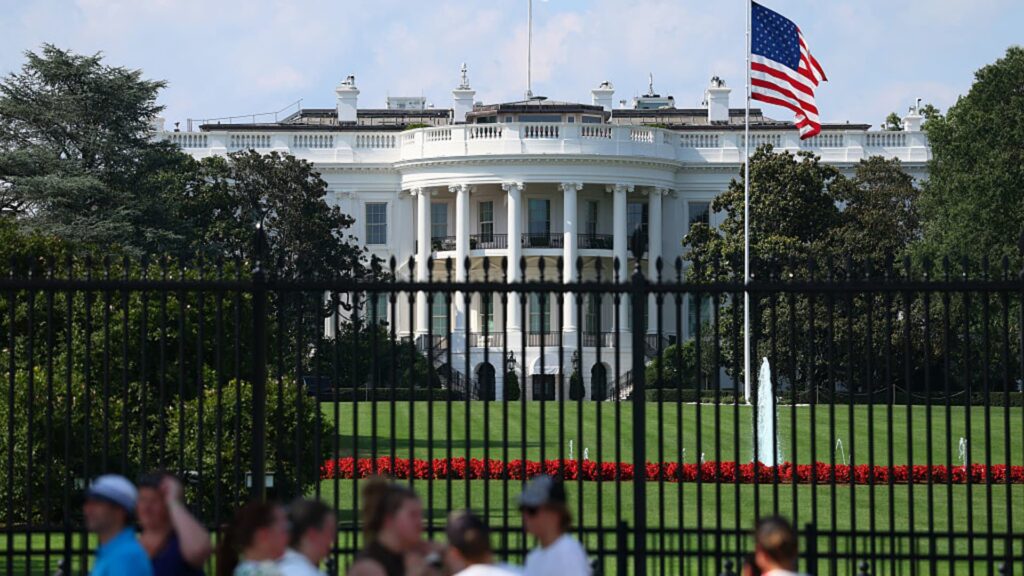

Nvidia, Microsoft, Meta, Palantir and more than 20 other companies released a letter Friday urging policymakers to avoid “premature restrictions” on open-weight artificial intelligence models that would “stifle competition or drive innovation overseas.”
Open-weight AI models are available for users to download, modify and run on their own infrastructure, and they have been the subject of fierce debate within the tech sector in recent weeks.
Chinese open-weight models are gaining steam against leading offerings from American companies like OpenAI and Anthropic, which primarily develop proprietary, closed models. Officials and executives have been weighing whether or not to restrict access to Chinese models in the U.S.
Moonshot AI, a Chinese startup, amplified concerns earlier this month after releasing a model called Kimi K3 that outperforms cutting-edge American offerings across some industry benchmarks. U.S. Treasury Secretary Scott Bessent told CNBC on Tuesday that the Trump administration would look into whether Chinese companies were stealing American intellectual property, and stated that the government has “the ability to sanction them because of this theft.”
But in the letter on Friday, the group of U.S. tech companies cautioned against any rash actions. They wrote that open-weight models strengthen competition and ensure that the benefits of the technology are “broadly shared rather than concentrated in a few hands.”
“Relying solely on closed models is not inherently safe: they can be breached, misused, or fail in ways that outsiders cannot detect,” the letter said. “And concentrating advanced AI capabilities behind a small number of closed models compounds that risk.”
Nvidia CEO Jensen Huang and Microsoft CEO Satya Nadella both shared the letter on their personal social media accounts.
Elon Musk, who runs an AI business under his rocket company SpaceX, also applified the letter on social media, writing that it has his “full support” in a post on X. SpaceX did not officially sign the letter.
OpenAI and Anthropic did not sign the letter. Both companies, which are each valued at nearly $1 trillion, are gearing up for potentially massive initial public offerings that could land as soon as this year. Anthropic confidentially filed its prospectus with the Securities and Exchange Commission in June, and OpenAI followed suit days later.
Greg Brockman, OpenAI’s president, said Thursday that the company believes in broad access, and that he has not been involved in any conversations with the Trump administration about potentially banning Chinese open-weight models in the U.S.
“I think that, that fundamentally, AI and AI usage is something that is actually very important to democratize,” Brockman told reporters during a briefing in New York City. “And so, for me, at a sort of deep level, I think that having more models, more usage, that is a good thing.”
OpenAI CEO Sam Altman addressed the letter in a post on X on Friday, writing that he wants the U.S. to win with both open-weight and proprietary models, and that he is “glad to see this.”
Earlier this month, the AI company Hugging Face used an open-weight model from the Chinese company Z.ai to contain a cyberattack that rogue OpenAI models carried out. OpenAI disclosed the attack on Tuesday and characterized it as an “unprecedented cyber incident.”
CEO of OpenAI Sam Altman speaks with reporters, following meetings on Capitol Hill, in Washington, D.C., U.S., June 3, 2026.
Kylie Cooper | Reuters
Yacine Jernite, head of machine learning at Hugging Face, told CNBC that the company initially tried to use Anthropic’s Fable 5 to analyze the attack, but that it didn’t work because the model’s guardrails couldn’t determine that Hugging Face was trying to defend itself.
Jernite said Hugging Face turned to Z.ai’s model GLM 5.2, and was able to contain the attack “very quickly using this model.”
White House advisor Michael Kratsios on Wednesday said that China’s Moonshot AI developed its Kimi K3 model by distilling Anthropic’s technology. Distillation is a term for an AI training method where a smaller, less capable model is built using outputs from an existing, stronger model.
Kratsios wrote in a post on X that legitimate AI distillation plays a vital role in the open innovation ecosystem, but warned that “large-scale, covert industrial distillation aimed at stealing proprietary U.S. technology” is “unacceptable.”
In the letter on Friday, the U.S. tech companies said that concerns about unlawful distillation should be addressed through “targeted legal and commercial frameworks” instead of with “sweeping restrictions on techniques that play an important role in AI innovation.”
“Our AI leadership will be judged not by one frontier AI model, but by whether the United States builds a strong, open ecosystem that diffuses into every sector,” the letter said. “This is essential for creating opportunities for innovation and prosperity across the country.”
WATCH: AI is forcing the cyber industry to revisualize how it operates, says TrustedSec’s David Kennedy