Once coached by Rahul Dravid, Chhattisgarh's Amandeep Khare chases his India dream
Andhra’s spinners were making life hard for Chhattisgarh at the DVR Ground in Mulapadu, near Vijayawada. Saurabh Kumar, Tripurana Vijay and Lalith Mohan kept the scoring slow and kept taking wickets, and at the other end, Amandeep Khare could see his partners getting out trying to play shots. So he stopped trying to score quickly. He defended for long spells, switched between a middle-stump and a leg-stump guard to find the odd gap, and stayed until Chhattisgarh had gone past Andhra’s 231. When the last wicket fell, he was unbeaten on 89, 11 runs short of a hundred, and his side led by six.
That turned out to be enough. Andhra declared their second innings on 184 for 3, which set a target of 179, and Chhattisgarh chased it down in 35.1 overs for the loss of five wickets. Khare made 30. It was Chhattisgarh’s first win of the Ranji Trophy Elite season, and when he spoke to IndiaToday.in, that mattered more to him than the missed hundred.
He had scored runs in the first two matches as well, and neither ended in a win. “It does not feel that good when you score runs but your team does not win,” he said. This time Chhattisgarh got the lead, and he thinks that changed the game. “After taking the lead, the pressure shifted to them. Then, in their attempt to win outright, I feel they declared a little early. “A defeat would have ended their hopes of qualifying. “If this match had slipped away from us, we would have been out of contention for qualification,” he said. Instead, “we are now in contention.”
Khare has been around for a while. He made his first-class debut against Tripura at Ranchi on 6 October 2016, in the first Ranji Trophy season Chhattisgarh ever played, and scored a hundred in his second match, against Andhra, finishing the first day on 136 not out. Ten years on, he has 17 first-class centuries, among them two double hundreds: 210 against Vidarbha and an unbeaten 203 against Saurashtra.
The runs have come in the shorter formats too. He has 2,649 List A runs at an average of 48.16 and 1,760 in T20s at a strike rate of 124.65, and he captains the state in all three formats. Some of his performances have stuck in people’s memory. There was 156 against Jammu and Kashmir in Raipur last November, and an unbeaten 176 at Hyderabad’s Gymkhana Ground early this year, where a ninth-wicket stand with Dev Aditya Singh denied Hyderabad an outright win. In June, he hit back-to-back centuries for Raipur Rhinos in the Chhattisgarh Cricket Premier League.
None of that has moved him very far up the ladder. His only call-up for Central Zone in the Duleep Trophy came in 2023-24, when he played one match and made 31 runs across two innings. There has been no Irani Cup or India A call either. Since the start of 2023, according to Sportstar’s count, only two Central Zone players have scored more runs than his 2,027: Madhya Pradesh’s Shubham Sharma and Vidarbha’s Yash Rathod.
Khare does not pretend that doesn’t bother him. “Naturally, you feel that you deserve an opportunity there, but you are not getting that opportunity. For a moment, it does feel bad.” He can explain it, though. Vidarbha, Uttar Pradesh and Uttarakhand all reach the knockouts and Chhattisgarh do not, so more players from those sides end up in the zonal team. “But those things are not in my control,” he said.
What he can control is how he bats when people are watching. Because Chhattisgarh go out early, they get only one or two live games a year, and Khare says he has made them count: nine hundreds and two fifties in 11 such games. “I feel those are big stages where players normally experience pressure,” he said. “On those stages, I feel very good because I get the opportunity to show what I am capable of.” The Duleep Trophy is not where he wants to stop. “I want to play for India A, and ultimately, my goal is to play for India.”
Cricket was always on at home. His grandfather played at school level and had to give it up because of family circumstances, but he loved the game and watched every match. Khare’s grandmother, mother and brother follow it just as closely, and he grew up watching Sachin Tendulkar and Virender Sehwag on television. He started out playing near his house with older boys, and one of them told him he should try professional cricket. “At that time, I did not pay much attention to it,” he said.
Inter-school matches followed, then a call-up for the School Nationals. In the year he joined, he played Under-14 and Under-16 cricket for the state and was sent to the Zonal Cricket Academy and the National Cricket Academy. The flights and hotels did some of the persuading. “For a small child, all those things are extremely fascinating,” he said.
By 2016, he was in India’s Under-19 squad for the World Cup. He puts that down to three hundreds in the Vinoo Mankad Trophy, 404 runs in the inter-zonal matches (dismissed twice, average 202), 97 in the Challenger Trophy final and a hundred against Sri Lanka in Sri Lanka. A minor injury in a warm-up game against the Board President’s XI in Mumbai cost him the first few matches of the tournament, and the team kept winning without him. “There was no reason for them to make changes to the team, and I did not get an opportunity to play,” he said.
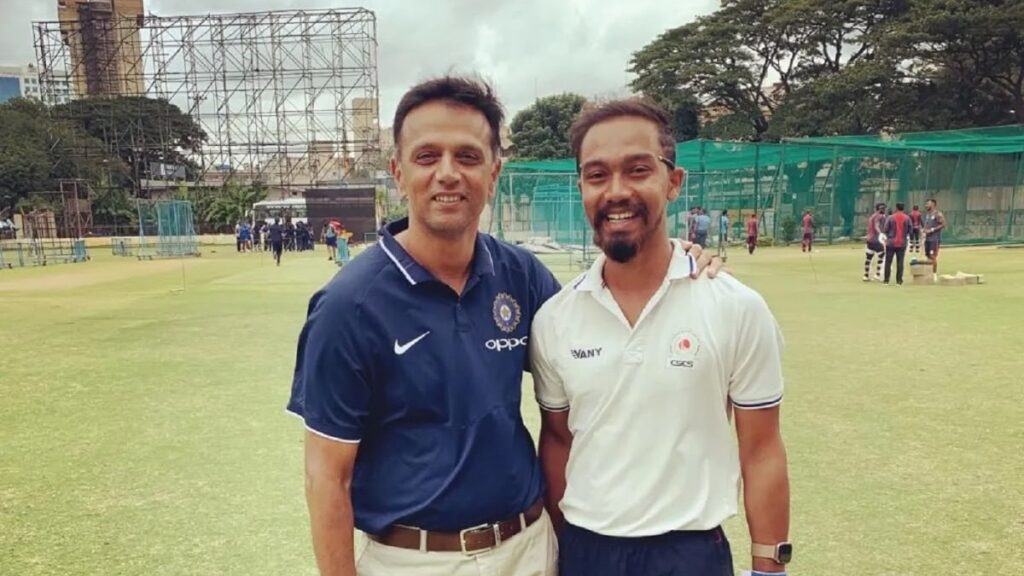
He still came away with something, mostly from the coach, Rahul Dravid. “He was himself a legendary player, but he kept everything very normal and made sure everyone remained relaxed,” Khare said. Once the day’s play was over, the squad was told to leave cricket behind and spend time with each other. What Khare took from it was simple: “you should know how to switch on and switch off.” Cricket asks for eight or nine hours of full attention a day, and in the hours after that Dravid wanted the players to get to know one another. “The better your bonding off the field, the more it reflects on the field. That was a very big lesson for me in life.”
Chhattisgarh received its Ranji Trophy affiliation that same year, which solved a problem he had been worrying about. “I was worried about where I would play Ranji Trophy from,” he said. He has played all formats for the state since the first match and has missed hardly a game or two. As captain, he now spends part of his time on the younger players, several of them from his hometown. “There are certain things I experienced during my early days, and I do not want the younger players to go through the same things,” he said.
Virat Kohli is his idol today and Virender Sehwag was before him, partly because both played all three formats, which is the kind of player Khare wants to be. It takes adjusting, he said: a Test match now, a T20 two days later, a one-dayer four days after that. “I keep asking myself questions, and slowly, I feel I am finding the answers.” The advice he hears most from senior players, including some in the India side, is to keep things simple. “The simpler you keep your thoughts about cricket, the clearer your mind will be. And the clearer your mind is, the better your chances of performing well.” He says he is trying to simplify his batting a little more every year.
He believes there is plenty left. “I still have the hunger, and I feel I can play cricket at a very high level for at least another 10-15 years,” he said. He also knows what is missing. “The only thing is that I need an opportunity. If I get one, I will definitely prove my point.”
– Ends