Story of a Hong Kong newspaper feud: Two fugitive opium dealers, media mogul Jimmy Lai and a smoking gun cellphone video

As Jimmy Lai’s pro-democracy paper ate into the Oriental Daily News’ readership, a deep, personal vendetta took root between the latter publication’s founders, by then fugitives in Taiwan, and the newcomer.
After decades of dispute, the two rivals this summer finally had their day in court, as Lai faced a charge of intimidating an Oriental Daily News reporter.
In footage shown to the court, Lai points his finger at the reporter, swears at him in Cantonese, and says: “I will definitely find someone to mess with you.” The reporter, whose identity is protected by an anonymity order, said Lai was threatening him physically, and that he suffered psychologically from the episode. Prosecutors said Lai was at a public event where reporters had the right to photograph him.
Lai pleaded not guilty to the charge of criminal intimidation, which carries a maximum sentence of two years, and on Thursday was acquitted. “I am not worried at all, because this is a minor case and the charge felt forced,” he said, before the trial began.
In recent years, Lai has made bigger enemies than the Oriental Daily News, as he vigorously opposes Beijing’s influence on Hong Kong. The septuagenarian is facing a slew of criminal charges, including several under Hong Kong’s sweeping new national security law, which carries a maximum sentence of life imprisonment.
“It would be difficult for Apply Daily to survive if Lai was jailed,” said Willy Lam, a professor in history at the Chinese University of Hong Kong and a former journalist, adding that survival strategies were likely being put in place at the newspaper for that scenario.
“Lai is not the editor, but he is the person providing the money for the paper and the symbol of defiance. He is a symbol of freedom of the media, in both Hong Kong and the Western world.”
An opium fugitive
But before officers had the opportunity to arrest Ma Sik-yu, widely known as White Powder Ma, he escaped to the neighboring island of Taiwan, which has no extradition treaty with Hong Kong. His younger brother Ma Sik-chun wasn’t so fast: he was arrested but managed to slip out of the city the next year by boat while on bail.
The pair lived the rest of their lives as fugitives in self-governing Taiwan, managing their media empire from afar.
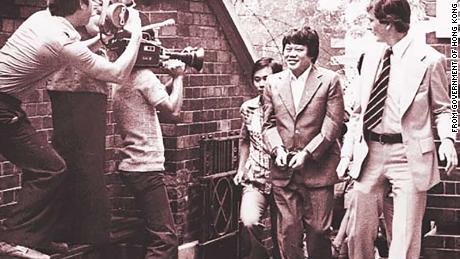

“After that, the entire mission of that newspaper group was one thing: get them (the brothers) back to Hong Kong,” says Mark Simon, a senior executive of Next Digital, which publishes the Apple Daily — his view was echoed by others who spoke to CNN on the condition of anonymity.
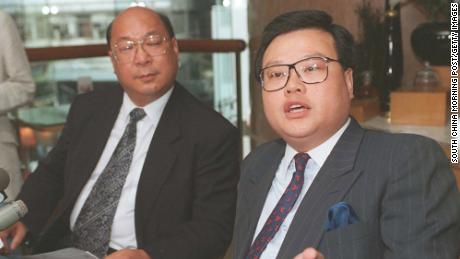
Publishing a photograph of Ma Ching-kwan with British Prime Minister John Major, and a menu from a dinner at 10 Downing Street he had attended on September 27, 1994 — three months after the donation had been made — the newspaper demanded a refund.
”We will categorically say that the Conservative Party did not or would not accept donations conditional on favors,” an unnamed spokesman for the Conservative Party was quoted as saying in 1998 in British newspaper, The Independent.
After White Powder Ma died in 1998, his younger brother was alone in Taiwan. Some, however, doubted Ma Ching-kwan ever really wanted his father back on home soil.
“If his father came back, he would no longer be the king of the paper,” said a long-time observer of the Oriental Daily News, who requested anonymity. “As it was, he had to send the front pages of the paper every day to Taiwan for approval before they hit the presses.”
In 2015, Ma Sik-chun died aged 77 in Taipei. He was still a wanted man in Hong Kong.
An apple a day
At around the same time the Ma brothers came to Hong Kong, another man destined to be a newspaper baron surreptitiously crossed over the border from mainland China searching for a safer life.

“Jimmy busted open their distribution network,” says Simon, who is Lai’s long-time, right-hand man, explaining that Apple Daily negotiated its way onto newsstands that were typically reluctant to sell competitors of the Oriental Daily News.
Apple Daily began to dent the Oriental Daily News’ readership. “Jimmy didn’t realize that this would prove to be such an enormous affront to this paranoid bunch of people who were busy, on the one hand, trying to clear up their name, and on the other hand, make sure that they were still the most dominant publication in the market,” said a long-time observer of the Oriental Daily News.
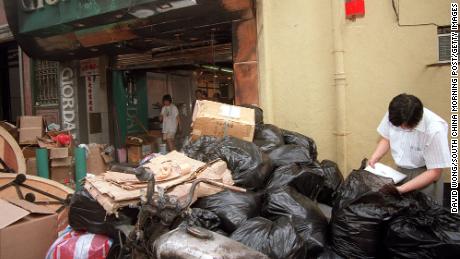
And as Lai’s feud with the Oriental Daily News intensified, Apple Daily fanned the flames, running stories that kept pressure on the Hong Kong government to not let the surviving Ma brother return from Taiwan.
Harassment
During Lai’s court hearings last month, it emerged that since at least 2013, Oriental Daily News has paid a team of reporters to follow Lai. The reporter whom the Apple Daily founder clashed with in June 2017 admitted in court to regularly trailing Lai leaving his house and work, taking photographs and video of those he interacted with, while always keeping a decent distance and never provoking him, he claimed.
“Why would you have a whole team of people being paid salaries for years on it and to follow around somebody you don’t like?” said the close observer of the Oriental Daily News empire. “It must have cost them an absolute fortune.”
But it wasn’t the first time the Oriental Daily News had assigned reporters to tail people it didn’t like.
In 1996, the Oriental Daily News sued Next Media for publishing on its front page a picture it had taken of pop star Faye Wong picking up her luggage at Beijing Airport while pregnant, without her consent. Oriental Daily News won a small sum for the copyright violation, but was made to pay for its appeal by a judge, who separately ruled against the paper in a case in which it was charged with publishing a series of indecent photographs of naked women.
In its Kung Fu Tea column, the newspaper wrote: “Oriental does not care if you are yellow-skinned or white or a pig or a dog. In our self-defence, we are determined to wipe you all out! Here, Kung Fu Tea warns the pigs and dogs: don’t you bother me again. Otherwise, when I counterattack in self-defence, you will regret it exceedingly, you will regret it! I repeat: you will regret it very much!”
Multiple people CNN approached for interviews for this article declined to speak on the record out of concern for their personal safety.
CNN reached out to the Oriental Daily News for comment on why it had a team tracking Lai for years, and the concerns of interviewees of this article, but did not get a response.
Criminal intimidation
Then in February this year, Lai was charged with criminal intimidation on the recommendation of Justice Teresa Cheng, who has been sanctioned in August by the United States for undermining Hong Kong’s freedoms. Arthur Lee, barrister and professional consultant at the Chinese University of Hong Kong, said generally when there is a long delay in charges being filed it can be due to a need to find more evidence, or difference in opinion as to whether to prosecute.
In a statement provided to CNN in response to a question on the initial delay in prosecuting the case, a spokesman for the Department of Justice said that it was “not appropriate for the Department of Justice to comment on the matter.”
“I consider it somewhat farcical that this even came to trial,” said Simon. “They harassed a guy to try to get a response and they got a response — but they didn’t get a guy trying to criminally intimidate anybody.”
In the judge’s verdict on Thursday, she said she could not “believe the reporter is an honest and reliable witness” and was not convinced he was “genuinely scared.” The court heard the reporter was seen smiling after the exchange with Lai.
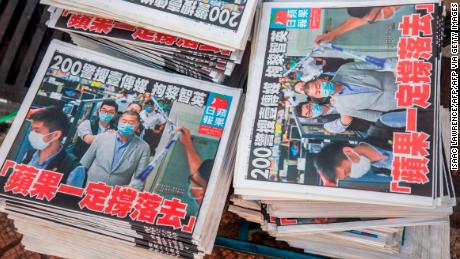
There are still more opportunities for Lai to go to jail this year. In February and April, Lai was charged with unlawful assembly for joining protests that were banned by the government in August and October last year. Each charge carries a maximum sentence of five years in prison. And Lai remains the most high-profile figure to be arrested under the national security law.
So far, the publicity around Lai’s arrests has given the Apple Daily a boost. Supporters last month rallied to buy Next Media stock, take out adverts in the paper and snap it up on news stands, causing it to sell out across the city and sell more than half a million copies in one day. Simon says digital subscriptions for Apple Daily, which launched an English-language version this year, are up by about 15% to 720,000, since the law came in.
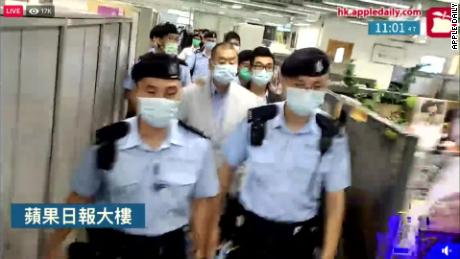
But if Lai was to be jailed, for any of the offenses he currently faces, the Oriental Daily News could find itself with a clear lead on the newsstands. Lam, the history professor and former journalist, says that in the current climate of growing media self-censorship, there is increasing worry that the Hong Kong and mainland governments will make life “more difficult for the newspaper — or even close it down.”
“Apple Daily is one of the very few media outlets which is there to criticize the Hong Kong and Beijing governments,” Lam said. Losing it would “be a loss for the Hong Kong community and a defeat for freedom of the media.”
“I don’t feel miserable about being handcuffed, neither do I feel humiliated, not at all … I am doing all these because this place has treated me too well and this is what I should.”
The battle on the newspaper stands lives to see another day.