Team sport? What knee injury taught Tejaswin Shankar about culture in Indian athletics
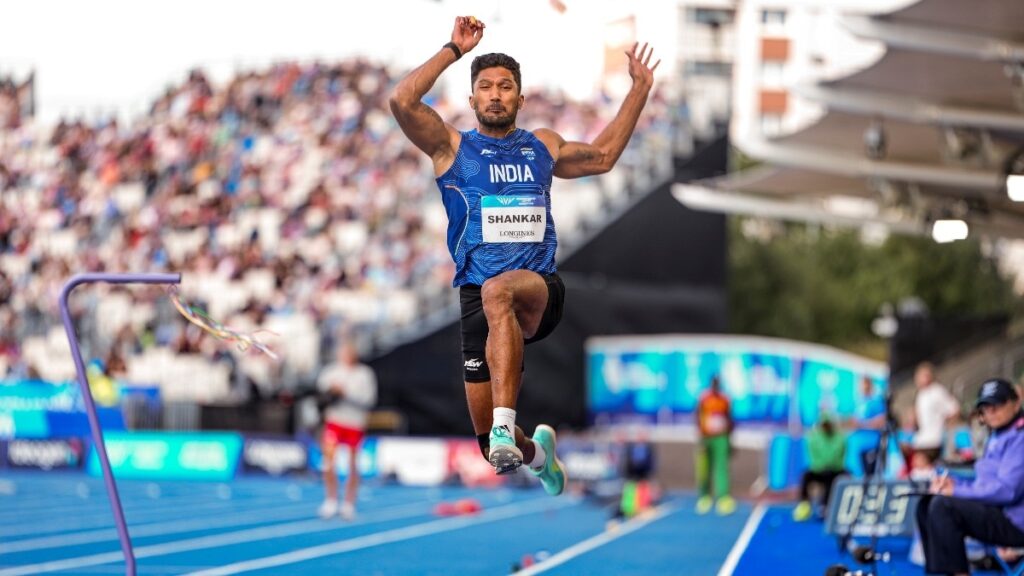
Even with an agonising patellar tendon injury threatening to end his Commonwealth Games campaign, Tejaswin Shankar refuses to go down without a fight. Sitting firmly in second place in the decathlon standings halfway through the competition, the Indian star remains in prime contention for a medal, all because he refused to give up.
After pulling out of the men’s high jump final, a teary-eyed Tejaswin had indicated that his CWG campaign might be over, but that turned out to be far from true on Thursday, July 30, when he came out and participated in 5 events of decathlon.
It was not a singular effort. First came the doctors, who treated him and got him fit enough to even take the field. Yet, the decathlon start was ominous: Tejaswin clocked 10.96s in the 100m sprint, finishing last among all athletes.
What could have served as the ultimate nail in the coffin for an athlete’s mind failed to break Tejaswin. He simply could not give up.
And thankfully he did not have to fight alone.
Over the two days leading up to the event, as he spent endless hours with doctors and endured sleepless nights rehabbing his knee, almost every Indian athlete in the contingent came to him to check on his health. They were busy preparing for their own events, but whenever they crossed paths with Tejaswin, they made sure to ask how he was feeling.
“Well, to be honest with you, there’s not one single athlete out there who did not check on me. Everybody in the team, I mean, this probably makes me feel like it’s not an athletics or a track and field team, but it’s a team sport event because literally every single one of the athletes checked on me.”
It happened everywhere, Tejaswin said, from the lists at the competition venue to the dining area in the athletes’ village.
“Every time they pass me on the list or, you know, in the dining area, whatever it is, every single one. There were a lot that came out to support today also. Everyone’s there, everyone’s asking about, you know, how I’m feeling.”
For Tejaswin, it was not just the questions about his knee that stayed with him. His teammates had seen the toll the injury was taking on him, too.
“Everybody said that they kind of felt bad watching me break down in front of, you know, the camera.”
For an athlete who had arrived in Glasgow as one of India’s biggest medal hopes, the moment was difficult. But the support around him also made Tejaswin realise that his Commonwealth Games campaign was no longer just about his own medal prospects.
He had become part of something bigger.
“So, I have come to this realisation that Commonwealth at this point in India has become a team sport and it’s not just an individual event. So everybody rallies around each other, and I feel like this is the culture. This is the environment I want to be part of.”
That was the culture Tejaswin wanted Indian athletics to carry forward. Not the familiar mindset of one athlete’s event being separate from another’s, but an environment where everyone celebrates each other’s successes and stands together through the difficult moments.
“I think we, as Indian athletes, want to promote in India and make track and field more of a fun sport and not just a secluded individual, my event, your event, kind of a mindset.”
“We want it to be our event. We want to celebrate everybody, we want to, you know, be in everybody’s sorrows, and that’s just how we want the next generation of sports to be.”
And after seeing his teammates rally around him through the most difficult phase of his Commonwealth Games campaign, Tejaswin was grateful that they had already begun building that culture themselves.
“And I’m so happy that all my teammates have taken that charge and I’m, you know, looking up to all of them.”
MASTERCLASS IN RESILIENCE
Perhaps fuelled by that sense of team warmth, Tejaswin put up a heroic effort across the five events of Day 1.
While the day started slowly with that 10.96s (870 pts) in the 100m, and ended in a brutal 400m sprint, where Tejaswin later admitted that after the 300m mark it felt like “a bear had latched onto my back”, as he clocked 49.51s (837 pts), what happened in between was nothing short of extraordinary.
Tejaswin achieved a personal best of 7.82m in the long jump (1,015 pts) and put in a superb 2.15m effort in his signature high jump (944 pts) to fling himself straight into the top tier of the field.
The high jump, in particular, carried a little more weight. This was the same event he had been forced to miss because of his knee injury, the event where he had been expected to challenge for a medal before his Commonwealth Games campaign appeared to be over.
Instead, Tejaswin returned to the high jump and cleared 2.15m.
Even with a modest 13.09m effort in the shot put (673 pts), his explosive jumps kept him right on the heels of the leader.
TEJASWIN SHANKAR IN 2ND PLACE
After five gruelling events, Tejaswin firmly holds second place with 4,339 points, trailing Canada’s Damian Warner by a razor-thin 14 points, while keeping England’s Sammy Ball a comfortable 90 points behind him.
The position is remarkable considering where Tejaswin was when the day began. A knee injury had taken away his individual high jump medal chance. His first event of the decathlon produced his slowest result. And yet, five events later, he is still firmly in the fight for a medal.
As he prepares for the pole vault, javelin and remaining events on Friday, Tejaswin isn’t just competing against the field. He is carrying with him the support of a contingent that refused to let one of its biggest medal hopes feel like he was fighting alone.
For Tejaswin, that may be the biggest takeaway from the first day of his decathlon.
In a sport built around individual events, individual performances and individual points, his injury brought out something much bigger from the Indian contingent.
A team.
– Ends