The night Indian women's cricket found its wings with World Cup heist
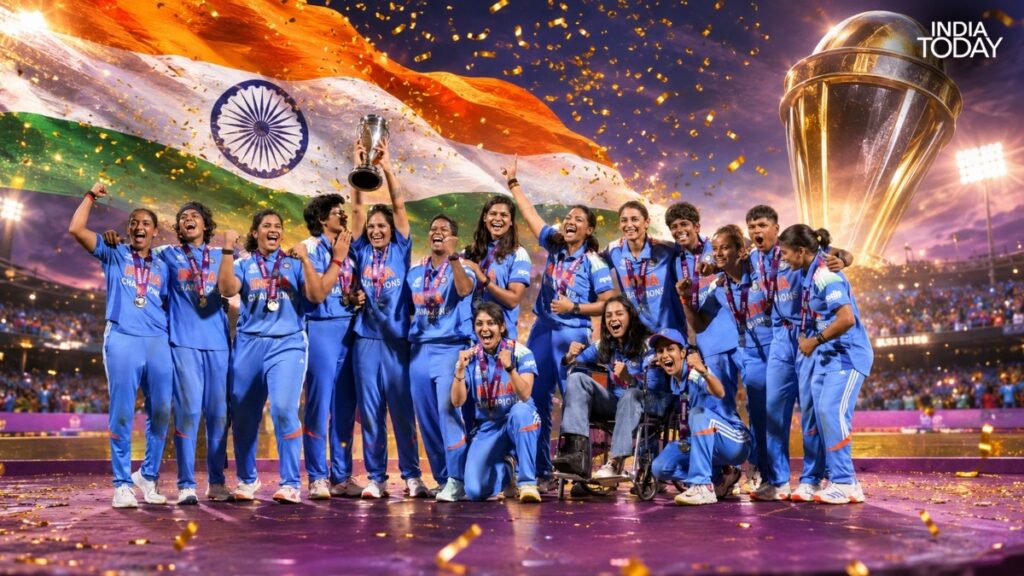
It has been 12 months since that unforgettable night, yet the memories remain as fresh as ever. It was a night when years of tears, heartbreak, sacrifices and unanswered prayers finally gave way to unbridled joy.
The Indian women’s cricket team did more than just win the ODI World Cup. They gave an entire generation of girls something far more precious: belief. The belief that their dreams were worth chasing, that the barriers standing in their way could be broken and that no girl should ever have to give up on becoming a cricketer simply because the world told her it wasn’t possible.
The match stretched deep into the night, but an entire nation refused to sleep. And when Harmanpreet Kaur pouched Nadine de Klerk’s catch to seal India’s victory over South Africa, the DY Patil Stadium in Navi Mumbai erupted. Pratika Rawal, celebrating with the team on a wheelchair after her injury, wore a smile that said more than words ever could. It was the smile of a nation that had waited long enough.
As journalists at India Today, we didn’t have the privilege of witnessing history unfold from the stands. We weren’t inside the DY Patil Stadium, surrounded by thousands of screaming fans. But the distance did little to diminish what we felt. Our hearts raced faster than John Abraham’s nitrous oxide-powered motorbikes in Dhoom.
It was well past midnight, but sleep was the last thing on our minds. Our fingers ached after a long day, but there was no stopping them. They continued to dance across our keyboards, almost like a musician’s fingers moving over a harmonium, searching for the perfect notes and melodies. We were exhausted, but we didn’t want to miss a single moment. How could we, when Indian cricket was living through a night it had waited decades for?
THE SLEEPING GIANT WAKES UP
If there was one player who emerged as an unlikely hero on that unforgettable night, it was Shafali Verma. Without her contribution, India could well have been staring at another World Cup heartbreak, reminiscent of the defeats they suffered in the 2017 ODI World Cup and the 2020 Women’s T20 World Cup.
Shafali wasn’t even part of India’s original World Cup squad. In fact, she wasn’t the first choice to replace Yastika Bhatia after the latter was ruled out through injury. Perhaps there were reasons for that. Shafali had an ODI average of just 22 and hadn’t scored a half-century in more than three years.
It was only after Pratika Rawal’s injury that Shafali finally got her opportunity. Even then, things didn’t immediately fall into place. She endured a disappointing outing against Australia in the semi-final, and questions were inevitable. Had India made the right call?
But the final had an entirely different script waiting for her. It was the stage on which the young opener would silence her doubters and remind the world of the extraordinary talent she possessed.
On November 2, 2025, Shafali played as though she had been saving her best for this very moment. Her magnificent 87 gave India the platform they desperately needed, but that was only half the story. As if her batting heroics weren’t enough, she produced a telling contribution with the ball, turning the contest decisively in India’s favour. She dismissed Kapp, who possessed the experience, temperament and ability to snatch the game away from India in the blink of an eye.
It was almost as if the sleeping giant had finally awakened just when India needed her the most. Our colleague Amar Sunil Panicker, who stayed back at work with us well past midnight, was among those left spellbound by Shafali’s performance.
“The potential Shafali possessed with the bat has been evident since her debut, so that knock wasn’t entirely surprising. But her bowling? That came as a complete surprise. It could have gone either way, but India knew the talent they had on their hands. That day, the world got to see just how special Shafali Verma truly is,” Amar said.
COMETH THE HOUR, COMETH DEEPTI SHARMA
While Shafali delivered a performance for the ages, India also had their premier all-rounder rise to the occasion when it mattered most. Deepti Sharma scored a crucial 58 in the final before returning to produce a match-winning five-wicket haul. But her journey through the tournament had been far from smooth. For a considerable part of the campaign, Deepti had been battling criticism and questions over her batting.
Our colleague Saurabh Kumar was in Visakhapatnam covering the matches when India suffered back-to-back defeats against Australia and South Africa in the group stage. Against Australia, Deepti managed just one run off six balls. Against South Africa, she struggled even more, scoring four off 14 deliveries.
“I think the frustration around Deepti was understandable during that campaign. In Visakhapatnam, Australia chased down 331, while South Africa chased a target of 252. These were games where India needed contributions across the batting order, and Deepti’s inability to score at a brisk pace, particularly against Australia when she made just one off six balls, did invite questions,” Saurabh said.
But the beauty of sport is that it always leaves room for redemption. Her knock in the final might not have been the explosive innings many expected, but it was an innings of immense value. And then came Deepti the bowler. The all-rounder transformed the contest with a spell that South Africa simply couldn’t find answers to.
“Before the final, I don’t think many of us expected her to have the kind of impact she eventually did. We knew she could play an important role, but what followed was something special.
“Having covered the campaign, what stays with me is the contrast. There had been questions about her batting for much of the tournament, but she produced her finest performance when India needed it most. I expected Deepti to contribute. I didn’t expect her to take charge of a World Cup final the way she did,” Saurabh added.
In the end, Deepti didn’t just silence the criticism. She turned it into the backdrop of one of the greatest performances of her career. When India needed a champion to step forward, their most dependable all-rounder delivered.
A JUGGLING ACT FOR THE AGES
For all the runs India had put on the board and the wickets they had picked up, there was one woman standing between them and history: Laura Wolvaardt.
The South African captain is not your conventional power-hitter who relies on sending the ball soaring into the stands. She has a different way of dismantling bowling attacks. With impeccable timing, effortless strokeplay and an almost meditative calmness at the crease, Wolvaardt has a way of grinding opponents down.
She had arrived in the final on the back of a magnificent 169 against England in the semi-final and was once again looking unstoppable. Having brought up her century, Wolvaardt was threatening to take the game away from India. Only two women had previously scored centuries in both the semi-final and final of a Women’s World Cup. Alyssa Healy had achieved the feat in 2022, and Wolvaardt also joined her in that exclusive club.
Just when it seemed India might be condemned to another night of heartbreak, Amanjot Kaur produced a moment that would live forever in the memories of Indian cricket fans.
On 101, Wolvaardt attempted to go aerial against Deepti Sharma but could only manage a top edge. The ball went high, and Amanjot settled underneath it. What followed was a moment that seemed to last an eternity. The ball slipped through her hands once, then again. For a fleeting moment, thousands of hearts must have skipped a beat. But Amanjot refused to give up. She juggled the ball, stretched every bit of her concentration and finally clung on to it.
As she fell flat on the ground with the ball safely in her hands, the relief was unmistakable. It was almost as if she had just caught the hopes and dreams of an entire nation. Radha Yadav hugged her in celebration, and the Indian players knew exactly what that wicket meant.
Our colleague Kingshuk Kusari still remembers that moment vividly. And why not? In a World Cup final, with the opposition’s best batter at the crease, even the slightest fumble can turn into a nightmare. For those few seconds, it seemed as though India were about to let their biggest opportunity slip away. But Amanjot held on, quite literally, when it mattered most.
“I think it was Wolvaardt’s wicket. Till she was there, batting in that form, South Africa had a reason to believe. I had to hold my breath when Amanjot fumbled the ball and then held on to the catch with her dear life,” Kingshuk said.
“The fact that our best fielder nearly fumbled and ended up taking a match-winning catch made it the most memorable moment for me.”
NO DEJA VU
India were firmly in the driver’s seat. They needed just four wickets to seal the World Cup, while South Africa were staring at the daunting task of scoring 90 runs off 63 balls. But there was one woman who refused to let India breathe easy: Nadine de Klerk.
The Indian players had every reason to be wary of her. After all, she had already snatched victory from the jaws of defeat with an unbeaten 84 in the group-stage clash in Visakhapatnam.
When de Klerk struck three boundaries, memories of that painful Vizag defeat would have come flooding back. The equation was still heavily in India’s favour, but anyone who had watched her heroics knew that numbers alone could not offer any guarantees.
Even with just one wicket remaining, there was no room for celebration. De Klerk had the temperament and firepower to make the impossible look achievable, something she would go on to demonstrate again at the same venue during WPL 2026 against Mumbai Indians. But this time, India weren’t going to let history repeat itself.
And then came the moment the entire country had been waiting for. Harmanpreet Kaur settled underneath the ball, held her nerve and completed the catch. De Klerk was gone. India were world champions.
Our colleague Alan John, who was watching the final on television from the office, remembers being on tenterhooks until that very moment.
“Even as Wolvaardt departed, Nadine de Klerk was the big wicket. Her heroics in the league-stage match were enough reason not to feel safe even at that point when India were on top,” Alan said.
“She had the ability to change the game, so it felt like the final was going to hinge on her dismissal. Funnily enough, she was the last to fall and it felt like a full-circle moment for the side. Claiming the wicket of de Klerk was the best way to cap off the tournament after the damage she did, and it was nice to see captain Harmanpreet take the catch,” Alan added.
Perhaps that was the most beautiful part of India’s triumph. The woman who had once broken their hearts was the last obstacle standing between them and history. And the captain herself made sure there would be no second heartbreak.
THE PERFECT REDEMPTION
There was a point in India’s World Cup campaign when questions were being raised about whether they even deserved to be considered title contenders. After beginning their campaign with victories over lower-ranked Pakistan and Sri Lanka, India suffered three consecutive defeats against Australia, South Africa and England.
India were still expected to scrape through to the semi-finals, but qualification was no longer the biggest concern. A far more uncomfortable question lingered: did this team really have what it took to become world champions? After all, winning a global title requires beating the best, and India had come up short against three of the strongest sides in the competition.
Saurabh, who watched India lose to Australia and South Africa, said, “Honestly, after the Vizag leg, I had serious doubts. Three successive defeats against Australia, England and South Africa had exposed India’s vulnerabilities, particularly the lack of a convincing sixth bowling option. The 330-run total against Australia, which still wasn’t enough, summed up India’s problems.”
The turnaround began with a commanding victory over New Zealand. It was more than just two points on the table. It was a much-needed injection of belief for a team that had begun to doubt itself. India had rediscovered their rhythm and marched into the semi-finals, where a familiar nemesis awaited them: Australia.
Earlier in the tournament, Australia had chased down 331 to register what was then the highest successful run chase in Women’s ODIs. This time, however, India had no intention of allowing history to repeat itself.
Chasing a daunting target of 339, India rode on Jemimah Rodrigues’ unbeaten 127 to pull off a stunning victory and take that record away from Australia. As Jemimah broke down in tears after sealing the win, it was impossible not to feel the weight of everything that had gone into that moment.
And then came the perfect ending. South Africa, the very team that had handed India one of their most painful defeats in the group stage, stood between them and the trophy. This time, India rose to the occasion, fought their way to victory and completed a journey that had once threatened to fall apart.
“Amid all the noise and scrutiny, Amol Muzumdar’s calmness in press conferences stood out. He never seemed rattled or appeared to lose faith. Looking back, that composure was striking. India eventually found their answers, and what followed was one of the most memorable turnarounds in World Cup history,” Saurabh added.
They had gone from being questioned to becoming champions. What had once looked like a campaign slipping away had turned into the perfect redemption story.
A WORLD OF CHANGE
A year ago, Indian women’s cricket was still fighting for greater recognition. Today, its biggest stars are being courted by brands, signing lucrative endorsement deals and commanding valuations that would have seemed unimaginable before their historic World Cup triumph. The transformation has been remarkable, and perhaps the biggest victory has come off the field.
The World Cup triumph transformed the commercial fortunes of India’s women cricketers almost overnight. According to industry estimates reported by The Economic Times in November 2025, endorsement values of leading Indian women cricketers surged by 25 to 100 per cent. Jemimah Rodrigues witnessed one of the biggest jumps, with her endorsement value rising from around Rs 60 lakh to over Rs 1.5 crore. Shafali Verma’s value, meanwhile, climbed from approximately Rs 40 lakh to more than Rs 1 crore.
Smriti Mandhana, already one of India’s most marketable female athletes, witnessed a further rise in demand for her endorsements. With more than 14 million Instagram followers at the time, she was already among the most recognisable faces in Indian sport. Rodrigues, meanwhile, attracted interest from several brand categories following her sensational World Cup campaign.
The change was not restricted to the established superstars. Harmanpreet Kaur, Harleen Deol and other members of the World Cup-winning squad also witnessed a surge in commercial interest. Harleen, in particular, landed a skincare endorsement, reflecting how her growing popularity was translating into opportunities beyond the cricket field.
More importantly, women cricketers are increasingly finding opportunities in sectors traditionally dominated by male sporting icons, including automobiles, banking, fintech and consumer technology. Their growing appeal among audiences has made them attractive ambassadors for brands looking to connect with a wider consumer base.
The World Cup did more than give India a trophy. It gave its women cricketers greater visibility, commercial value and recognition. They are no longer just sporting heroes; they are becoming influential brands in their own right. And this could be only the beginning.
THE DOMINANT INDIA YET TO COME
Winning the World Cup was a landmark moment for Indian women’s cricket. But the real challenge was always going to begin after the celebrations. India had climbed the mountain, but could they stay at the summit? Could they turn one historic triumph into an era of sustained dominance? That is the question facing Indian cricket now.
The 2026 Women’s T20 World Cup was a reminder that there is still plenty of work to be done. India failed to reach the semi-finals after losing their decisive group-stage encounter against Australia. While India’s campaign ended in disappointment, Australia marched into the knockouts unbeaten and eventually lifted their seventh title. It was another demonstration of the consistency, depth and ruthlessness that have made Australia the benchmark in women’s cricket.
India, meanwhile, are still searching for their first major T20I World Cup title. The ODI triumph proved that they have the talent and temperament to beat the best on the biggest stage. But one World Cup cannot define an era. India need to replicate that success in T20 cricket, build greater consistency across formats and develop a bench strength that allows them to remain competitive even when their established stars are unavailable.
Head coach Amol Muzumdar, too, has made it clear that sustained dominance is the ambition. He recently said he would be happy if India began dominating world cricket two years down the line.
India have already achieved something generations before them could only dream of. But the next generation deserves more than a single moment of glory. It deserves a team that can win consistently, challenge every opponent and make competing for trophies a habit rather than an exception.
The first mountain has been conquered. Now comes the harder climb. India need to prove that they can build a dynasty. The dream is no longer just to win a World Cup. It is to become the team everyone else has to beat.
– Ends