U.S. still watching allies for alignment of interests even amid defense pullback, analyst says
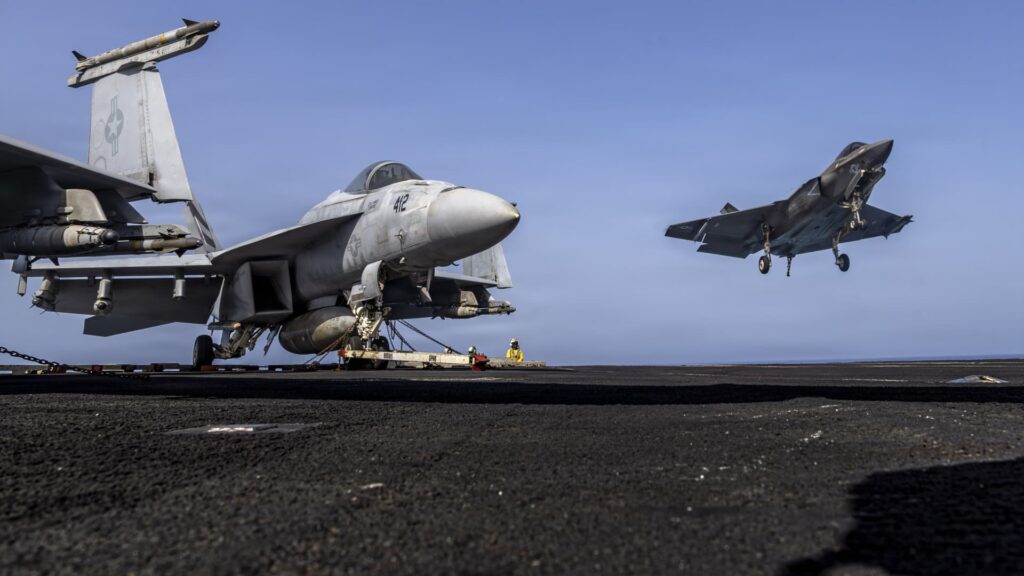
An F-35C Lightning II, attached to Marine Fighter Attack Squadron (VMFA) 314, prepares to make an arrested landing on the flight deck of Nimitz-class aircraft carrier USS Abraham Lincoln (CVN 72), May 25, 2026.
US CENTCOM
A U.S. pullback from Asia will give regional allies more responsibility for their own defense — but Washington is still watching for alignment with its own interests, according to Derek Grossman, professor of political science at the University of Southern California.
“The guiding mantra has been less of the U.S. is more, so long as countries who are doing things in the absence of the United States are doing things in line with what the U.S. wants,” Grossman told “Squawk Box Asia” on Wednesday.
Grossman’s comments came after President Donald Trump reiterated calls to substantially reduce joint military exercises with South Korea, citing the cost of drills, Seoul’s refusal to support U.S. war efforts against Iran, and his “good” relationship with North Korean leader Kim Jong Un. This week, the U.S. military also moved to cancel joint marine drills with South Korea that were scheduled for next month, due to constraints from the Iran war.
Washington appears willing to accept more regional cooperation without direct American involvement – as long as those partnerships remain aligned with U.S. interests, Grossman said..
“If Australia, the Philippines and Japan are meeting up without the United States in their own ‘minilateral’ security grouping, that’s fine because we trust all three of those countries,” he said. “The problem is when Japan starts meeting up with China and Russia,” he added.

Allies will likely respond by increasing “their military spending, investing more heavily in their own defense, and forming new partnerships with neighbors,” said Jennifer Kavanagh, senior fellow and director of military analysis from Defense Priorities. “Over time, regional partnerships that do not include the United States can provide U.S. allies with a Plan B.”
Grossman said that the focus of the current administration has been the defense of Taiwan, even as the U.S. “systematically deprioritizes other areas of Asia.”
U.S. Secretary of State Marco Rubio stated that “no one is contemplating walking away from Taiwan,” reaffirming Washington’s commitment to its security while en route to Asia last year. He also warned Beijing against “destabilizing actions” on Taiwan ahead of Trump’s meeting with Xi in May this year.
Still, Grossman said it remains to be seen how effective that stance is.
“The question immediately posed should be: how can you defend Taiwan when you’re fighting a war in Iran and wasting munitions there?” he said. “I don’t think the United States has really answered that question sufficiently.”