Wimbledon: Not at full throttle, Jannik Sinner still stands atop the tennis world
There are champions who overwhelm opponents with brute force and there are champions who survive through sheer conviction. Jannik Sinner’s successful defence of his Wimbledon crown belonged firmly to the latter category.
Wimbledon 2026 men’s singles final Highlights
For the better part of the last two years, the Italian has looked untouchable on the biggest stages, collecting Grand Slam titles with an air of inevitability. Yet, his run to the 2026 Wimbledon title was anything but straightforward. There were moments when he flirted with disaster, stretches when his game lacked its usual sharpness and days when the world No.1 had to lean on his resolve rather than his devastating baseline power.
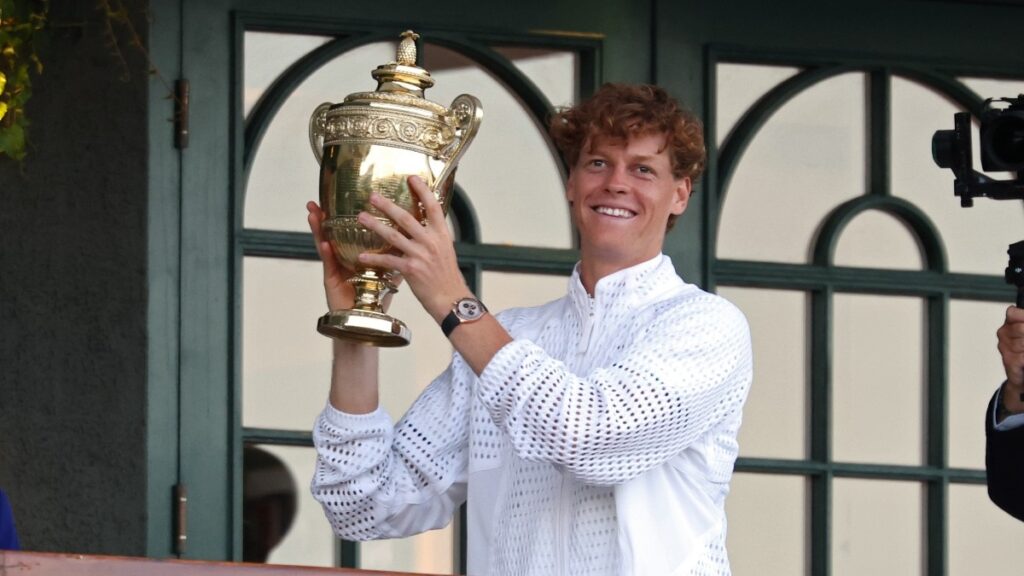
And still, when the dust settled on Centre Court on Sunday evening, it was Sinner who stood with the trophy in his hands once again.
The 24-year-old defeated Alexander Zverev 6-7 (7), 7-6 (2), 6-3, 6-4 in the final to retain the Wimbledon title and claim the fifth Grand Slam crown of his career. The triumph also cemented his position at the summit of men’s tennis, adding another chapter to a remarkable rise that has brought him titles at the Australian Open, the US Open and now back-to-back championships at the All England Club.
The result, however, tells only a fraction of the story.
This was not Sinner operating at his irresistible best. This was a champion discovering yet another way to win. Because greatness is not measured only by the heights a player can reach when everything falls into place; it is revealed in the moments when timing deserts him, confidence wavers and the margin for error disappears. Wimbledon 2026 was not about perfection. It was about survival, resilience and the rare ability to conquer even on days when the game does not entirely obey.
A CHAMPION PUSHED TO THE BRINK
For a player who has made Grand Slam success look routine in recent seasons, Sinner’s Wimbledon began in dramatic fashion.
The top seed found himself staring at a shock first-round exit against Miomir Kecmanovic. Two sets down after the first three, Sinner was on the verge of one of the biggest upsets in recent Wimbledon history. The Centre Court crowd sensed vulnerability, something rarely associated with the Italian in recent times.
Instead of folding, Sinner rediscovered his rhythm. He clawed his way back into the contest, gradually imposing himself from the baseline and eventually escaping with a five-set victory. It was one of the defining moments of the opening day, with the defending champion surviving an early scare that could easily have derailed his title defence.
The escape was significant not only because it kept his campaign alive, but also because it exposed something unusual: Sinner was not invincible.
And perhaps that is precisely what made this title run so compelling. Champions are often celebrated for their brilliance, but the truly exceptional ones endure when brilliance abandons them. Wimbledon became less a display of dominance and more a test of character.
Even in the second round, the Italian was forced into uncomfortable territory against Nuno Borges, battling through two tie-breaks before advancing. Across the fortnight, Sinner played seven tie-breaks—the most he has contested in a single Grand Slam campaign—winning five and losing two.
For a player whose biggest victories have often been built on relentless efficiency, those numbers reveal a different reality. Wimbledon 2026 demanded patience and resilience in equal measure.
THE MARGINS THAT DEFINED GREATNESS
The tie-break statistics offer perhaps the clearest window into Sinner’s championship.
Before arriving in London, he had never needed so many pressure-filled shootouts to capture a major title. His previous Slam triumphs were largely characterised by control, by an ability to seize momentum early and suffocate opponents before matches became complicated.
This year was different.
Against Jan-Lennard Struff in the quarter-finals, Sinner needed a tie-break to stay in control of a match in which he had to fight hard. He eventually won 7-5, 7-6 (4), 6-3, but not before surviving a set point and navigating one of the tournament’s most dangerous servers.
Struff had never played in a Grand Slam quarter-final before and became the oldest man in the Open Era to reach that stage for the first time. Keeping this in mind, Sinner was expected to coast through, but he had to stay on his toes. He had consciously shifted his focus towards conserving energy after his physically draining first-round battle.
The numbers underline just how demanding the fortnight became. Seven tie-breaks in seven matches is a workload more commonly associated with players fighting for survival than with the world No. 1.
Yet Sinner repeatedly found answers.
Perhaps that is the clearest marker of his evolution. Earlier in his career, tight moments occasionally exposed emotional cracks. Today, they reveal his greatest strength. He no longer panics when matches become messy. He embraces the chaos.
The most feared champions are not those who win only when they are at their dazzling best. They are the ones who continue collecting trophies even when their game falters, because they possess an unshakeable belief that, somehow, they will find a way.
That calmness carried Sinner into the second week and eventually into the championship match.
THE ZVEREV PUZZLE AND AN IMPERFECT FINAL
If there was one player expected to truly test Sinner, it was Alexander Zverev.
The German arrived in London with momentum and confidence after lifting the French Open title, but he also carried an unwanted burden: a dismal record against Sinner. Before the final, the Italian had beaten him in each of their previous nine meetings, transforming what once looked like a balanced rivalry into a one-sided affair.
Even so, the Wimbledon final offered complications.
Zverev claimed the opening set in a marathon tie-break and repeatedly stretched Sinner with his powerful serve and heavy groundstrokes. The contest remained finely poised deep into the third set, with the defending champion still searching for the break that could tilt the match in his favour.
Sinner eventually prevailed to secure his second consecutive Wimbledon title.
Yet the match may have turned on an unfortunate moment.
Zverev suffered a knee problem midway through the third set after slipping on Centre Court, visibly hampering his movement for the remainder of the contest. The injury altered the dynamic of the final and raised unavoidable questions about what might have happened had the German remained fully fit.
There is every chance that Sinner would still have found a way. Champions of his calibre usually do.
Because by now, Sinner has built a reputation that extends beyond the purity of his ball-striking. He has become a player who trusts his instincts when circumstances turn difficult, who refuses to surrender control even when momentum slips away.
DOMINANCE WITHOUT PERFECTION
The most remarkable aspect of Sinner’s Wimbledon triumph is not that he defended his title. It is that he managed to do so without ever appearing to hit top gear.
There were warning signs throughout the tournament: the five-set scare in the opening round, the succession of tie-breaks, the long stretches of uncertainty and the physical and mental effort required to survive.
Yet, once again, Sinner ended the fortnight as champion.
His route to the title was in stark contrast to the ruthlessness he displayed in the semi-finals, where he dismantled Novak Djokovic in straight sets to book his place in the final. The victory reaffirmed his status as the sport’s leading force, even if the path there had been unexpectedly turbulent.
For years, tennis fans have debated whether the post-Big Three era would produce a player capable of sustaining dominance. Sinner’s Wimbledon campaign provided a compelling answer.
The Italian is no longer defined by perfection. He is defined by adaptability.
He can survive when his timing deserts him. He can endure when matches become physical. He can absorb pressure in tie-breaks and emerge stronger. Most importantly, he can win Grand Slam titles without producing his very best tennis.
And that, perhaps, is the final step in the making of a champion. The great players dazzle when everything clicks; the extraordinary ones continue to triumph when it does not.
If this version of Jannik Sinner—one pushed to the edge in the opening round, dragged into seven tie-breaks and forced to dig deeper than ever before—can still walk away with the Wimbledon trophy, then the gap between him and the rest of the tennis world may be even greater than it appears.
Because the most unsettling truth for his rivals is this: Sinner no longer needs to be at his best to remain the best.
– Ends