Will rates go higher in Europe this week? Central banks confront stagflation threat
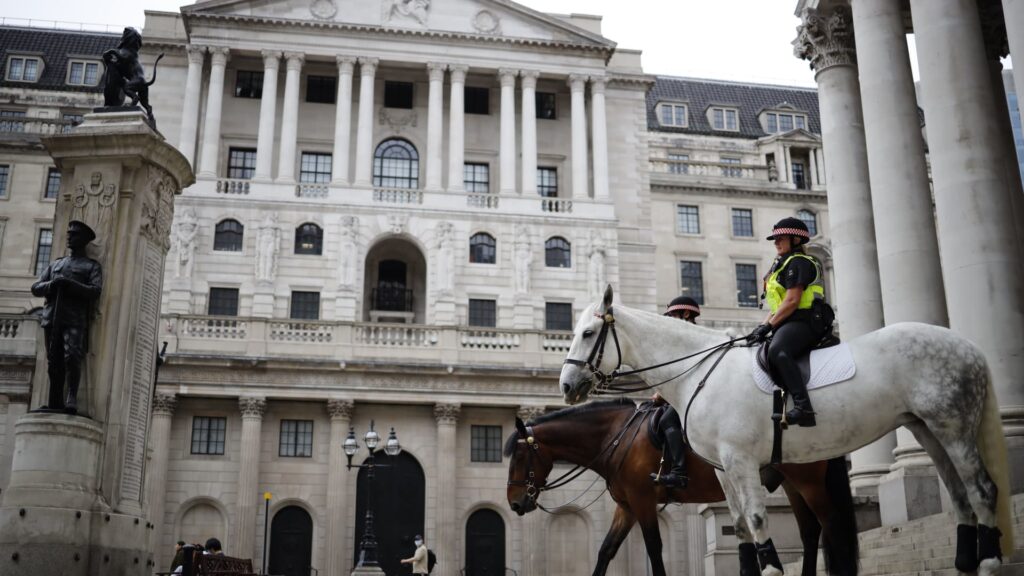
Mounted police officers sit in outside the Royal Exchange and the Bank of England in London on June 17, 2020.
TOLGA AKMEN | AFP via Getty Images
Europe’s central banks are in focus this week as the European Central Bank and Bank of England release their latest monetary policy decisions against a backdrop of rising prices and growth fears.
March data from the euro zone and the U.K. shows the Iran conflict is already weighing on economies, sparking fears of looming “stagflation” — slow growth, high inflation and rising unemployment.
Both the ECB and BOE kept rates on hold in March as the war started to shake the global economy, and both are expected to take a cautious approach on Thursday.
Markets quickly started pricing in interest rate hikes by both central banks in response to the outbreak of the Iran conflict, but economists now think policymakers will look through the “noise” around inflation spikes and keep rates on hold for longer at 2% for the ECB and 3.75% for the BOE.
The decisions come as inflation in the euro zone stands at 2.5%, and at 3.3% in the U.K, above the banks’ respective 2% targets.
“Energy prices aren’t far enough above the ECB’s forecast assumptions, while negotiation attempts between the U.S. and Iran sustain the bias towards assuming a short conflict,” Oxford Economics’ Chief Germany Economist Oliver Rakau told CNBC in emailed comments.
“Surveys also suggest a more front-loaded economic hit than in 2022, dampening worries about second-round effects,” he said.
Second-round effects refer to the more indirect consequences of sudden inflation shocks, such as workers seeking higher wages and firms raising prices. These often prove “stickier” and harder for central bankers to quell with monetary policy decisions.
A projected illumination marking the 75th anniversary of the Schuman Declaration, on the Grossmarkthalle building at the European Central Bank headquarters in Frankfurt, Germany, on May 9, 2025.
Alex Kraus/Bloomberg via Getty Images
Rakau added that the data needed to show sufficient evidence of second-round effects to push the ECB into action, but the bar is low.
“We expect signs of rising inflation expectations, a resilient labor market, contained economic damage and accelerating core inflation to trigger rate hikes in June and July,” he said, noting: “This modest tightening balances the inflicted economic costs and the ECB’s aim of capping second-round effects.”
The ECB’s forward guidance will be closely watched on Thursday, as ever. ECB President Christine Lagarde said at the bank’s last gathering a month ago that policymakers were ready to hike interest rates even if an expected jump in euro zone inflation proves temporary.
Economists say the bank’s June meeting will be the one to watch, with a potential 25-basis-point increase to take its key interest rate to 2.25%.
The ECB’s governing council will want to afford itself “full optionality to raise rates at a subsequent meeting should the data warrant it,” BNP Paribas economists said in emailed analysis ahead of the meeting.
“An April hold would therefore not necessarily signify a response is not required, only that there is insufficient data to justify the decision at this moment. Absent a significant and sustained fall in energy prices in the near term – not our central case – we ultimately expect the data to support a 25bp rate hike at the June meeting.”
BNP Paribas does not think the ECB would pre-commit to a hike, or indicate a strong bias towards such an outcome, however. “Instead, it is likely to emphasize it is ‘well positioned’ to wait and see – in line with the slightly less hawkish tone of recent communications,” they noted.
CFO of Santander Jose Garcia Cantera told Squawk Box Europe on Wednesday he does not expect to see significantly higher rates on the continent anytime soon.
“The central banks are taking a pause. In Europe, they are looking to higher rates, but very moderately,” he said. “The [ECB] was doing a great job of containing inflation, so that trend will probably mean the need for higher rates is going to be very moderate.”

BOE hesitates
When the Iran war started in late February, it upended the BOE’s forecasts for inflation to start cooling towards its 2% target.
The bank said in March it expected inflation is now likely to peak between 3% and 3.5% in the second and third quarters of 2026, due to higher energy prices, but cautioned that uncertainty over the war made predictions tricky. The last data showed inflation jumped to 3.3% in the twelve months to March, up from 3% recorded the month before.
A series of interest rate cuts were expected in 2026, but those predictions reversed once the war broke out with the expectation that the bank will hike rates this year.
Those expectations have diminished, however, and economists now expect the majority of BOE’s nine-member monetary policy committee (MPC), led by Governor Andrew Bailey, to show extreme caution on monetary policy.
Andrew Bailey, governor of the Bank of England (BOE), during the Monetary Policy Report news conference at the bank’s headquarters in the City of London, UK, on Thursday, Aug. 1, 2024.
Bloomberg | Bloomberg | Getty Images
A majority of economists polled by Reuters last week said they expected the BOE to keep rates unchanged for the rest of the year, arguing policymakers will choose to “look through” the spike in inflation caused by external factors. BOE rate-setters will also be wary of encouraging “stagflation” if they raise rates.
For this week’s meeting, a majority of economists expect an 8-1 split in favor of keeping rates on hold this month, with BOE hawk and Chief Economist Huw Pill expected to be the only dissenter in favor of a hike. Morgan Stanley’s Chief U.K. Economist Bruna Skarica and Strategist Fabio Bassanin said markets would be looking for simple communication from the bank and a clear strategy.
“Messaging-wise, it is hard to see anything but guidance of potential action should risks of second-round effects rise. We do assume a more prominent role versus March for caveats around acting in a manner that takes into account the impact of tighter policy on growth,” they said in emailed analysis ahead of the vote.
The analysts said that “the question is not whether inflation will rise following the sharp uptick in commodity prices. The dilemma, rather, is whether tightening policy to ensure a swifter return to the 2% target would be worth the estimated loss in growth.”
Suren Thiru, ICAEW’s chief economist, said a policy hold looks a near certainty.
“Stagflation fears will cast a long shadow over this policy meeting with elevated concerns over inflation possibly pushing at least one of the more hawkish rate-setters to break ranks and vote to raise rates,” he added.
“Setting policy is likely to become more hazardous for committee members, especially given rising global headwinds.”
Thiru added: “The squeeze on demand in the economy from weakening wage growth and a slowing economy should give policymakers sufficient wriggle room to keep rates on hold through this period of elevated inflation.”