10-year Treasury yield hits new high for the year after very hot producer prices reading
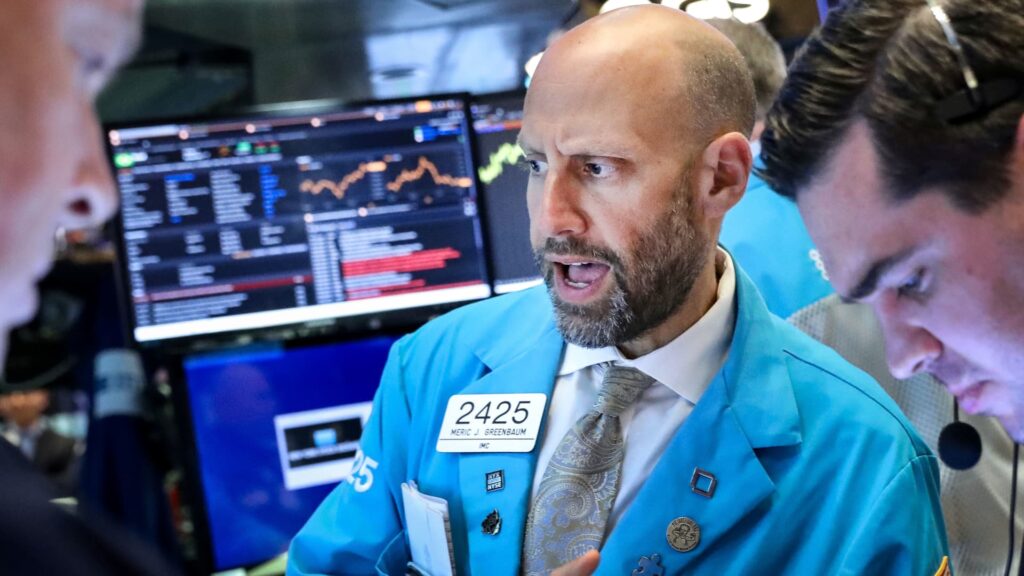
Traders work on the floor at the New York Stock Exchange.
Brendan McDermid | Reuters
The 10-year U.S. Treasury note yield rose on Wednesday as investors digested the implications of hotter-than-expected wholesale prices in April.
The yield on the 10-year note — the key benchmark for U.S. government borrowing — was last up 1 basis point at 4.481%. It had risen as much as 3 basis points to hit a high of 4.49%, reaching its highest level since July 17.
The 2-year Treasury note yield, which more closely tracks short-term Federal Reserve interest rate policy, was less than 1 basis point lower at 3.992%. The longer-dated 30-year Treasury bond yield was up more than 1 basis point at 5.048%. It had earlier advanced 2 basis points to 5.05%, its highest level since July 17.
One basis point is equal to 0.01%, and yields and prices move in opposite directions.
The producer price index rose a seasonally adjusted 1.4% for the month, much higher than the 0.5% Dow Jones consensus forecast and the upwardly revised 0.7% March increase. This was the largest monthly gain since March 2022.
On an annual basis, the index was up 6%, the biggest increase since December 2022.
“Wednesday’s PPI was strikingly elevated as producers are feeling the ripple effects of $100 per barrel oil, which is raising the cost of production across the board, as energy is arguably the most critical input cost,” said Clark Bellin, president and CIO of Bellwether Wealth.
The Bureau of Labor Statistics reported Tuesday that non-seasonally adjusted consumer prices rose at an annual rate of 3.8% in April — the highest since May 2023. That was more than the 3.7% year-over-year inflation expected by economists polled by Dow Jones. Annual core inflation, excluding food and energy, rose by 2.8%, also above the 2.7% anticipated by economists.
By either measure, inflation is running far hotter than the central bank’s stated goal of 2%, which the Fed seeks in order to meet its objective of ensuring stable prices in the economy.
The hot inflation readings could complicate the Federal Reserve’s path forward.
“The Federal Reserve has an inflation problem on its hands at a time when the labor market has slowed down, and that makes its job much more difficult, especially as the central bank is set to welcome a new Chair in the very near-term,” Bellin said.
— CNBC’s Lisa Kailai Han also contributed to this report.