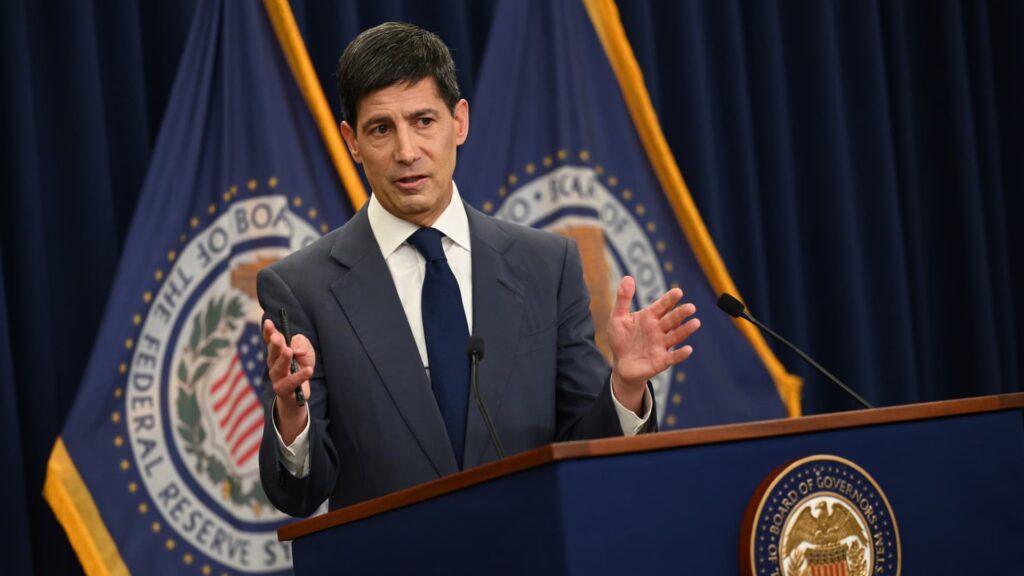
The Federal Reserve needs to seriously consider raising rates at next week’s meeting as upside risks to inflation have the potential to spiral out of control. While markets still expect de-escalation as the most likely path forward, the geopolitical backdrop has deteriorated considerably over the past week. If the current conflict persists for even a few more months, the resulting strain on global energy supplies and shipping routes could push prices dramatically higher. Even putting aside those risks, capital expenditures related to the AI buildout, robust consumer spending and rising wages driven by a tight labor market have kept inflation above the Fed’s 2% mandate. Meanwhile, financial leverage and speculation are on the rise, creating the potential for asset bubbles. Animal spirits driven by AI fever drove South Korea’s Kospi index up over 116% this year before crashing into a bear market. The Bank of Korea waited too long to hike rates and regulators too long to rein in margin excess, a cautionary example as the Fed risks making the same mistake. Oil buffer is running out Strategic reserve releases have provided a critical buffer, with hundreds of millions of barrels released globally to offset supply disruptions. However, those reserves are finite, and with U.S. inventories already near multidecade lows, the ability to cushion further disruptions is becoming increasingly limited. If the Strait of Hormuz remains effectively closed into the fall, markets may be forced to reprice oil sharply higher as supply tightens. The risk extends well beyond crude prices. The strait is a critical artery for global trade, carrying significant volumes essential commodities aside from oil and LNG. Threats to shipping routes in the Red Sea and Black Sea are adding to global supply chain pressures. Prolonged conflict could reignite inflation by raising energy and transportation costs, squeezing consumers and businesses at a time when markets have largely assumed price pressures will continue to ease. Both Iran and the United States are likely to remain locked in conflict because each side sees continued escalation as serving its strategic interests, while the costs of backing down have increased. Iran appears motivated to use control over the Strait of Hormuz and attacks on regional infrastructure and shipping as its strongest leverage against U.S. pressure — especially before alternative energy routes and defensive measures reduced its ability to disrupt global markets. The U.S., meanwhile, faces pressure to prevent Iran from gaining control over a critical trade chokepoint and to avoid appearing unable to protect energy security and nuclear proliferation. Trump appears willing to accept prolonged inflation if it allows the conflict to run its course. That stance is consistent with his own remarks praising the inflation he has said he ” loves .” Tariffs are back on the table for both Canada and a host of other countries . The Fed risks falling behind While the Fed may argue that monetary policy has limited effects on tariffs and supply side shocks and that it has no way of knowing how large or long lasting those effects may be, the greater risk is if inflation expectations become unanchored due to an oil price spike. Given the uncertain outcomes the Fed needs to think less in terms of linear economic curves and more probabilistically, in which case the potential upside for inflation given an energy price spike could warrant quicker action. If the situation in the Strait remains unchanged by the Fed’s September meeting, the window for a timely policy response may have already closed, leaving the Fed behind the curve. Even so, a softer-than-expected June consumer price index will likely keep the Fed on hold in July as it leans on backward-looking data distorted by a one-time flood in the supply of oil during the short ceasefire. Speeches from two influential Fed governors, Christopher Waller on July 13 and John Williams on July 15 pointed to the favorable trajectory of oil prices, noting it would help ease headline inflation. Here is Waller: “Market prices for the delivery of crude oil between now and the end of December have given back much of their earlier increases, and that will put downward pressure on headline inflation in the coming months.” And Williams: “Based on oil prices today and futures market pricing into next year, it appears that prices for energy and related goods have likely peaked and will come down closer to levels seen before the initial closure of the Strait of Hormuz. Of course, this situation is fluid and subject to a great deal of uncertainty.” A week and a half later, these observations look dated and likely don’t reflect the current views of the governors. It’s notable that they are not looking at prices for front month crude, but rather are looking out a few months on the futures curve as those prices more accurately reflect price expectations over the medium term. December WTI futures are now trading above $79 a barrel, just $6 below their 2026 contract high, suggesting that market participants expect current shipping and production disruptions to persist. Markets have already looked past the CPI report. Ten-year Treasury yields are now six basis points higher than they were on July 14, just before the release, as investors shift their focus to the potential deterioration in supply chains and energy production. It’s very much the long end of the yield curve that the Fed risks losing control of through inaction. Expectations for a 25-basis point hike in July are also on the rise, with traders on Kalshi expecting a 22% chance, up from 4% on July 16 , while the CME’s FedWatch tool , which uses 30-day Fed Funds futures prices, implies a 36% chance of a hike. Chairman Kevin Warsh has talked tough on inflation and his creation of task forces to study how the Fed operates seems a measured approach, but portends inaction. A 25-basis point hike in July would be a true pronouncement that the Fed is serious about inflation, and it doesn’t need to be completely about energy risks. A resilient consumer gives the Fed room to tighten Consumer demand remains robust. Core retail sales climbed 10.1% year-over-year in June, the ninth month in a row, according to the CNBC/NRF Retail Monitor. Working class consumers care more about inflation than the stock market. Adam Parker of Trivariate Research argues that the K-shaped economy “is more balance sheet than income statement.” Lower income households are not building wealth at the rate of their higher income cohorts, but lower income wage growth is accelerating, credit performance remains healthy and “most households still describe their finances as acceptable.” Consumers continue to spend. CIBC Head of Equity and Portfolio Strategy Christopher Harvey pointed out in a Monday note that executive commentary from recent bank earnings has been very positive on the consumer side with JPMorgan Chase CFO Jeremy Barnum saying, “when it comes to consumer credit performance, it’s just about the labor market. And so you’re not going to hear anything from me that’s new or differentiated about the labor market, like we all see the same numbers and it’s been surprisingly resilient.” Unemployment, the other side of the Fed’s dual mandate, was 4.2% in June below the 4.4% seen in December 2025, the last time the Fed cut rates. Thursday’s weekly jobless claims were the lowest since 1969. It would be hard to argue that the current labor picture is keeping the Fed from raising rates. On the corporate side, the unabated AI buildout is pushing prices higher. “Backlogs are continuing to rise as supply remains constrained across many parts of the AI infrastructure stack,” UBS strategist Keith Parker wrote Monday in a note. Warsh had opined that AI-driven productivity gains could lead to disinflation, but Barclays analyst Jonathan Millar said “available data provide little compelling evidence that industries with faster AI adoption are already experiencing stronger productivity growth. Given this, we have little reason to believe that such productivity gains are already leading to cost savings that will help tame inflation, which argues against moves to ease monetary policy on such grounds.” “AI investment has contributed 1pp to real GDP growth over the last year with upper income consumption adding another 90bp, supported by wealth effects,” Parker said Tuesday. Sticky inflation It could also come down to the fact that five years above its 2% target rate is just too long to call transitory. Even after coming in softer than expected, the core CPI in June was 2.6% year-over-year, the same as December 2025. June’s core personal consumption expenditures price index, the Fed’s preferred gauge of inflation, will be released Thursday, after the Fed’s two-day meeting on Tuesday and Wednesday. The core PCE is expected at 3.4% year-over-year. It has been slowly creeping higher in 2026 after printing in a range of 2.6% to 3.0% in 2024 and 2025. Even after stripping out temporary factors Bank of America analyst Aditya Bhave writes core PCE would still be 2.5% and that “the combination of persistently elevated core inflation and a stable, if not improving, labor market argues for tighter monetary policy rather than an extended pause.” In a separate note, Bank of America Global Economist Claudio Irigoyen, who expects the Fed to hike a total of 75 basis points this year, said that “if markets conclude that underlying inflation hasn’t subsided, [Warsh] could lose the credibility that he earned with his hawkish tone in June. In this case, the yield curve would steepen, with long-end breakeven inflation pricing in a sustained inflation overshoot.” Don’t wait for the bubble to burst A Fed hike could also help rein in speculative excesses and help promote financial system stability. Margin debt has grown over 40% year-over-year to levels last seen near speculative market peaks in 2000, 2007 and 2021, according to data from Leuthold Group. And that doesn’t consider leveraged ETFs, which have seen astronomical asset growth this year. All this borrowed money is pushing the limits of the balance sheet capacity of the large money center banks and raising the cost of equity financing. South Korea provides a cautionary tale about what can happen if you wait too long to act. A boom in AI-related stocks Samsung and SK Hynix helped fuel an increase in household debt used to purchase more stocks and real estate in Seoul. In mid-July, the Bank of Korea raised interest rates for the first time in over three years while regulators halted new single-stock leveraged ETF listings but only after the Kospi index fell 26% from highs reached a month previous, leaving investors asking for their money back after more than 300,000 retail trading accounts (1 in 30 adults in the country) were wiped out on a single day following margin calls, according to Goldman Sachs. The Fed’s challenge is not to predict exactly how these risks will unfold, but to recognize that the cost of waiting may be far greater than the cost of acting preemptively. By delivering a 25-basis-point hike in July, the Fed could demonstrate continued resolve on inflation, retain room to maneuver in the face of future shocks, and mitigate the risk of once again being forced to play catch-up. THIS CONTENT IS PROVIDED FOR INFORMATIONAL PURPOSES ONLY AND DOES NOT CONSTITUTE FINANCIAL, INVESTMENT, TAX OR LEGAL ADVICE OR A RECOMMENDATION TO BUY ANY SECURITY OR OTHER FINANCIAL ASSET. THE CONTENT IS GENERAL IN NATURE AND DOES NOT REFLECT ANY INDIVIDUAL’S UNIQUE PERSONAL CIRCUMSTANCES. THE ABOVE CONTENT MIGHT NOT BE SUITABLE FOR YOUR PARTICULAR CIRCUMSTANCES. BEFORE MAKING ANY FINANCIAL DECISIONS, YOU SHOULD STRONGLY CONSIDER SEEKING ADVICE FROM YOUR OWN FINANCIAL OR INVESTMENT ADVISOR. Click here for the full disclaimer.