European nations to boycott FIFA World Cup if privatisation plans go ahead

The Union of European Football Associations (UEFA) and its 55 member associations have unanimously voted to boycott the FIFA World Cup and all other FIFA competitions if world football’s governing body proceeds with its controversial proposal to sell minority stakes in a subsidiary that would manage its global tournaments.
The decision, taken during a virtual meeting on Thursday, marks a dramatic escalation in the growing opposition to FIFA President Gianni Infantino’s plan to create a 20 billion US Dollar subsidiary to oversee the commercial rights of the World Cup and other FIFA competitions. FIFA intends to offer up to 20 per cent ownership in the entity to external investors while retaining majority control.
WORLD CUP NOT FOR SALE
In a strongly worded statement, UEFA said its member associations had unanimously rejected the proposal, warning that European national teams would stay away from FIFA events unless the plan was scrapped.
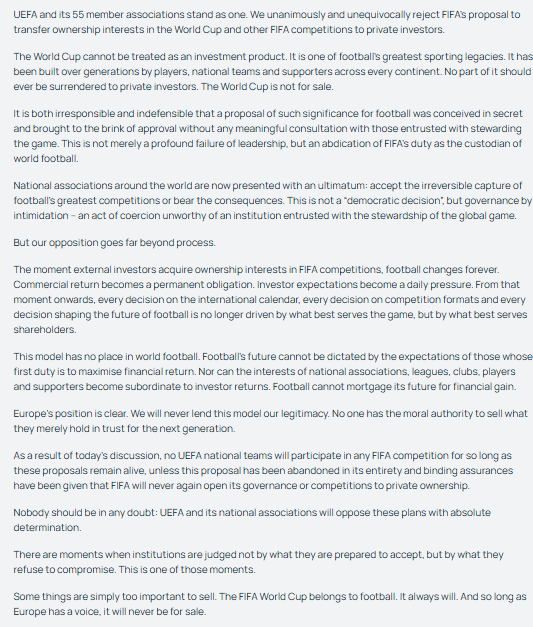
“No UEFA national teams will participate in any FIFA competition for so long as these proposals remain alive, unless this proposal has been abandoned in its entirety and binding assurances have been given that FIFA will never again open its governance or competitions to private ownership,” UEFA said.
The European governing body insisted that football’s biggest tournament could not be treated as a commercial asset.
“The World Cup cannot be treated as an investment product. It is one of football’s greatest sporting legacies. It has been built over generations by players, national teams and supporters across every continent.
“No part of it should ever be surrendered to private investors. The World Cup is not for sale.”
England’s Football Association backed UEFA’s position, with an FA spokesperson saying the organisation “stands shoulder to shoulder with our European colleagues.”
OPPOSITION GROWS
The backlash against FIFA’s proposal has spread beyond Europe.
Earlier this week, the Asian Football Confederation (AFC) criticised FIFA for failing to consult its member associations before announcing the plan. AFC president Sheikh Salman bin Ebrahim Al Khalifa described the lack of consultation, along with the absence of detailed governance, financial and legal analysis, as “totally unacceptable.”
CONCACAF, the governing body for North America, Central America and the Caribbean, also questioned FIFA’s decision-making process, saying member associations had not been adequately consulted before the proposal was unveiled.
The African confederation is expected to discuss the issue at an executive committee meeting next week, while Oceania’s governing body will deliberate on the proposal next month. South American governing body CONMEBOL has yet to publicly state its position.
FIFA’S PROPOSAL
FIFA announced earlier this week that it plans to establish a new commercial subsidiary valued at around 20 billion US Dollars to manage the World Cup and its other competitions.
The governing body plans to sell minority stakes of up to 20 per cent to external investors while retaining majority ownership and operational control.
As part of the proposal, FIFA has offered significantly increased financial distributions to its 211 member associations. Each association would receive US$40 million if the proposal is approved by September 19. If rejected, the payout would revert to the previously proposed US$10 million per association.
Infantino has maintained that the proposal will ultimately be decided through a vote of FIFA’s member associations before being considered by the FIFA Council.
Former Liberty Media chief executive Greg Maffei, who is advising FIFA on the project, defended the proposal, saying FIFA was not “selling the World Cup” and would continue to retain majority control of its competitions.
WHAT NEXT?
The controversy comes with several major FIFA tournaments on the horizon, including the 2027 Women’s World Cup in Brazil and the inaugural Under-15 World Cup in Azerbaijan later this year.
With UEFA threatening to pull all of its national teams from FIFA competitions and other confederations voicing similar concerns over governance and transparency, FIFA now faces mounting pressure to convince its member associations that the proposal will safeguard the future of the world’s biggest football tournaments rather than fundamentally change them.
– Ends