S&P 500 falls, weighed down by oil prices; Nasdaq craters as AI stocks falter: Live updates
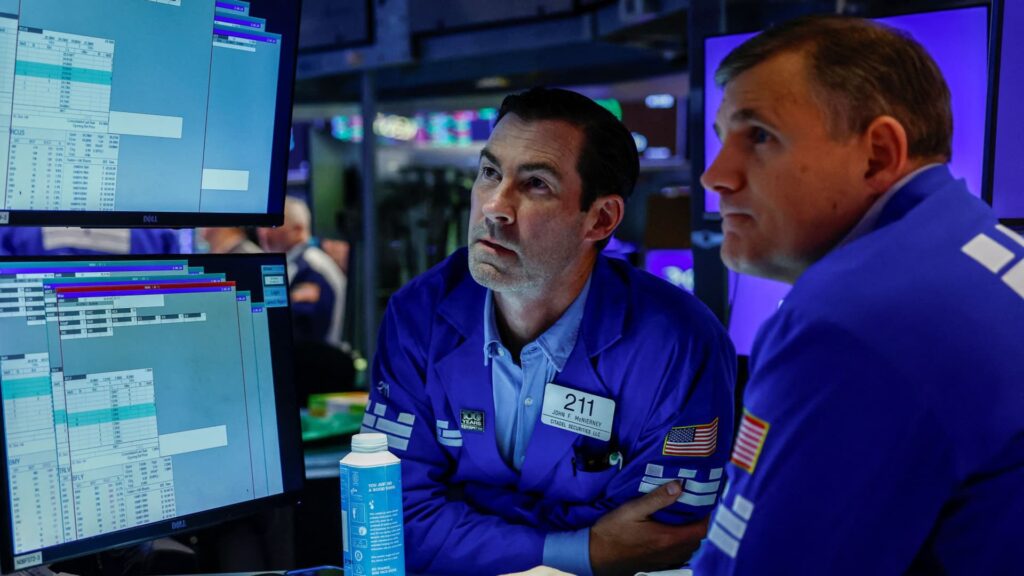
Traders work on the floor of the New York Stock Exchange (NYSE) in New York City.
Jeenah Moon | Reuters
The S&P 500 moved lower on Thursday as investors faced pressure from falling technology stocks and elevated oil prices.
The broad market index dipped 0.6%, while the Nasdaq Composite was down 1.2%. The Dow Jones Industrial Average shed 67 points, or 0.1%.
Shares of key tech names came under pressure after the Financial Times reported that OpenAI’s annualized revenue is about $20 billion short of the amount previously signaled. Shares of Oracle were down more than 5%, while chipmakers such as Nvidia and Advanced Micro Devices lost 2% and 3%, respectively.
Adding to the downbeat sentiment, oil prices spiked also after President Donald Trump said he doesn’t want to make a deal with Iran to end the war, while the U.S. is reportedly preparing for “massive bombing” in the Middle East. However, he later said that the U.S. won’t attack Iran before the midterm elections early next month, moving oil off its highs. Brent crude was last seen up 4% to around $104 per barrel. West Texas Intermediate futures, meanwhile, advanced 4% to around $91.
Traders also watched the moves in Treasury yields after the 10-year yield and 30-year yield scaled to fresh 24-year highs this week. The benchmark 10-year yield was last down more than 3 basis points at 5.244%, while the 30-year yield was down 4 basis points at 5.621%. Those moves came after a solid 30-year auction by the Treasury.
“At the end of the day, I think it’s inflation pressures, primarily driven by energy, that have shifted the Fed’s disposition and have in a lot of ways shifted the long end of the curve as well,” said Ross Mayfield, Baird investment strategist. “If we announced a deal with Iran tomorrow that was structurally sound and removed a lot of the tensions from the area, and oil dropped from $90 a barrel to $70 a barrel, yields would come down meaningfully.”
Yields and oil have stoked volatility in equities of late, as concern grows that higher energy prices will keep inflation elevated and force the Federal Reserve to further raise rates.
While Mayfield said equities have been “pretty resilient” overall in the face of these pressures, with the S&P 500 and Nasdaq notching fresh all-time highs this week, he still doesn’t think it would “take much of a move higher” on the long end of the yield curve to spell “more significant headwinds” for stocks. He believes yields could stabilize in the 5% to 6% range.
“We are in the process of the market adjusting to these new yields,” he added. “In a lot of ways, higher yields are reflective of stronger nominal growth and slightly higher inflation, and if that’s the case going forward, then again, it makes the argument that this kind of higher-for-longer or normal-for-longer rate environment is probably here to stay, barring a big recession where the Fed cuts rates to zero.”
Palantir Technologies was one of the few stocks trading higher on Thursday, with shares gaining 2% after the name received an upgrade at Goldman Sachs. The firm called for more upside ahead as the total addressable market could be “setting up for another step function change” as a result of the shift to sovereign AI and bespoke applications.