Some in Florida and Alabama without power as Isaias moves north to Appalachians and Mid-Atlantic
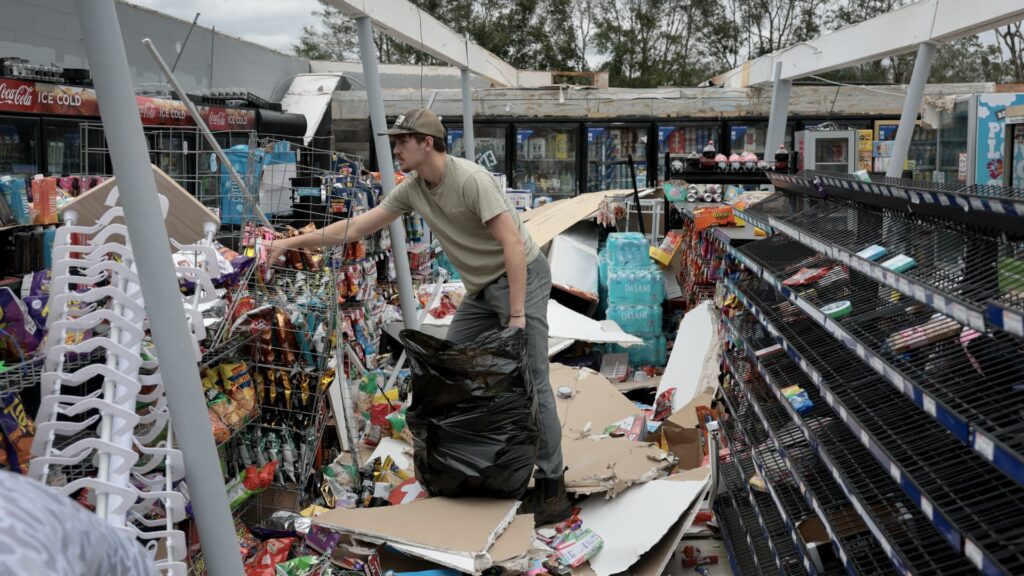
Copper Brock helps salvage what he can from the Milton Quick Stop after the roof was torn off when Hurricane Isaias passed through the area on Oct 10, 2026, in Milton, Florida. Hurricane Isaias made landfall as the season’s first Atlantic hurricane with Category 2 winds.
Joe Raedle | Getty Images News | Getty Images
Nearly 396,000 customers across the Florida Panhandle and southern Alabama remained without power early Sunday as remnants of Isaias moved north, where widespread moderate to heavy rainfall was expected across the central Appalachians and mid-Atlantic region.
Heavy rainfall was expected to be the “primary hazard” as the storm moves north, said Philippe Papin, a senior hurricane specialist at the National Hurricane Center in Miami. Parts of the southeastern U.S. and mid-Atlantic could see scattered power outages and downed trees and power lines. Life-threatening surf and rip current conditions were expected to continue along the Gulf and southeastern Atlantic coasts, according to the National Weather Service.
“We’re expecting that heavy rainfall to continue here across the central Appalachians into the mid-Atlantic here during the day on Sunday, and we’re still expecting isolated flash and urban flooding, and there may be also some residual gusty winds associated with the system as it continues to kind of move up the spine of the Appalachian mountains,” Papin said.
At least four deaths were linked to the storm, including two people killed when trees fell onto homes in Florida and Alabama. Forecasters warned that flooding could stretch into the Appalachians.
Isaias made landfall Friday as a Category 2 hurricane near Destin, Florida, a Gulf Coast vacation spot filled with high-rises and tourist shops.
Despite warnings of storm surges, several major routes along the coast were open by daybreak Saturday and free of the downed trees and power lines typically seen after major hurricanes.
Hurricane-force winds in the Florida Panhandle blew the roof off a Pensacola hotel, and the city’s mayor said the airport “took some damage.” The storm flattened a boathouse in Destin and ripped away part of a high-rise facade in Panama City Beach.
A worker in a condominium parking lot swept piles of the building’s insulation while others put back beach chairs that had been tossed about.
In Florida’s Escambia County, Sheriff Chip Simmons said a woman was killed when a tree fell on her home, and a man died of carbon monoxide fumes from a generator running in his garage. Four of the man’s family members, ranging in age from 4 to 72, were treated but were expected to survive, the sheriff said.
Isaias, the first hurricane of the Atlantic season, roared farther into Alabama with tropical-force winds.
One person died when a tree fell on a house in Birmingham, said Cory Moon, the city’s fire chief. A second storm-related death in Alabama was attributed to a motor vehicle crash involving a downed tree in Barbour County, said Josh Johnson of the state’s emergency management agency.
Along Alabama’s Gulf Coast, authorities in Mobile reported numerous downed trees and power lines.
President Donald Trump approved an emergency declaration for Georgia after earlier doing the same for Florida and Alabama, allowing for federal aid.
The U.S. Energy Department authorized emergency exchanges of crude oil from the nation’s strategic petroleum reserve to address storm-related supply disruptions.
The National Weather Service said parts of Georgia and the Carolinas could see heavy rain capable of causing flash floods.
Meanwhile, in the Pacific, Simon was a Category 4 storm with 150 mph (241 kph) winds as it approached Mexico’s coast. Simon was expected to bring heavy rainfall to parts of southwestern Mexico beginning Sunday, with life-threatening flooding and mudslides.
Papin said Rachel was also expected to bring heavy winds and rain to northern Mexico and Southern California after becoming a post-tropical cyclone overnight.