The call that mattered most after Chinmay Sutar's historic 400 in Ranji Trophy
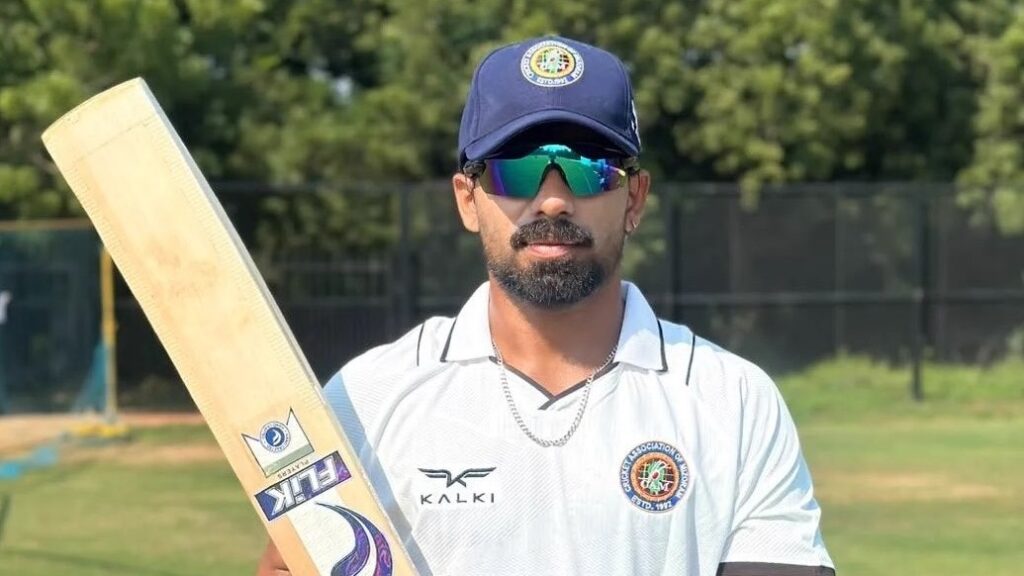
The tears came after the runs, the milestone and the history. For Chinmay Sutar, though, the most important moment of a day that changed his cricketing life had little to do with the record books. It was a phone call to his father, Rajesh.
As Sutar sat unbeaten on 400 for Mizoram against Nagaland in the Ranji Trophy Plate Group on Monday, he had become only the second Indian batter to score a quadruple century in first-class cricket. But when the day’s play ended, it was not the numbers that occupied his mind. It was the person who had stood by him through the disappointments that preceded them.
“The first person I called after the day’s play was my father. It was a big milestone, and I wanted to share it first with my dad,” Sutar told PTI from Sovima, Nagaland.
“He has been a big supporter of mine from early years.”
A FATHER’S UNWAVERING SUPPORT
The emotion was understandable. For a cricketer whose journey had been marked by missed opportunities, the achievement was more than a remarkable innings. It was a moment of vindication, shared first with the person who had urged him to keep believing when the chances he wanted did not come.
Rajesh, who played seven first-class matches for Mumbai, understood the demands of the game. More importantly, he had remained a constant source of support when his son struggled to find opportunities in his home state.
“He remained by my side whenever I missed out on a chance to play and advised me to stay strong and trust my abilities,” Sutar said.
“And now, a big moment came in my career. I thought he should be the first person I speak to.”
A DIFFICULT CAREER DECISION
For Sutar, 29, the road to 400 was not simply about converting a good start into a monumental score. It was also about refusing to let a lack of opportunities dictate the course of his career.
The right-hander had featured in the Vijay Hazare Trophy for Mumbai, but his ambition extended beyond limited-overs cricket. He wanted to play red-ball cricket, and when regular opportunities proved difficult to find, he made the difficult decision to move to Mizoram.
“Obviously, it was a difficult decision for me. But I always wanted to play red-ball cricket. I was not getting those chances in Mumbai,” he said.
“So, when I got a chance to play for Mizoram, I did not want to let go of the possibility of playing red-ball matches. So, I took it.”
The move eventually brought him to a moment few batters ever experience. Sutar finished unbeaten on 400 off 517 balls, striking 46 fours and seven sixes, as Mizoram declared at 581 for nine.
Only Maharashtra’s Bhausahab Babasaheb Nimbalkar, who scored 443 not out against Kathiawar in 1948, had previously crossed 400 in first-class cricket for India.
A PARTNERSHIP FOR THE AGES
Yet, Sutar’s landmark might have remained out of reach without an extraordinary final-wicket partnership. When Lalrempuia Chhakchhuak joined him, Sutar was batting on 231 and Mizoram had reached 392. The pair added an unbeaten 189 runs, with Chhakchhuak contributing 14 from 76 balls and Sutar scoring 169 of the partnership.
Sutar was quick to acknowledge the importance of his partner’s composure.
“He really batted well, without any nerves,” he said, explaining that the pair focused on smaller targets rather than chasing a particular milestone. Their approach kept the innings moving and allowed the historic score to emerge naturally.
THE JOB IS NOT DONE
For all the personal significance of the achievement, Sutar was equally appreciative of the environment he had found in Mizoram, praising his teammates’ work ethic and hunger to improve.
The quadruple century, however, has not ended his immediate responsibilities. With Mizoram looking to secure full points, Sutar knows that the job remains unfinished.
The next challenge is to bowl Nagaland out cheaply and enforce the follow-on.
But whatever happens next in the match, Monday will remain a defining day in Sutar’s career. He made history with his bat, found a partner when he needed one most and, when it was finally time to celebrate, reached for his phone.
The record belonged to Chinmay Sutar. The first call belonged to his father.
– Ends