Databricks sales growth tops 80%, but margin are shrinking from swarm of AI agents
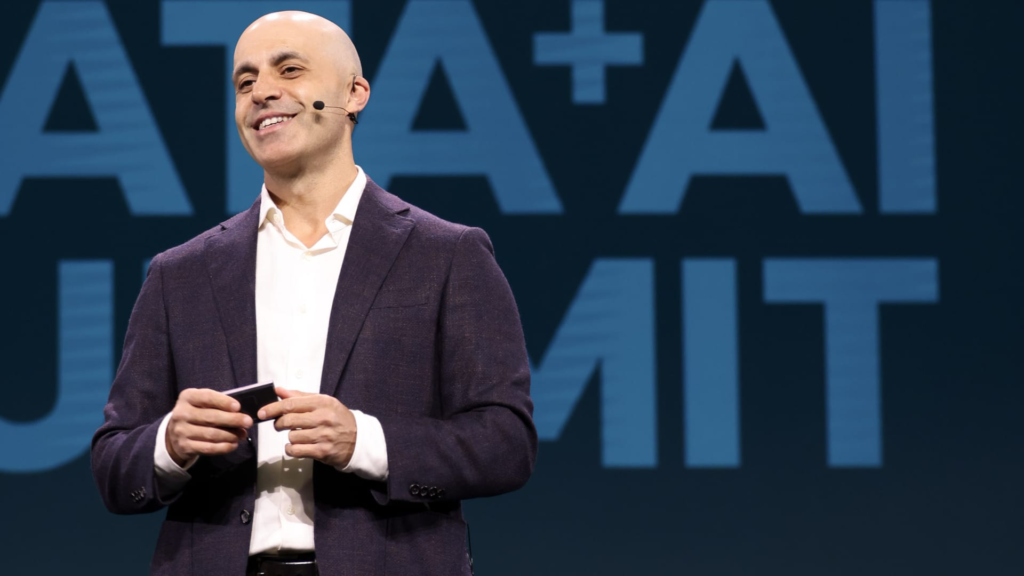
Ali Ghodsi, co-founder and CEO of Databricks, speaks at the company’s Data and AI Summit in San Francisco on June 16, 2026.
Grant Terzakis Media | Databricks
Databricks has a unique role in the AI boom. Revenue continues to soar as businesses swarm to the company’s data analytics tools. But as clients rely on more AI agents to clean up data and ask questions, Databricks is enduring higher costs, leading to lower margins.
“It’s the consumption-based business model, agentic AI coming,” Databricks CEO Ali Ghodsi told CNBC in an interview on Tuesday at the company’s Data and AI Summit in San Francisco. “The agents are generating way more queries. We have all these agents, the agents and agent platform we have also generates revenue, so it just increases the consumption of everything all around.”
Databricks told analysts at the conference that annualized revenue jumped over 80% from a year earlier and now sits at $6.9 billion, up from a figure of $5.4 billion in the fiscal fourth quarter.
With a private market valuation of $134 billion, Databricks is worth more than rival Snowflake, which went public in 2020 and now has a market cap of about $83 billion. Snowflake’s annualized revenue is around $5.6 billion, based on its latest quarterly results published last month.
Databricks continues to sit on the sidelines of the public market even as its fellow highly valued peers line up for IPOs. SpaceX held the largest debut on record last week, topping a $2 trillion market cap in its first day of trading on Friday. And AI model developers OpenAI and Anthropic have filed for confidential offerings.
While Databricks is often grouped in with the AI model companies, it has a very different role in the market. Databricks’ Genie can answer questions from business users about corporate data, and its Agent Bricks allows developers to build custom AI apps. As those products get more popular, Databricks must spend more on underlying models.
Ghodsi declined to provide Databricks’ current gross margin, but he said it will go lower. His company now gets $1.7 billion in annual revenue from AI products, up from $1.4 billion in February.
One of the big trends in AI today is that companies are cracking down on runaway spending from token usage. Databricks’s Unity AI Gateway can notify people as they get close to using up their AI budgets.
Companies have stopped tokenmaxxing, or encouraging workers to use as many tokens as possible, and are now “value-maxxing” to optimize efficiency while still drawing on AI’s powers, Ghodsi said.
Large companies “want to be able to absolutely use the frontier, smartest models,” he said, highlighting Anthropic’s Mythos. “They are interested in that, but not for everything, right? And for the mundane tasks, they absolutely want to curb the cost and use simple open-source models.”
Chinese models are extremely popular among Databricks customers, Ghodsi said.
“The customers are really demanding the choice,” he said.
Databricks is looking for growth by selling tools refined for specific industries. The company announced its entry into the cybersecurity market in March with the introduction of the Lakewatch software. On Tuesday, Databricks said it would buy Panther, a security startup valued at $1.4 billion in 2021, and it unveiled CustomerLake software for managing marketing data.
WATCH: Databricks CEO Ali Ghodsi: AI doesn’t have an intelligence problem. It has a context problem