Forged in Chennai, unleashed in Hyderabad: Inside Praful Hinge and Sakib's rise
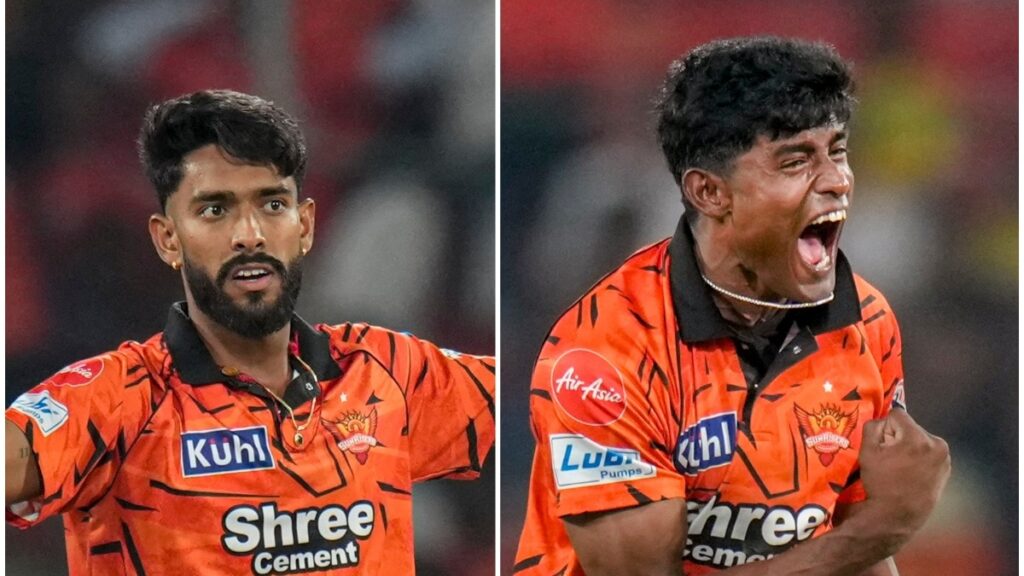
For nearly four decades, the nets at the MRF Pace Foundation in Chennai have hosted a quiet parade of the world’s most lethal fast bowlers. From Glenn McGrath and Chaminda Vaas to India’s own Zaheer Khan and Jasprit Bumrah, generations have been forged on this hallowed ground. It is a patch of dirt and grass that has arguably done more for India’s pace revolution than any other single acre of land in the country.
So, when 15-year-old batting sensation Vaibhav Suryavanshi began toying with the IPL’s most renowned names, it was perhaps inevitable that the bowler with the perfect execution plan would hail from that same Chennai foundry.
“I had told people that I would bowl a bouncer to him and get him out first ball,” said Prufful Hinge, the 24-year-old Sunrisers Hyderabad breakout star, after his Player of the Match performance against Rajasthan Royals on April 13.
But Prufful’s ability to execute that plan didn’t begin in the SRH dugout. While the strategy may have been refined there, the roots of those necessary tools trace back to those same nets in Chennai. Varun Aaron, his bowling coach at SRH, himself once trained there on his way to the Indian team.
The MRF Pace Foundation, now in its 38th year, remains the “unbreakable” force for the nation’s fast-bowling battery.
In this regard, Chief coach at the MRF pace foundation and former India U-19 World Cup captain, M Senthilnathan, speaking to IndiaToday.in, offered a window into the system that shaped them. From the gruelling physical rehabilitation that rebuilt Praful’s career to the technical refinement that unlocked Sakib Hussain’s raw 140-click pace, Senthilnathan’s insights reveal the meticulous engineering behind the IPL’s latest bowling sensations.
REHABILITATING AND REFINING: THE CASE OF PRAFUL HINGE
When Praful arrived at the academy in 2023, he wasn’t a finished product. He was, in many ways, a broken one.
“When he came, he had some back injury,” Senthilnathan recalls. At that point, the foundation didn’t put a ball in his hand immediately. Instead, they put him through a rigorous rehab program. The goal wasn’t just to fix the back, but to find out why it broke. The diagnosis led to a deep-dive technical overhaul.
Praful’s recovery then evolved him into a bowler capable of executing at state level immediately.
So, the following year, the aim was to quench the roots, to let the potential blossom. This is where former Australian bowler and current director of the MRF academy, Glenn Mcgrath played a big role. He took Praful with him to Australia as part of an exchange program.
“He came back in 2024,” Senthilnathan continued. “We started to work on him with the new ball. That’s where Glenn comes into it and plays a big part.”
He revealed that the Australian gave every bit of the knowledge he had acquired from his playing days. “How to use the new ball, how to bowl with the red ball, and then after that, we worked on his white ball skills both with the new ball as well as the old ball,” he adds.
And then later in Brisbane, Queensland at the academy’s exchange program – in collaboration with Cricket Australia – in addition to playing on Australian wickets, he was taught the professionalism of self-care.
Under McGrath’s tutelage, the young boy from Nagpur got himself to grips with bowling accurate line and lengths and persisting with it.
Senthilnathan emphasised that Praful’s success isn’t magic – it’s geometry. By hitting the “exact length” between 4 and 6 meters, Praful is executing the foundational lesson taught by Glenn McGrath at the academy. It’s a length that lives around the ‘No man’s land’– too full to pull, too short to drive – effectively ‘renting a room’ on a spot that eventually forces a mental collapse from the batsman. Interestingly, the young gun has a lethal Yorker in his arsenal as well.
SAKIB HUSSAIN: THE NATURAL 140
If Praful is the surgeon, Sakib Hussain is the blunt-force instrument. Hailing from a humble background from Gopalganj in Bihar, Sakib’s entry into the 2023 batch was fuelled by one undeniable trait: raw, unadulterated speed.
“He clocks around 140 [km/h] naturally,” elaborates Senthilnathan.
But to bear the brunt of it structurally, it seemed concerning for Shakib. “For that kind of frame, if someone can bowl that quick, they might break. So we worked immensely on his strength.”
Unlike Praful, Sakib’s journey didn’t include the Australian exchange, not because of lack of talent, but because of success. His selection for Kolkata Knight Riders (KKR) meant he was fast-tracked into the high-pressure environment of the IPL.
Senthilnathan is cautious but optimistic about Sakib’s ceiling. While he won’t be able to astrologically predict a 150 km/h reading, he notes that at 22, Sakib hasn’t even hit his physical peak.
The focus in his final year with the academy was on his workload management to ensure that his uniquely high-velocity action doesn’t become a liability.
A key figure in this process was Australian fitness consultant Kevin Shevell, who had previously trained McGrath. His philosophy centred on making fast bowlers “unbreakable.” Notably, the foundation does not charge any money from the cricketers it trains.
A SYSTEM THAT KEEPS DEILEVERING
The success of Praful and Sakib is part of a broader, systematic triumph for the foundation. Senthilnathan pointed out that against Rajasthan Royals, all ten wickets for SunRisers Hyderabad were taken by MRF academy graduates – four each by Praful and Sakib, and two by Eshan Malinga.
So, the story unfolding at SRH may still be in its infancy, but on Monday night against RR, it offered a familiar promise of fast bowlers taking their first steps into that fast-bowling lineage.
IPL 2026 | IPL Schedule | IPL Points Table | IPL Player Stats | Purple Cap | Orange Cap | IPL Videos | Cricket News | Live Score
– Ends
Tune In