More than a view: How Dharamsala's stadium rewrote the story of a Himalayan town
The instructions were simple enough: enter through Gate 3A. What they did not tell me was that getting there would require parking a rented scooter at a boys’ government school, walking fifty metres uphill. Lungs heaving in the thin mountain air, passing through a government building, and then descending a steep flight of stairs before finally arriving at the stadium gate. By the time I reached it, I had already earned my seat in the press box.
Terrain makes a huge difference. And in Dharamsala, terrain is everything.
There is no sea of fans outside the Himachal Pradesh Cricket Association Stadium the way you find at Wankhede or Eden Gardens, no wall of sound, no drumming conglomerations, no synchronised chanting half a kilometre from the gate. The reason is simple, and architectural: the stadium’s gates are spread across different altitudes, different planes of the hillside. One entrance sits on a higher ridge, another lower down. The crowd is not gathered. it is distributed across the mountain, trickling in through their respective gates, each group on their own small vertical journey.
But then you are inside. And everything changes.
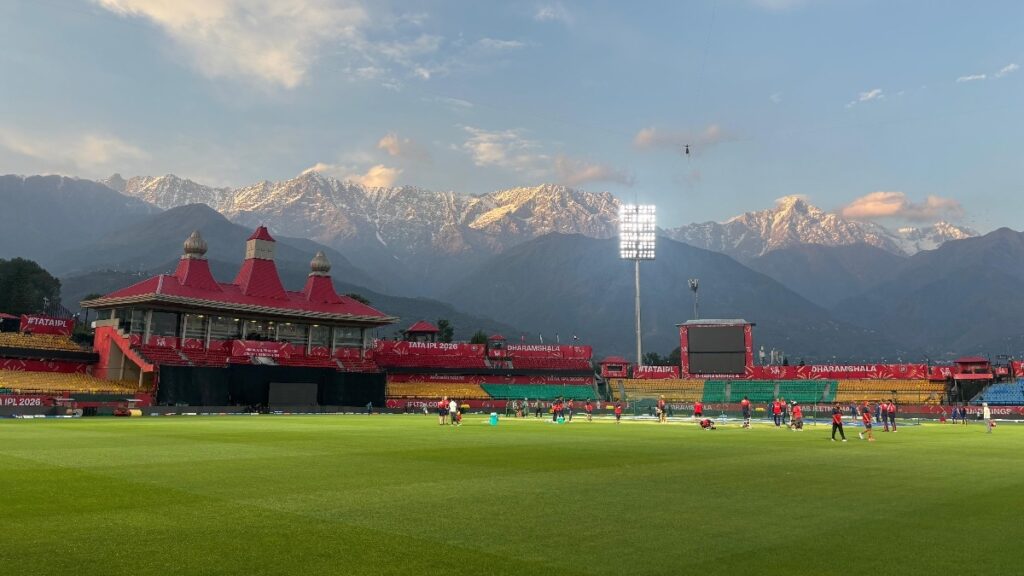
Twenty-three thousand people filling the stands. The pavilion rising ahead of you, and behind it — not a scoreboard, not a sponsor hoarding, but the full, unbroken wall of the Dhauladhar range, snow still on the higher peaks, clouds drifting at mid-height, the ancient rock face glowing in the afternoon light. There is no television frame wide enough to hold it. No broadcast camera can make you feel the scale of it, the closeness of it, the way the mountains seem to be seated among the crowd, watching alongside you. You have to be there. You simply have to be there.
LITTLE LHASA FIRST
Long before a cricket ball was bowled here, Dharamsala had its own quiet magic. When the 14th Dalai Lama fled Tibet in 1959 and settled in McLeod Ganj, the town was transformed overnight. Monks, refugees, scholars, and seekers from across the world followed. McLeod Ganj became “Little Lhasa”, home to the Tibetan government-in-exile, the Namgyal Monastery, the Norbulingka Institute. I stayed at Norling House, a guesthouse within the Norbulingka campus, prayer flags in the breeze the only alarm clock you need.
But for all its spiritual gravity, Dharamsala had always played second fiddle in Himachal Pradesh’s tourism hierarchy. Shimla came first. Manali came second. Dharamsala was a distant third. Beloved, distinctive, but perpetually in the shadow of its more famous siblings. That is no longer true.
BLASTING THE ROCKS
The man who changed Dharamsala did not set out to change tourism. He set out to change cricket.
When Anurag Singh Thakur became HPCA president in July 2000, Himachal Pradesh had exactly one cricket ground, the Indira Gandhi Stadium in Una. The state had been affiliated to the BCCI since 1984 but remained, as the association’s own records put it, “minnows of Indian cricket.”
There was no infrastructure, no exposure, and no real pathway for the state’s young players to reach the top. Thakur had seen what other states had built and believed Himachal deserved better — not just as a matter of pride, but as a matter of necessity. You cannot produce cricketers without giving them somewhere to play.
He wanted a stadium. Not just any stadium — an international one. The original plan was Shimla’s Annandale ground, but the Army, which controls the cantonment, refused. Dharamsala was chosen instead. In March 2002, the state government allotted 16 acres of land in the lap of the Dhauladhar range to the HPCA. What followed was an act of stubborn, almost unreasonable ambition.
Arun Dhumal, Thakur’s brother and a long-time HPCA figure who would later become IPL chairman, still recalls standing at the site and wondering what exactly they had gotten themselves into.
“I was not even convinced that we could create a good ground here,” he told IndiaToday.in.
“You had rocks about 30 to 50 metres high, and hard rock too. The level of this ground used to be where you now find the college building behind it. So the entire soil had to be excavated to flatten the land. Flattening the land itself was a huge challenge. I was thinking to myself why he had taken up this task — but kudos to him. Within two years, the stadium got inaugurated, and by 2005 we were able to host a game.”
Materials had travelled through winding mountain roads. Weather delays had been routine. The terrain had pushed back at every stage. But by 2003, the HPCA Stadium stood — its Tibetan-inspired red-roofed pavilion blending into the hillside as though it had always been there, the Dhauladhar peaks forming a backdrop that no architect could have designed and no budget could have bought.
CHAI, HILLS, CRICKET
The first international visitors arrived in March 2005 — the Pakistan national side, led by Inzamam-ul-Haq, for a tour game against a BCCI Board President’s XI.
Among them was Shahid Afridi, and the allrounder, never short of a word, reportedly summed up the experience with characteristic flair: “Janab, ye Hindustan ki saazish hai — humme aisi jagah practice ke liye laye hain jahaan nazaarein dekho. Yahan toh chai pio aur pahad dekho.”
This is India’s conspiracy, he said. They have brought us to a place where all you want to do is drink tea and look at the mountains.
He was not entirely wrong. And he was, unknowingly, the first in a long line of international cricketers who would fall a little in love with this place.
NO BEER LEFT
The ICC inspected the ground — a committee led by former Australian cricketer David Boon — and certified it for international cricket. The first ODI followed in January 2013, India versus England. Then came T20 Internationals, more ODIs, IPL matches from 2010 onwards, the 2016 ICC World T20, five matches of the 2023 Cricket World Cup including the blockbuster India versus New Zealand game, and two historic Test matches — India versus Australia in 2017 and India versus England in 2024.
The 2023 World Cup was a watershed moment. Fans who had watched cricket at venues across India — Mumbai, Kolkata, Ahmedabad — made the trip to Dharamsala and came away speaking about it differently. “Spectators who witnessed games across all the venues during the 2023 World Cup told me that the kind of experience they had in Dharamsala was unmatched and unparalleled, and they were very well looked after,” Dhumal told me. “That kind of word-of-mouth is priceless.”
But if the World Cup announced Dharamsala to the cricket world, the 2024 Test against England introduced it to a very particular and very enthusiastic tribe: the Barmy Army. England’s legendary travelling supporters’ group has been to cricket grounds on every continent, in every climate, under every conceivable set of conditions. They are not easily impressed. What happened in Dharamsala in February 2024, though, was something else entirely.
“The biggest contingent of the Barmy Army ever to come for a Test match in India was here,” Dhumal recalled, a broad smile crossing his face. “Thousands of people had come from England and the entire Dharamsala town was looking like one of the cities of England. The Test match got over in two-and-a-half days, but the Barmy Army ensured that the entire town was free of beer in two days. Every restaurant had to put up a banner outside saying they had no beer left.”
He paused, clearly relishing the memory.
“They had an amazing experience. They promised me that whenever England plays here next, there will be an even bigger contingent of the Barmy Army coming from England. That says everything. These are people who have seen cricket everywhere in the world, and Dharamsala left them wanting more.”
It is not only visiting fans who feel it. The players themselves are drawn to this place in a way that is unusual for a cricket venue. Unlike the anonymity-destroying fishbowls of Mumbai or Bengaluru, Dharamsala offers cricketers something rare: the ability to simply be.
During this IPL season, Rohit Sharma and Tilak Varma were spotted walking through McLeod Ganj in the evening, and Arshdeep Singh was out with his partner, all of them doing what anyone does in this town on a free night: heading out for dinner, unhurried, largely unbothered. McLeod Ganj has that effect.
The lanes are narrow, the restaurants warm, the mountains in the dark making everyone feel equally small and equally at ease. A cricketer here is just another person looking for a good meal.
CRICKET PLANS EVERYTHING
On May 17, 2026, Punjab Kings hosted Royal Challengers Bengaluru at the HPCA Stadium. I was there, and so was a particular kind of traveller: one who had built their entire trip around the fixture.
The Sharma family from Rajasthan, all eight of them, of all ages, had booked the moment the IPL schedule dropped. The match was the anchor; the Bhagsu waterfall, the monastery visits, the market evenings all arranged around it.
Two young men from Uttar Pradesh had timed their Triund trek to end the day before the match, nine kilometres up into the Dhauladhar, overnight at 2,800 metres, back down in time for the gates.
“Trek first, then IPL,” one said, still carrying the daze of altitude.
“The best two days in a long time.”
Uday, Prithvi, and Basha, software engineers from Andhra Pradesh, had made the plan four days earlier, on impulse built from years of watching this ground on television.
“Every time there was a match here, one of us said we should just go,” Uday said.
“This time we did.”
After the match, I found Harjinder Singh Juneja and Gaurvi Rathore at a restaurant in Dharamsala. Hajinder in RCB colours, Gaurvi in PBKS, both from Jaipur, first visit, tickets booked weeks in advance.
“Every IPL venue has energy,” Hajinder said. “But here it is calm. The mountains make you calm even when you are excited. I have never felt that at a cricket match before.”
“We argued about whose team won,” he said.
“But somehow, sitting here after the match, with this air and this tea, it doesn’t feel that important.”
That is what Dharamsala does to you.
THE TOWN TRANSFORMED
The economic transformation has been staggering.
Rahul Dhiman, President of the Hotel and Restaurant Association of Smart City Dharamsala, has watched it unfold business by business, season by season.
“Whenever there are matches — IPL, World Cup, Tests, ODIs — there is a major boost in business across Dharamsala and McLeodganj especially,” he told IndiaToday.in.
“It has benefited small homestays as well as big hotels. In the last ten years, major groups like Radisson and Hyatt have come because we are now getting high-end tourists as well.”
Twenty years ago the landscape looked entirely different. There were almost no hotels with more than 20 or 30 rooms. Roads were poor. Flights were few. Large hospitality groups had little reason to notice a hill town that, for all its charm, had not yet crossed into the national imagination.
“Earlier, around 10 years ago, we were lacking in all these aspects,” Dhiman said.
“Now four-lane roads are coming up. The airport is expanding. Within the next two or three years, when that expansion is commissioned, it will further boost tourism significantly.”
Even the HPCA has its own stake in the hospitality boom — a Radisson tie-up that houses international teams, support staff, and match officials in surroundings as beautiful as the mountains outside the window.
Dhumal frames the change in numbers that are almost hard to believe.
“Before the stadium, there was hardly any hotel with more than 20-30 rooms. Now every major brand has a presence — Hyatt, Radisson, Taj, ITC. Land prices have grown almost 100 times from what they were before the stadium. The Gaggal airport operates about five flights daily — more than Shimla or Manali. People knew Shimla and Manali, but after this stadium, Dharamsala is known globally. One cricketing project can transform an entire state.”
During the IPL match I had to move hotels, my room was needed, everything nearby was full. I ended up eight kilometres out of town. At peak cricket season, Dharamsala runs out of rooms before it runs out of enthusiasm.
RIVER, TEMPLE AND TEA
The roads clog badly after matches. Thousands of fans streaming out simultaneously on mountain roads not engineered for this volume. But here is the thing: nobody seems to mind very much. The air is too clean, the hills too beautiful, the mood in the town too warm for frustration to take hold. People step out of their cars, lean against the hillside, and look at the stars. I sat in traffic for forty minutes after one match and found myself oddly, inexplicably content.
The next morning I drove down to the Manjhi river, which comes rushing off the Dhauladhar range in a cold, clear tumble over smooth stones. A short walk away stands the Aghanjar Mahadev Temple — five hundred years old, carved from the rock, dedicated to Shiva, entirely unhurried by the world that has grown up around it. I sat there for an hour, watching the water, listening to the river. Then I came back and opened my laptop to file my pieces.
The Tibetan restaurants were opening for breakfast. The smell of thukpa and butter tea drifted up the lane, mixing with woodsmoke and damp pine. A couple at the next table were having a full English breakfast. The coffee is good here, the tea is better, and the mountains are available from every window. Cricket does strange and wonderful things to a hill town.
This is what the stadium has given Dharamsala: a reason for the world to stay longer, to go beyond the match, beyond the venue, into the town’s older, quieter, more complicated soul.
GIRLS GO FIRST
But the most enduring thing the HPCA built is not what it gave tourists. It is what it gave the girls of Himachal Pradesh.
“Anurag wanted to create infrastructure so youngsters from the state could get a chance,” Dhumal said.
“The idea was not only to create the most beautiful stadium, but to ensure Himachal gets the opportunity to represent India.”
And represent India they did, the women first.
“Before any of our young men could represent India, three of our girls had already done it — Sushma Verma, Renuka Singh, and Harleen Deol. That has been very satisfying.”
Rishi Dhawan, who as a teenager scored a mammoth 340 runs against Railways in the Cooch Behar Trophy, followed.
“Rishi did very well too,” Dhumal said. “We are hopeful more youngsters follow.”
85 SHOWED UP
Coach Pawan Sen had joined HPCA in 2007, a former Ranji Trophy cricketer from Sundernagar who had spent two years coaching the boys’ residential academy at the stadium. When Anurag Thakur launched a free residential academy for women.
Sen was given the task. He was not sure what to expect.
“At that time, it was surprising even for me because women’s cricket was not something people spoke much about,” he told IndiaToday.in.
“But during the very first trials, 85 girls turned up. Even I was surprised because I did not know there was that much awareness or interest.”
From those trials, 20 girls were selected. They lived in a guest house in Kangra. Training began at 6 in the morning before the girls went to school, and resumed at 4 in the afternoon when they returned. Sen managed almost everything himself — fitness, skills, even the first-aid trunk.
“Initially it was difficult because HPCA did not have enough trainers or physios,” he said.
“I had to carry everything.”
Within two years, the academy had shifted into the stadium complex itself, sharing the facilities that had by then become the centrepiece of Himachal cricket.
The early years were hard. In a zone that included Punjab, Haryana, and Delhi, Himachal’s women lost heavily and often. But something was building. Sen entered the girls into an open boys’ tournament in Kangra — 35 teams, the girls the only women’s side. They reached the final. The next morning, every newspaper in the region carried the story.
Thakur had given the academy three years to produce results. As the third year arrived, Sen gathered the girls and told them plainly: this was do or die. “If we don’t qualify this season,” he told them, “all of you will go back home and your cricket careers will end before they even begin.”
That season, they beat Haryana, narrowly lost to Punjab by two runs, and then faced Delhi in the final league game with a place in the knockouts at stake. The night before, Sen pulled aside his opener, Diksha, and his captain Sushma Verma. He told Diksha one thing: don’t get out. “She held my hand and told me, ‘Sir, don’t worry. Go and sleep peacefully. We will win tomorrow.'”
Against Delhi, Diksha batted unbeaten through the innings. Himachal qualified and then won four straight knockout games to reach the final.
In 2013, Sushma Verma, the wicketkeeper who had grown up in this programme, who had been one of those teenagers told that India was impossible, got the call from the national selectors.
Sen still uses the moment as his most powerful motivational tool. “I tell the girls: if someone who trained with you from Day One can reach India, why can’t you?”
Harleen Deol arrived at the academy as a 13-year-old left-arm spinner, batting at number eight, her parents worried she would quit cricket altogether. Sen converted her into a top-order batter — one match, one innings, one instruction to just see off the new ball, and she scored 48 and never looked back. She went on to play for India and was part of the World Cup-winning side last year.
Then came Renuka Singh, who took 23 wickets in a single domestic season, still did not get selected, lost her father, watched her mother struggle, waited through a pandemic, and finally got her India call-up in 2022.
And Tanuja Kanwer, who completes the quartet of Himachal women to have represented the country, another product of the same programme, the same early mornings, the same stubborn belief that the mountains could produce cricketers the whole country would watch.
“I have seen very tough times,” Sen said quietly.
“Earlier nobody cared about women’s cricket. People even mocked me for coaching girls. Today they are getting equal importance, financially and professionally. That gives me great satisfaction.”
The academy, which operated from within the stadium complex from 2011, has now shifted near Nagrota as the stadium’s match calendar has grown too crowded. HPCA is building a dedicated facility there — ground, residential rooms, gym, everything — exclusively for the girls.
In another few months, they will move in completely. The stadium that started it all has, in a sense, outgrown them. That is not a bad problem to have.
KEEP IT INTIMATE
Dhumal is bullish about what comes next, 70 cricket sub-centres planned across the state, 55 already operational in rural areas, tie-ups with schools so that village talent gets spotted early and given a pathway.
“The kind of infrastructure we have for our budding cricketers is unmatched and unparalleled, much better than a few other state associations,” he said.
For a state that had one ground and near-zero representation when the century turned, that is a transformation the numbers alone cannot fully capture.
But when I ask him about the stadium itself, expansion, bigger capacity, more seats, he becomes more reflective.
An old HPCA official I met put it simply: “I think it should remain this way. That’s its charm.”
Dhumal does not entirely disagree. The power of this place comes precisely from its intimacy: 23,000 seats, not 90,000; open stands that let the mountain breeze through; mountains so close you can watch the cloud shadows move across the snow between overs. You can hear the ball hit the bat. You can hear the fielder’s boots on the outfield grass.
“Whoever has played here has loved the stadium,” Dhumal said. “Whoever has come to watch has said they haven’t seen something like this.”
The roads will clog after the match. You will walk uphill to reach the gate. You will quite possibly find there is no beer left in town. And you will not, for a single moment, regret having come.
The stadium gave Dharamsala a global postcard. The mountains made sure nobody forgot it.
IPL 2026 | IPL Schedule | IPL Points Table | IPL Player Stats | Purple Cap | Orange Cap | IPL Videos | Cricket News | Live Score
– Ends