Senate advances DHS funding bill, tees up House vote to end shutdown as TSA lines at airports stretch
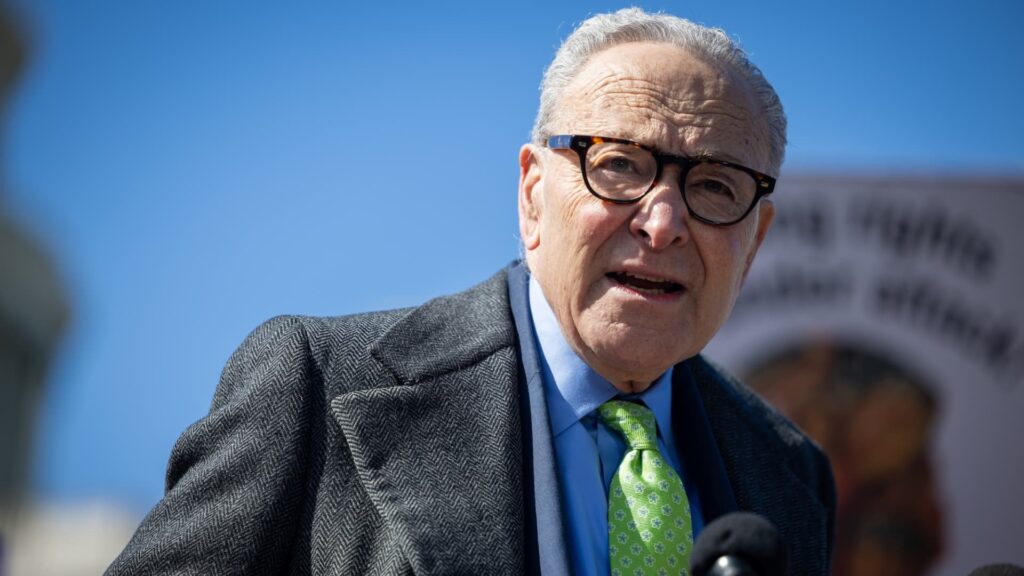
Senate Minority Leader Chuck Schumer, D-N.Y., speaks during a rally against the SAVE America Act outside the U.S. Capitol in Washington, March 18, 2026.
Nathan Posner | Anadolu | Getty Images
The Senate early Friday morning advanced a bill to fund most of the Department of Homeland Security, in a move to end the partial government shutdown that has disrupted air travel across the U.S.
After weeks of Republicans fighting Democrats on their calls to remove funding for Immigration and Customs Enforcement from any potential deal, the bill does exactly that. It would fund all of DHS except for ICE and parts of Customs and Border Protection, though it does not include the changes to ICE’s immigration enforcement practices that Democrats had demanded.
It now moves to the House for final approval. A vote could be held as soon as Friday as lawmakers seek to leave Washington for a scheduled two-week recess.
“I think we’re gonna pass it. I hope we can get it done today,” Rep. Jodey Arrington, R-Tex., the chairman of the House Budge Committee said in an interview with CNBC’s “Squawk Box.”
“There’s a rule that would need to be waived,” Arrington said. “I think we should in these exigent circumstances.”
Senate Minority Leader Chuck Schumer, D-N.Y., speaking on the Senate floor, said of the bill, “This could have been accomplished weeks ago if Republicans hadn’t stood in the way.”
“Democrats held firm in our opposition that Donald Trump‘s rogue and deadly militia should not get more funding without serious reforms, and we will continue to fight for those reforms,” Schumer said.
The Senate vote is an encouraging step toward ending the shutdown, which resulted in missed paychecks for Transportation Security Administration agents and long lines at airports.
Lawmakers scrambled much of the week to strike a deal before the recess, but as talks broke down late Thursday, Trump intervened and announced via Truth Social that he would pay TSA agents via executive order.
“Because the Democrats have recklessly created a true National Crisis, I am using my authorities under the Law to protect our Great Country, as I always will do!,” Trump posted. “Therefore, I am going to sign an Order instructing the Secretary of Homeland Security, Markwayne Mullin, to immediately pay our TSA Agents in order to address this Emergency Situation, and to quickly stop the Democrat Chaos at the Airports.”
The shutdown began in February in the weeks after federal agents shot and killed two U.S. citizens in Minneapolis as part of a federal immigration crackdown. Democrats demanded changes in ICE and DHS more broadly and refused to fund the department.
Friday’s vote largely ends that impasse, though it was far from a kumbaya moment.
Senate Appropriations Committee Chair Susan Collins, R-Maine, said in a statement that Democrats “remained intransigent and unreasonable” in their DHS funding demands.
“Congressional Democrats have done real damage to the appropriations process by repeatedly forcing government shutdowns and refusing to fund entire agencies,” Collins said. “Their refusal to fund ICE and Border Patrol leaves our borders and our country less secure and sets a precedent that they may one day come to regret.”
Republicans have vowed to restore funding to ICE via a second party-line legislative package using the Senate “budget reconciliation” procedure they used to pass last year’s tax and spending bill. Republicans’ next measure with ICE funding may also include a grab bag of other issues, including defense funding and the SAVE America Act, a Trump-backed voter ID and noncitizen voting bill that has captivated the right flank of the GOP in recent months.
“This bill will focus on ensuring ICE and other vital functions of homeland security, as well as the U.S. military and efforts to increase voter integrity, are Democrat-resistance proof,” Senate Budget Committee Chair Lindsey Graham, R-S.C., said in a post to X on Thursday.
Budget reconciliation is a procedural tool that requires only a simple majority to pass — as opposed to the 60 votes usually required to overcome a filibuster in the Senate — provided its components have some spending or revenue impact.