S&P 500 falls to start the week, dragged down by a sell-off in chip stocks: Live updates
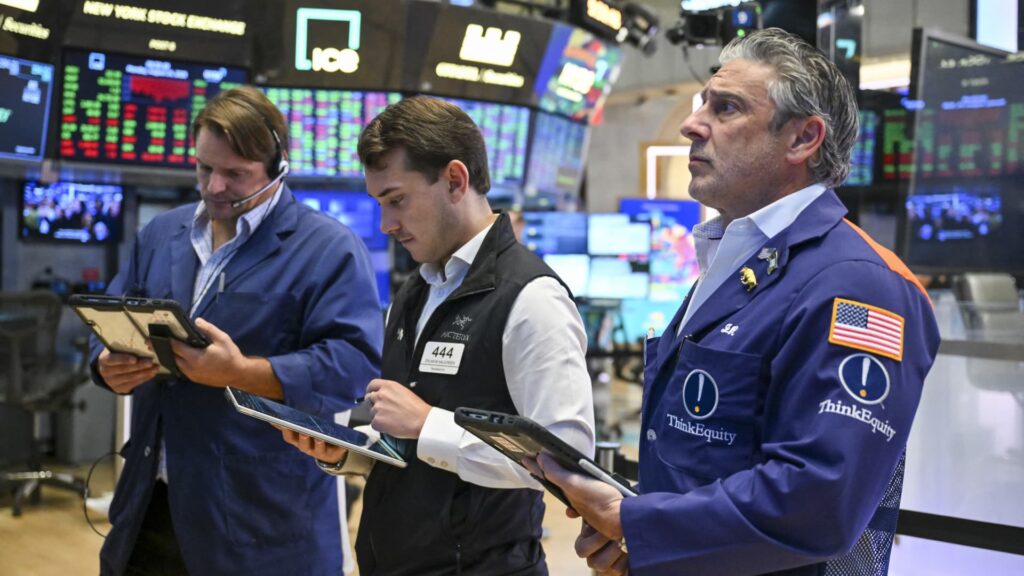
Traders work on the floor of the New York Stock Exchange (NYSE) during morning trading on Aug. 24, 2026 in New York City.
Angela Weiss | AFP | Getty Images
The S&P 500 fell slightly on Monday as a drop in key technology stocks overshadowed a move lower in Treasury yields.
The broad market index fell 0.28% to 7,652.86, while the Nasdaq Composite lost 0.76% and closed at 25,980.19. The Dow Jones Industrial Average gained 140.15 points, or 0.26% to 53,417.16.
Declines in chip stocks weighed on the broader market. Micron Technology shed 5.8%, while Advanced Micro Devices and Broadcom pulled back more than 3% and 2%, respectively. The iShares Semiconductor ETF (SOXX) slid 2.7%.
Other tech stocks fell as well. Coherent and Lumentum dropped more than 4% each, while Sandisk dropped 6%. Corning moved down almost 3%, while Seagate Technology declined 6.5%.
Yields moved lower after CNBC reported that the Treasury may use the General Account to fund a buyback operation. The 10-year Treasury note yield fell more than 3 basis points to 4.704%. The yield on the 30-year Treasury bond, which topped 5.3% last week to reach levels not seen in nearly 20 years, shed more than 4 basis points to 5.234%.
The report comes after Treasury Secretary Scott Bessent told CNBC last week that the Treasury Department’s plans to at least double the level of government debt buybacks in the next few months could be larger than the $4 billion that was announced earlier that week.
Some reprieve was given to the long end of the U.S. yield curve after the initial announcement, but it was ultimately short-lived.
Stocks have been pressured by rising bond yields around the globe, with rates in Japan, France and Germany scaling to multi-year highs. Investors grew fearful that the U.S.-Iran war would continue for longer, keeping oil prices elevated and driving inflation higher.
“The Treasury attempt to cap long rates by issuing more short-term paper as the financing tool will tether US government interest rate expense ever closer to what the Federal Reserve does with the fed funds rate,” said Peter Boockvar, chief investment officer at One Point BFG Wealth Partners. “I don’t think this is something Kevin Warsh will talk about in his speech Friday but it is a new element he’s going to have to deal with.”
Chairman Kevin Warsh is expected to deliver a speech at the Fed’s annual symposium in Jackson Hole, Wyoming.
Weighing on sentiment Monday, President Donald Trump announced that the U.S. will increase tariffs on imports of “all Cars, Trucks, both large and small, Automotive Parts, and Steel” from Canada to 50%, effective Jan. 1, 2027.
“We’re in a little bit of the little summer doldrums,” said Robert Conzo, chief executive officer at The Wealth Alliance. However, if earnings growth continues to come in strong and inflation prints are as expected, the state of the equity market should be “pretty good” from here, he added.
Investors this week will get new inflation data in the form of the July personal consumption expenditures price index on Wednesday. Artificial intelligence will also be in focus, with Nvidia and Marvell Technology set to report earnings Wednesday and Thursday, respectively.