The AI economy is rewriting the American Dream — and blue-collar workers are poised to win
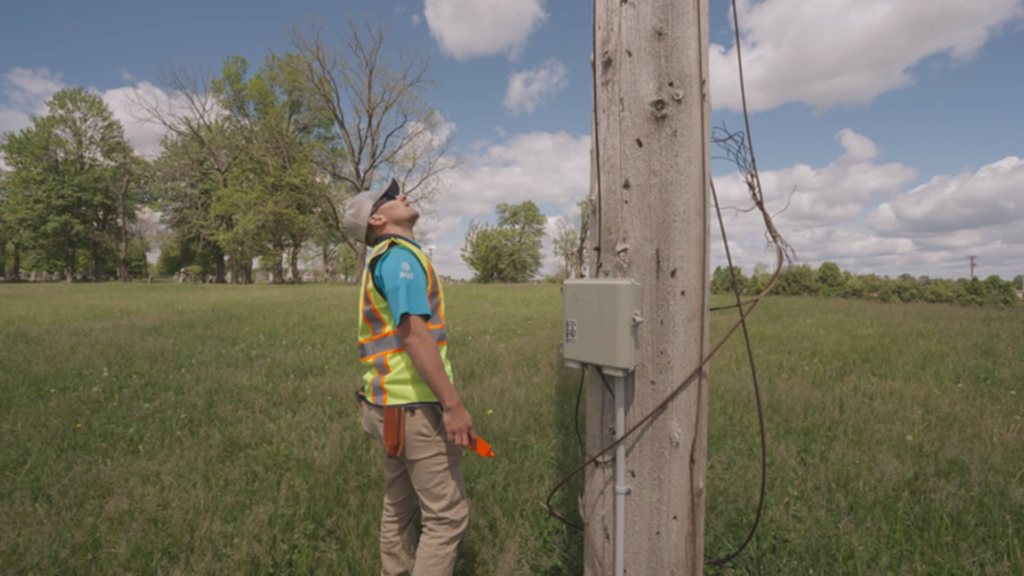

From the Dayton, Ohio, suburbs to boardrooms in Dallas, the employees fueling AT&T’s next wave of growth aren’t fresh-faced college graduates with expensive four-year degrees. They’re skilled, blue-collar workers ready to get their hands dirty — and AT&T can’t find enough of them.
“We need people who know how to actually work with electricity. We need people who understand photonics. We need people who can go into folks’ homes and connect this infrastructure to make it work right,” AT&T CEO John Stankey told CNBC during a recent interview from the company’s Dallas headquarters.
“We find that we’ve got to go out and find them, train them, and incent them to come in,” he said. “It’s not like we’re growing them on trees in the United States.”
AT&T’s dilemma — hunting for blue-collar workers at a time when a record number of college students are projected to graduate this spring — underscores the palpable crisis facing new degree holders as the first wave of the AI revolution hits the U.S. economy.
For much of the postwar era, the American bargain was clear: Go to college, get a degree and claim your place in the middle class. As factories gave way to offices and the U.S. economy increasingly rewarded credentials over physical labor, a four-year diploma became one of the clearest symbols of upward mobility. But as AI spreads across corporate America and begins to absorb the entry-level work that once gave graduates their start, that promise is beginning to fracture.
While the rapid spread of AI has not yet led to broad layoffs and empty offices, many new graduates, especially those in AI-exposed industries, are learning their degrees may no longer guarantee the opportunities they once did.
John Stankey, Chairman and CEO at AT&T, speaking at CNBC’s Invest In America Forum in Washington, D.C. on April 15th, 2026.
Aaron Clamage | CNBC
Meanwhile, as AI implementation spreads and CEOs find they can do more with less labor, hiring is slowing. The downturn has hit hardest the workers with little real-world experience and those in industries expected to be most vulnerable to AI replacement, such as marketing, legal, accounting, human resources and IT.
If the trend continues, AI could reorder the U.S. workforce and global economy, redrawing the map of opportunity in ways that even some leading economists and technologists say they are only beginning to understand.
“Is the American Dream going away because of AI?… I think the fears are all very valid,” said May Hu, a 26-year-old tech consultant turned social media influencer who said she was laid off from Deloitte last year for what she described as nonperformance reasons. “I pursued college because… I think [for] most people who want to be working professionals … college is the route,” she continued. “That’s starting to change now.”
Like any technological revolution, the AI boom is expected to create new types of work. But, in a cruel twist for college graduates, many of those jobs will be blue-collar roles that for now don’t require a four-year degree, centered around the construction and maintenance of data centers.
Still, it’s unclear how sustainable the blue-collar job boom will be once companies complete an expected wave of chip factories, data centers and other AI-fueled construction in the coming years.
Major U.S. companies from Ford to Nvidia have stressed the growing need for workers to build out those facilities.
“This is the largest infrastructure buildout in human history that is going to create a lot of jobs,” Nvidia CEO Jensen Huang said during a panel at the World Economic Forum in January. “We are going to have plumbers and electricians and construction and steel workers and network technicians and people who install and fit out the equipment.”
He added that many of those roles will bring six-figure salaries as the U.S. addresses a “great shortage” of workers.
Saline, Michigan, Construction of a $16 billion data center, developed by Related Digital for Oracle and Open AI.
Jim West | Universal Images Group | Getty Images
In March, AT&T announced plans to invest $250 billion over the next five years to expand its fiber network and meet the demands of AI data centers and a surge in network usage, fueled both by AI and a rise in mobile streaming and uploading.
About 15% of that investment will be used for hiring and training employees, but not necessarily for white-collar jobs at its corporate office. Instead, it will primarily be used for blue-collar front-line workers, the majority of whom are skilled technicians, the company said.
“As a society and within the United States, we’ve put a huge premium in value socially on a college degree, maybe for good reason, but in some cases … we maybe have missed the mark,” said Stankey. “That hasn’t been optimal when you see the cost of education increasing at higher than the rate of inflation and yet we’re short HVAC [heating, ventilation and air conditioning] repair people, we’re short electricians, we’re short technicians that can go in and work on fiber.”
The birth of the American Dream
At the beginning of the 20th century, about 1 in 10 17-year-olds in the U.S. had finished high school while far fewer young adults had pursued higher education, according to the National Center for Education Statistics. More time in school meant less food on the table, and few Americans had the privilege of pursuing more comfortable work outside of factories and farms.
That all started to change after World War II, when the GI Bill offered veterans free access to college and public universities began cropping up across the country, fueling what labor historian Shannan Clark called an “explosion” in higher education.
There was “a widespread belief, shared by Democrats and Republicans alike, that this was a good investment. It was good for people to have access to higher education and that this sort of increase in human capital and a more trained, more capable, more knowledgeable workforce would also be a more productive workforce, right?” said Clark, an associate professor of history at Montclair State University.
In the coming decades, millions of Americans would trade sweltering factories for air-conditioned offices, hammers and nails for keyboards and mice, and hourly wages for sustainable salaries. Women and minorities entered the workforce in record numbers, wages grew and quality of life increased, fueling a rise in innovation, globalization and gross domestic product. By the end of the 20th century, society was in near universal agreement that an education and a little bit of grit were a sure path to the American Dream.
Data shows that four-year degrees still lead to higher wages and lower unemployment over a lifetime. Even so, the belief that college is the safest way to the American Dream has changed in recent years. First, the return on investment of a four-year degree came into question amid surging higher education costs and student debt. That return is still around 12.5% as of 2024, making it well worth the cost for many graduates, but it hasn’t budged beyond 13% for the past three decades, according to research from the Federal Reserve Bank of New York.
Now, AI could put the value of a diploma under even greater pressure.
“What does AI do best? AI is basically an infinite supply of 21-year-old interns that are smart but have no context,” said consultant Aaron Cheris, the global head of Bain & Company’s retail practice. “The job they used to do is now the one that AI is doing, right? AI is doing the entry-level job.”
That’s made it harder for new graduates to find work, some research and data suggest.
The average unemployment rate for recent college graduates ages 22 to 27 dating back to 1990 is 4.5%, but in 2025, that average jumped to around 5.4%, according to data from the Federal Reserve Bank of New York.
The impact appears particularly acute among entry-level employees in AI-exposed fields.
Last year, Stanford’s Digital Economy Lab published a research paper titled “Canaries in the Coal Mine?” that found early-career workers in roles most exposed to AI, such as software developers, marketing professionals and sales managers, saw 16% slower growth in employment than the least exposed young workers between mid-2024 and September 2025.
Using payroll data from ADP, researchers found the trend persisted even when they controlled for company-specific challenges, rising interest rates, remote work and other variables. Those who held jobs where AI was poised to augment their work versus automate saw growing employment in the same time period.
“It is notable that since we came out with the first draft of the paper, the effect has grown from 13% to 16%, so whatever it is, it’s not rebounding, or wasn’t some kind of temporary blip,” said Stanford University economist Erik Brynjolfsson, one of the paper’s authors and a leading expert on the economics of technology and AI. “If you just look at the top line of the ADP data, the overall effect, there wasn’t much going on. It’s only when you narrow in … that you start seeing the different kinds of effects.”
If the trend continues for young workers in AI-exposed roles, “we’re going to see it affect the broader labor market more,” said Brynjolfsson.
Lee Tucker, a senior economist with the Center for Economic Studies at the U.S. Census Bureau, published a paper in April that built on Stanford’s research and found that the impact on early career workers was also showing up in a different data set: the agency’s quarterly workforce indicators.
In his research, Tucker found that the hiring of workers between the ages of 22 and 24 dropped 9% immediately after ChatGPT in late 2022 launched for workers in AI-exposed industries such as finance, insurance and professional services, compared with all other industries.
Between the third quarter of 2022 and the second quarter of 2025, there was a 12% to 15% decline in employment for workers in those industries, leading to about 150,000 fewer early-career jobs, the research found.
While there is some evidence this decline may have started around 2020 and may not be fully attributable to AI, Tucker found the decline in employment was almost entirely due to fewer hires, not layoffs.
“I empathize with early career workers, especially new graduates that are trying to get hired or just starting sort of their first rung on the career ladder,” Tucker told CNBC in an interview. “It is true that it is tough out there, and the data really do back that up.”
The vanishing investment banker
The advent of generative and agentic AI, and the technology’s ability to take over some entry-level work, has raised questions about the future of the junior consultant, the investment banking analyst and the first-year associate at a white-shoe law firm.
Should senior leadership keep recruiting large classes from top schools and devote the time and money needed to train them, knowing those workers will form the bedrock of their future talent pipeline, or should they invest elsewhere and let AI do those jobs?
In a recent interview with Derek Waldron, JPMorgan Chase‘s chief analytics officer, CNBC asked if the bank has any plans to cut its recruitment classes. He said he didn’t know the firm’s specific strategy, but acknowledged “there may be some rightsizing.”
“It’ll depend on the pipelines, the opportunities. In some cases, bigger [classes], in some cases, frankly, could be smaller as well,” said Waldron.
Waldron suggested the nature of work could shift for junior employees who do make it through the door — toward managing AI systems instead of doing the underlying work themselves.
“The world is moving to a paradigm where every employee becomes a manager, but a manager of AI systems,” said Waldron. “So whereas a new joiner in the past was basically primarily the worker doing the work, the expectation is that they would be able to come in and begin to act as a manager of sort of AI tools.”
In some ways, that shift could be good news for entry-level employees, because they’re AI natives and may be more tech savvy than their older colleagues.
“I want more of them,” WHP Global CEO Yehuda Shmidman said of entry-level employees at his firm, which counts brands such as Toys “R” Us, Vera Wang and Express among its portfolio. “If you’ve been using AI to help you with that final paper at school, we’re probably going to want to know how you’re going to use AI to help us with the next contract negotiation. So I’m all in favor of it.”
But the shift also highlights how necessary it is for students to be graduating with skills in AI that go beyond using it to write an email or replace a Google search.
“If a kid comes out of school now and is like the expert in Claude and OpenAI … and is able to then say to even, like, an accounting team, ‘Hey, look, I can come in and I can do the job of three people versus you hiring them, because I can use AI,’ OK, that person will still get a job,” said Omair Tariq, the founder and CEO of startup Cart.com, which provides logistics, fulfillment and other services for retailers such as Adidas, Guess and Eddie Bauer, and has about 1,400 employees.
If they can’t, Tariq said, he’s not interested in hiring them.
“When you’re in college, all you know is what’s in your curriculum. The curriculum is available in a book or online. It’s all tangible, it’s all ones and zeros. It’s all the sh– that AI can read in 30 seconds that you took four and a half years to read,” said Tariq. “So tell me again what you can do that AI can’t do, because you don’t have any real-world experience.”
Already, college campuses are feeling the pressure to change their curriculums and even their approach to higher education to adjust to an AI future.
“For graduates to compete effectively, they’re going to need to know how to do at age 22 what they used to do at age 27,” said Matt Sigelman, the president of the Burning Glass Institute, a think tank that studies the future of work. “They’re going to need to be able to start their careers in the middle and not the beginning.”
How quickly colleges can adjust could determine how much AI will disrupt the careers of graduates in the future.
Tobias Sytsma, an economist at the think tank Rand who studies AI and the future of work, said recent graduates, those paying off college loans and students getting ready to enter college will likely face the most issues during this transition period. If the data continues to show an impact on early career workers, they could become victims of economic “scarring,” leading to unemployment, underemployment and lower incomes throughout their lifetimes. If there’s a major disruption to the middle class pipeline — the route young adults take from college to higher-paying jobs — that could have an enormous impact on the economy. Consumption could shrink, housing demand could fall and existing inequality issues could grow.
“The size of that transition cohort is important. If it takes 20 years and … basically everyone that was thinking about going to college or just finished college is really struggling, then that’s a huge chunk of the future workforce that’s going through this scarring process,” said Sytsma. “If the transition is really quick and we’re able to kind of rapidly adjust the institution of higher learning so that we maintain value, then maybe the scarring cohort is a little bit smaller and the aggregate effects are a little bit smaller. But at this point, I think it’s pretty hard to tell.”
Suburban daydreams
Kyson Cook, 24, joined AT&T as a premises technician after leaving college and later returned to school with help from the company’s tuition reimbursement program.
Mickey Todiwala | CNBC
In a small Ohio city between Dayton and Columbus, the American Dream is alive and well for 24-year-old Kyson Cook. The father of one owns a three-bedroom home, has no debt beyond his mortgage and ends most workdays around 4:30 p.m., leaving plenty of time to shoot pool, go fishing or spend time with family. He has a small plot of land with space for his daughter to play, along with enough money to buy her whatever toys she wants and regularly contribute to a mutual fund with her name on it, without needing to cut back on new clothes, vacations or eating out.
In an interview, he told CNBC that the “coolest job in the world” pays for it all.
“I’m proud to tell people what I do. I climb telephone poles. It’s awesome,” said Cook, a premises technician with AT&T who helps connect the telecom giant’s fiber infrastructure to customer homes.
“You feel like a superhero up there,” he added. “To other people, it might sound like, ‘Oh, it’s hard work. I don’t want to do that. You have to work in the elements.’ But there’s so many good things that come along with this job.”
Cook, whose father and grandfather both worked at AT&T, said he started at the company in April 2022, a few months after he dropped out of college and realized he’d rather work with his hands. In less than a year, he’d saved up enough to buy his house. When his daughter was on the way about two years later, he said, he went back to college and got a bachelor’s degree — paid for by AT&T — because he thought it could help him get promoted in the future, even if the management roles he’d be aiming for don’t require it.
Cook is one of the thousands of technicians helping AT&T expand its network so the telecom giant can meet the needs of an AI future. AT&T’s global workforce has been cut by more than half over the last decade, but the company is increasing head count in some areas and working to recruit skilled tradespeople who aren’t required to have a college degree to join the company.
Kyson Cook, an AT&T premises technician, walks through an AT&T facility in Kettering, Ohio.
Mickey Todiwala | CNBC
AT&T said it plans to hire around 3,000 technicians this year and is ramping up recruitment in places such as Nashville, San Francisco and North Carolina where it’s finding a dearth of skilled workers. That’s on top of the 10,000 the company has already hired over the last three years. To get employees up to speed, AT&T said it may spend anywhere between $50,000 and $80,000 in training per person.
“We’re investing a huge amount of money. We’re putting fiber out there. This needs to be built,” said Stankey. “And so part of what we’re doing is, we need trade.”
AT&T’s hunt for blue-collar workers comes amid a national shortage for certain skilled tradespeople and a slight uptick in unemployment for college-educated adults.
This year, there’s a shortage of around 350,000 workers necessary to meet the demand for construction services in the U.S., a deficit that’s expected to grow to more than 450,000 next year, according to a January report from Associated Builders and Contractors, a trade association for the construction industry.
By 2030, about 2.1 million skilled trades jobs could go unfilled, according to the U.S. Department of Education.
Shortfalls are more severe in areas with major projects such as semiconductor fabrication facilities, exacerbated by the fact that about one-fifth of electricians are over 55, said ABC chief economist Anirban Basu.
“Even if construction spending fails to exceed expectations this year and next, contractors will continue to struggle to fill open positions, especially in certain occupations and regions,” said Basu. “Recent industry efforts to accelerate skilled worker development have helped, but the industry is effectively swimming upstream.”
Meanwhile, college-educated adults over the age of 25 are seeing a slight rise in unemployment.
For nearly a decade other than the Covid pandemic, the unemployment rate for adults 25 and over who have a bachelor’s degree has been at 3% or lower, but in August, that number jumped to 3.2%, the first time the figure was over 3% in around nine years aside from during the pandemic, data from the U.S. Bureau of Labor Statistics shows.
Since then, the rate has largely hovered at 3% or higher before falling to 2.8% in April.
The unemployment rate for those 25 and up who have a bachelor’s degree or higher shows a similar trend.
Further, white-collar roles such as management, professional and office jobs have seen unemployment rise each year since 2023, while unemployment for blue-collar positions, like construction and maintenance jobs, largely declined or stayed roughly the same last year compared with 2024, BLS data show.
Still, the benefits of a college degree have hardly gone away. College graduates overall enjoy lower lifetime unemployment and higher earnings than those without degrees, who are more likely to be laid off during recessions or slowdowns. Between January 2000 and April 2026, the average unemployment rate for those with just a high school diploma was 5.7%, higher than the 3.2% average for those with a bachelor’s degree, BLS data shows.
It’s tough to draw conclusions from minute changes in noisy data, and the figures are still emblematic of a relatively healthy job market and in line with historical averages.
But the divergence in unemployment among blue- and white-collar workers is a trend economists are closely watching.
“I’d be a little bit careful about drawing too much from these small trends. Maybe it could be indicative of future changes,” said Bharat Chandar, a postdoctoral researcher at the Stanford Digital Economy Lab and one of the authors of the “Canaries in the Coal Mine?” report. “I think we need to wait and see.”
High stakes
To woo more technicians such as Cook and other skilled laborers, AT&T said it’s had to be competitive. For field technicians, it pays sign-on and retention bonuses of between $5,000 and $10,000, and entry-level wages can range between $18.18 and $31.45 per hour, depending on location and experience. The roles can also come with full benefits, including medical insurance, a 401(k) plan, tuition reimbursement, paid parental leave, adoption reimbursement, and up to 50% off AT&T mobile and internet plans, among other perks, according to online job descriptions.
Combating the shortage of skilled tradespeople requires not only government involvement but also a societal shift around whether college is the right move for every worker, Stankey said.
“We probably ought not to just assume that sending everybody to a four-year degree is the right answer,” he said. “We should be more thoughtful about what that four-year degree needs to look like, or what that advanced learning needs to look like, and also ask, does all work require that?”
Kyson Cook, an AT&T premises technician, inspects a utility pole in Ohio. Cook helps install and connect fiber service for AT&T customers.
Mickey Todiwala | CNBC
It’s understandable that many people chose offices over more hands-on work decades ago and why some companies struggle to recruit certain blue-collar workers. A long-held prestige and social standing come with a college education and a white-collar profession. Blue-collar work tends to be more physically demanding and often risky.
Workers such as Cook have to scale telephone poles 25 feet or higher off the ground, and though AT&T says its technicians are trained closely on safety, the type of work he does is still dangerous. Telecommunications line installers and repairers have a higher rate of fatal workplace injuries industrywide when compared with workers overall, according to BLS data.
In addition, they need to be able to lift and move up to 60 pounds, be available on holidays, work in small spaces and be prepared to tolerate rain, snow and extreme heat, according to online job descriptions.
During a recent shift, Cook said, he had to work in the rain and was so chilled he couldn’t get warm until he made it home and showered. He said that despite the physical toll his role can take, he’d still choose being a technician over an office job any day. If he’d stayed in college the first time around and pursued a white-collar career path, he said, he’d likely be in debt, wouldn’t own a home and would be making less money than he is now.
Plus, there’s another perk that’s proving to be quite important these days: Cook said he’s not even remotely concerned about AI taking his job.
“I don’t think robots can be climbing poles anytime soon,” he said, laughing. “Computers can’t do what we do.”
— Additional reporting by CNBC’s Steve Liesman, Hugh Son and Charlotte Morabito